Results by title
121 books match the query 'Cinema' and 4 start with d
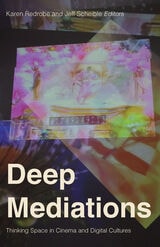
Deep Mediations
Thinking Space in Cinema and Digital CulturesKaren Redrobe
University of Minnesota Press, 2021
The preoccupation with “depth” and its relevance to cinema and media studies
For decades the concept of depth has been central to critical thinking in numerous humanities-based disciplines, legitimizing certain modes of inquiry over others. Deep Mediations examines why and how this is, as scholars today navigate the legacy of depth models of thought and vision, particularly in light of the “surface turn” and as these models impinge on the realms of cinema and media studies.
The collection’s eighteen essays seek to understand the decisive but evolving fixation on depth by considering the term’s use across a range of conversations as well as its status in relation to critical methodologies and the current mediascape. Engaging contemporary debates about new computing technologies, the environment, history, identity, affect, audio/visual culture, and the limits and politics of human perception, Deep Mediations is a timely interrogation of depth’s ongoing importance within the humanities.
Contributors: Laurel Ahnert; Taylor Arnold, U of Richmond; Erika Balsom, King’s College London; Brooke Belisle, Stony Brook University; Jinhee Choi, King’s College London; Jennifer Fay, Vanderbilt U; Lisa Han, UC Santa Barbara; Jean Ma, Stanford U; Shaka McGlotten, Purchase College-SUNY; Susanna Paasonen, U of Turku, Finland; Jussi Parikka, U of Southampton; Alessandra Raengo, Georgia State U; Pooja Rangan, Amherst College; Katherine Rochester, VIA Art Fund in Boston; Karl Schoonover, University of Warwick (UK); Jordan Schonig, Michigan State U; John Paul Stadler, North Carolina State U; Nicole Starosielski, New York U; Lauren Tilton, U of Richmond.
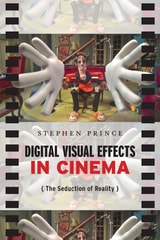
Digital Visual Effects in Cinema
The Seduction of RealityPrince, Stephen
Rutgers University Press, 2012
Avatar. Inception. Jurassic Park. Lord of the Rings. Ratatouille. Not only are these some of the highest-grossing films of all time, they are also prime examples of how digital visual effects have transformed Hollywood filmmaking. Some critics, however, fear that this digital revolution marks a radical break with cinematic tradition, heralding the death of serious realistic movies in favor of computer-generated pure spectacle.
Digital Visual Effects in Cinema counters this alarmist reading, by showing how digital effects–driven films should be understood as a continuation of the narrative and stylistic traditions that have defined American cinema for decades. Stephen Prince argues for an understanding of digital technologies as an expanded toolbox, available to enhance both realist films and cinematic fantasies. He offers a detailed exploration of each of these tools, from lighting technologies to image capture to stereoscopic 3D. Integrating aesthetic, historical, and theoretical analyses of digital visual effects, Digital Visual Effects in Cinema is an essential guide for understanding movie-making today.

Double Lives, Second Chances
The Cinema of Krzysztof KieslowskiAnnette Insdorf
Northwestern University Press, 2013

Drive in Cinema
Essays on Film, Theory and PoliticsMarc James Léger
Intellect Books, 2015