Results by title
129 books match the query 'City and town life' and 4 start with d

Dog Eat Dog
A NovelNiq Mhlongo
Ohio University Press, 2012
Dog Eat Dog is a remarkable record of being young in a nation undergoing tremendous turmoil, and provides a glimpse into South Africa’s pivotal kwaito (South African hip-hop) generation and life in Soweto. Set in 1994, just as South Africa is making its postapartheid transition, Dog Eat Dog captures the hopes—and crushing disappointments—that characterize such moments in a nation’s history. Raucous and darkly humorous, Dog Eat Dog is narrated by Dingamanzi Makhedama Njomane, a college student in South Africa who spends his days partying, skipping class, and picking up girls. But Dingz, as he is known to his friends, is living in charged times, and his discouraging college life plays out against the backdrop of South Africa’s first democratic elections, the spread of AIDS, and financial difficulties that threaten to force him out of school.
[more]
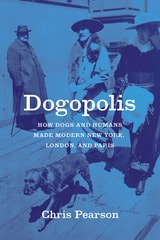
Dogopolis
How Dogs and Humans Made Modern New York, London, and ParisChris Pearson
University of Chicago Press, 2021
Dogopolis presents a surprising source for urban innovation in the history of three major cities: human-canine relationships.
Stroll through any American or European city today and you probably won’t get far before seeing a dog being taken for a walk. It’s expected that these domesticated animals can easily navigate sidewalks, streets, and other foundational elements of our built environment. But what if our cities were actually shaped in response to dogs more than we ever realized?
Chris Pearson’s Dogopolis boldly and convincingly asserts that human-canine relations were a crucial factor in the formation of modern urban living. Focusing on New York, London, and Paris from the early nineteenth century into the 1930s, Pearson shows that human reactions to dogs significantly remolded them and other contemporary western cities. It’s an unalterable fact that dogs—often filthy, bellicose, and sometimes off-putting—run away, spread rabies, defecate, and breed wherever they like, so as dogs became a more and more common in nineteenth-century middle-class life, cities had to respond to people’s fear of them and revulsion at their least desirable traits. The gradual integration of dogs into city life centered on disgust at dirt, fear of crime and vagrancy, and the promotion of humanitarian sentiments. On the other hand, dogs are some people’s most beloved animal companions, and human compassion and affection for pets and strays were equally powerful forces in shaping urban modernity. Dogopolis details the complex interrelations among emotions, sentiment, and the ways we manifest our feelings toward what we love—showing that together they can actually reshape society.
[more]
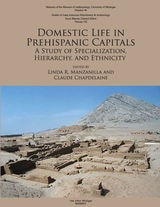
Domestic Life in Prehispanic Capitals
A Study of Specialization, Hierarchy, and EthnicityEdited by Linda R. Manzanilla and Claude Chapdelaine
University of Michigan Press, 2009
With major differences in size, urban plans, and population density, the capitals of New World states had large heterogeneous societies, sometimes multiethnic and highly specialized, making these cities amazing backdrops for complex interactions.
[more]
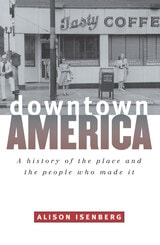
Downtown America
A History of the Place and the People Who Made ItAlison Isenberg
University of Chicago Press, 2005
Downtown America was once the vibrant urban center romanticized in the Petula Clark song—a place where the lights were brighter, where people went to spend their money and forget their worries. But in the second half of the twentieth century, "downtown" became a shadow of its former self, succumbing to economic competition and commercial decline. And the death of Main Streets across the country came to be seen as sadly inexorable, like the passing of an aged loved one.
Downtown America cuts beneath the archetypal story of downtown's rise and fall and offers a dynamic new story of urban development in the United States. Moving beyond conventional narratives, Alison Isenberg shows that downtown's trajectory was not dictated by inevitable free market forces or natural life-and-death cycles. Instead, it was the product of human actors—the contested creation of retailers, developers, government leaders, architects, and planners, as well as political activists, consumers, civic clubs, real estate appraisers, even postcard artists. Throughout the twentieth century, conflicts over downtown's mundane conditions—what it should look like and who should walk its streets—pointed to fundamental disagreements over American values.
Isenberg reveals how the innovative efforts of these participants infused Main Street with its resonant symbolism, while still accounting for pervasive uncertainty and fears of decline. Readers of this work will find anything but a story of inevitability. Even some of the downtown's darkest moments—the Great Depression's collapse in land values, the rioting and looting of the 1960s, or abandonment and vacancy during the 1970s—illuminate how core cultural values have animated and intertwined with economic investment to reinvent the physical form and social experiences of urban commerce. Downtown America—its empty stores, revitalized marketplaces, and romanticized past—will never look quite the same again.
A book that does away with our most clichéd approaches to urban studies, Downtown America will appeal to readers interested in the history of the United States and the mythology surrounding its most cherished institutions.
A Choice Oustanding Academic Title.
Winner of the 2005 Ellis W. Hawley Prize from the Organization of American Historians.
Winner of the 2005 Lewis Mumford Prize for Best Book in American
Planning History.
Winner of the 2005 Historic Preservation Book Price from the University of Mary Washington Center for Historic Preservation.
Named 2005 Honor Book from the New Jersey Council for the Humanities.
[more]