Results by title
138 books match the query 'Civil War' and 4 start with d

Deep in the Piney Woods
Southeastern Alabama from Statehood to the Civil War, 1800–1865Tommy Craig Brown
University of Alabama Press, 2018
Beyond the backwoods—uncovering the Civil War legacy of Alabama’s forgotten frontier.
Much of Alabama’s written history concentrates on the Tennessee Valley, the hill counties, and the Black Belt, while the piney woods of south central and southeastern Alabama, commonly known as the wiregrass region today, is one of the most understudied areas in Alabama history. Deep in the Piney Woods: Southeastern Alabama from Statehood to the Civil War, 1800–1865 offers a comprehensive and long overdue account of a historically rich region of the state, challenging many commonly held assumptions about the area’s formation and settlement, economy, politics, race relations, and its role in both the secession of the state and the Civil War.
Historians routinely depict this part of the state as an isolated, economically backward wilderness filled with poor whites who showed little interest in supporting the Confederacy once civil war erupted in 1861. Tommy Craig Brown challenges those traditional interpretations, arguing instead that many white Alabamians in this territory participated in the market economy, supported slavery, favored secession, and supported the Confederate war effort for the bulk of the conflict, sending thousands of soldiers to fight in some of the bloodiest campaigns of the war.
This thorough and expansive account of southeastern Alabama’s role in the Civil War also discusses its advocacy for state secession in January 1861; the effects of Confederate conscription on the home front; the economic devastation wrought on the area; and the participation of local military companies in key campaigns in both the eastern and western theaters, including Shiloh, the Peninsula Campaign, the Overland Campaign, Atlanta, and Franklin-Nashville. Brown argues that the lasting effects of the war on the region’s politics, identity, economy, and culture define it in ways that are still evident today.
Disaster Nationalism
Tsunami and Civil War in Sri LankaVivian Y. Choi
Duke University Press, 2025
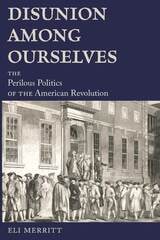
Disunion Among Ourselves
The Perilous Politics of the American RevolutionEli Merritt
University of Missouri Press, 2025
Winner of the 2024 Society of the Cincinnati Prize from the American Revolution Institute
Winner of the 2023 American Revolution Round Table of Philadelphia book award
In this eye-opening account, Eli Merritt reveals the deep political divisions that almost tore the Union apart during the American Revolution. So fractious were the founders’ political fights that they feared the War of Independence might end in disunion and civil war.
Instead of disbanding into separate regional confederacies, the founders managed to unite for the sake of liberty and self-preservation. In so doing, they succeeded in holding the young nation together. To achieve this, they forged grueling compromises, including Declaration of Independence in 1776, the Mississippi-Fisheries Compromise of 1779, and the ratification of the Articles of Confederation in 1781.
In addition to bringing new insights to the history of the American Revolution, Disunion Among Ourselves has inevitable resonances with our present era of political hyperpolarization and serves as a touchstone for contemporary politics, reminding us that the founders overcame far tougher times than our own through commitment to ethical constitutional democracy and compromise.
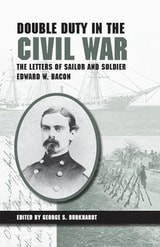
Double Duty in the Civil War
The Letters of Sailor and Soldier Edward W. BaconEdited by George S. Burkhardt
Southern Illinois University Press, 2009
In 1861 at the age of eighteen, Edward Woolsey Bacon, a Yale student and son of well-known abolitionist minister Leonard Bacon, left his home in New Haven, Connecticut, to fight for the United States. Over the next four years Bacon served in both the Union navy and army, which gave him a sweeping view of the Civil War. His postings included being a captain’s clerk on the USS Iroquois, a hospital clerk in his hometown, a captain in the 29th Connecticut Infantry (Colored), and a major in the 117th U.S. Colored Infantry, and he described these experiences in vibrant letters to his friends and family. Historian George S. Burkhardt has compiled these letters, as well as Bacon’s diary in the impressive Double Duty in the Civil War: The Letters of Sailor and Soldier Edward W. Bacon.
Bacon tells of hunting Confederate commerce raiders on the high seas, enduring the tedium of blockade duty, and taking part in riverine warfare on the Mississippi. He recalls sweating in South Carolina as an infantry officer during drill and picket duty, suffering constant danger in the battlefield trenches of Virginia, marching victoriously on fallen Richmond, and tolerating the boredom of occupation duty in Texas.
His highly entertaining letters shed new light on naval affairs and reveal a close-knit family life. The narrative of his duty with black troops is especially valuable, since few first-hand accounts from white officers of the U.S. Colored Troops exist. Furthermore, his beliefs about race, slavery, and the Union cause were unconventional for the time and stand in contrast to those held by many of his contemporaries.
Double Duty in the Civil War is filled with lively descriptions of the men Bacon met and the events he experienced. With Burkhardt’s careful editing and useful annotations, Bacon’s letters and diary excerpts give rare insight into areas of the Civil War that have been neglected because of a lack of available sources. Given the scarcity of eyewitness testimonies to navy life and life in African American regiments, this book is a rarity indeed.