Results by title
55 books match the query 'Civil society' and 2 start with d

Dilemmas of Political Change in Mexico
Edited by Kevin J. Middlebrook
University of London Press, 2004
The victory by Vicente Fox Quesada in Mexico's July 2000 presidential election was a watershed in the country's political history. His triumph convincingly marked the consolidation of electoral democracy and, by ending seven decades of uninterrupted national rule by the "official" Institutional Revolutionary Party (PRI), symbolized a clear break with the political regime established following the 1910-1920 revolution. Nevertheless, many legacies of postrevolutionary authoritarianism persist, and Mexico's democratization process remains incomplete. The seventeen contributors to this volume assess Mexico's political dynamics at the turn of the century and the many pending challenges in the construction of a more fully democratic political order.
They examine: (1) changes affecting the party system, electoral institutions, and voting behavior; (2) the evolving role of the armed forces, organized labor, big business, and rural producers; (3) the new importance of civil society, the mass media, and cross-border social coalitions; (4) and key issues of political representation and governance, including executive-legislative relations, judicial performance, federalism, the constitutional rights of indigenous peoples, and the political role of Mexicans resident in the United States.
They examine: (1) changes affecting the party system, electoral institutions, and voting behavior; (2) the evolving role of the armed forces, organized labor, big business, and rural producers; (3) the new importance of civil society, the mass media, and cross-border social coalitions; (4) and key issues of political representation and governance, including executive-legislative relations, judicial performance, federalism, the constitutional rights of indigenous peoples, and the political role of Mexicans resident in the United States.
[more]
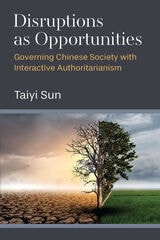
Disruptions as Opportunities
Governing Chinese Society with Interactive AuthoritarianismTaiyi Sun
University of Michigan Press, 2023
Disruptions as Opportunities: Governing Chinese Society with Interactive Authoritarianism addresses the long-standing puzzle of why China outlived other one-party authoritarian regimes with particular attention to how the state manages an emerging civil society. Drawing upon over 1,200 survey responses conducted in 126 villages in the Sichuan province, as well as 70 interviews conducted with Civil Society Organization (CSO) leaders and government officials, participant observation, and online research, the book proposes a new theory of interactive authoritarianism to explain how an adaptive authoritarian state manages nascent civil society. Sun argues that when new phenomena and forces are introduced into Chinese society, the Chinese state adopts a three-stage interactive approach toward societal actors: toleration, differentiation, and legalization without institutionalization. Sun looks to three disruptions—earthquakes, internet censorship, and social-media-based guerrilla resistance to the ride-sharing industry—to test his theory about the three-stage interactive authoritarian approach and argues that the Chinese government evolves and consolidates its power in moments of crisis.
[more]