Results by title
146 books match the query 'Collections, Catalogs, Exhibitions' and 7 start with d
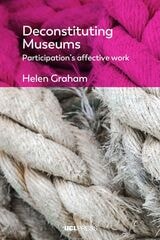
Deconstituting Museums
Participation's Affective WorkHelen Graham
University College London, 2025
In recent years, museums have turned to encouraging visitor participation in hopes of becoming more inclusive, accessible, and diverse. Despite these efforts, significant gaps between the politics of museum administration and those of participatory practice have often led to disappointment and anger. According to Helen Graham, while museums embody a logic of representational liberalism whereby museum professionals make decisions on behalf of “future generations” and “the public,” participation pulls from direct and horizontal political traditions. In light of this problem, Deconstituting Museums develops critical and creative interventions in implementing museum participation, envisioning how the affective component of participatory practice could enable new possibilities in both museum practice and political ontology.
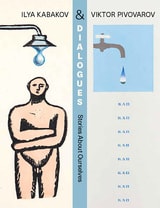
Dialogues
Ilya Kabakov and Viktor Pivovarov, Stories about OurselvesKsenia Nouril
Rutgers University Press, 2020
This exhibition catalog brings together Kabakov and Pivovarov’s key works for the first time, putting the two artists in dialogue and recreating their artistic community. It not only includes nearly hundred pages of full-color illustrations, but also provides complete English translations of the Russian texts that appear in the volume, plus new interviews with each artist. Taken together, they give viewers a new appreciation of the different aesthetic strategies each artist used to depict the absurdities of everyday life in the Soviet era. Published in partnership with the Zimmerli Museum.
Diary/Landscape
James Welling
University of Chicago Press, 2014
In July 1977, Welling began photographing a two-volume travel diary kept by his great-grandmother Elizabeth C. Dixon, as well as landscapes in southern Connecticut. In one closely cropped image, lines of tight cursive share the page with a single ivy leaf preserved in the diary. In another snowy image, a stand of leafless trees occludes the gleaming Long Island sound. In subject and form, Welling emulated the great American modernists Alfred Stieglitz, Paul Strand, and Walker Evans—a bold move for an artist associated with radical postmodernism. At the same time, Welling’s close-ups of handwriting push to the fore the postmodernist themes of copying and reproduction.
A beautiful and moving meditation on family, history, memory, and place, Diary/Landscape reintroduced history and private emotion as subjects in high art, while also helping to usher in the centrality of photography and theoretical questions about originality that mark the epochal Pictures Generation. The book is published to accompany the first-ever complete exhibition of this series of pivotal photographs, now owned by the Art Institute of Chicago.
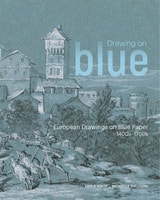
Drawing on Blue
European Drawings on Blue Paper, 1400s–1700sEdina Adam
J. Paul Getty Trust, The, 2024
The rich history of blue paper, from the late fifteenth to the mid-eighteenth centuries, illuminates themes of transcultural interchange, international trade, and global reach. Through the examination of significant works, this volume investigates considerations of supply, use, economics, and innovative creative practice. How did the materials necessary for the production of blue paper reach artistic centers? How were these materials produced and used in various regions? Why did they appeal to artists, and how did they impact artistic practice and come to be associated with regional artistic identities? How did commercial, political, and cultural relations, and the mobility of artists, enable the dispersion of these materials and related techniques? Bringing together the work of the world’s leading specialists, this striking publication is destined to become essential reading on the history, materials, and techniques of drawings executed on blue paper.
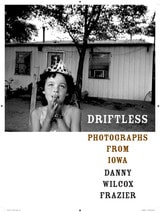
Driftless
Photographs from IowaDanny Wilcox Frazier
Duke University Press, 2007
Robert Frank, Prize Judge
In Driftless, Danny Wilcox Frazier’s dramatic black-and-white photographs portray a changing Midwest of vanishing towns and transformed landscapes. As rural economies fail, people, resources, and services are migrating to the coasts and cities, as though the heart of America were being emptied. Frazier’s arresting photographs take us into Iowa’s abandoned places and illuminate the lives of those people who stay behind and continue to live there: young people at leisure, fishermen on the Mississippi, veterans on Memorial Day, Amish women playing cards, as well as more recent arrivals: Lubavitcher Hasidic Jews at prayer, Latinos at work in the fields. Frazier’s camera finds these newcomers while it also captures activities that seemingly have gone on forever: harvesting and hunting, celebrating and socializing, praying and surviving.
This collection of photographs is a portrait of contemporary rural Iowa, but it is also more that that. It shows what is happening in many rural and out-of-the-way communities all over the United States, where people find ways to get by in the wake of closing factories and the demise of family farms. Taken by a true insider who has lived in Iowa his entire life, Frazier’s photographs are rich in emotion and give expression to the hopes and desires of the people who remain, whose needs and wants are complicated by the economic realities remaking rural America. Poetic and dark but illuminated with flashes of insight, Frazier’s stunning images evoke the brilliance of Robert Frank’s The Americans.
To view an image gallery, click here.
documenta 12 education 2
Between Critical Practice and Visitor Services Results of a Research ProjectEdited by Carmen Mörsch
Diaphanes, 2009
Education is situated in tension between public sphere and institution, amateur and professional, artist and audience. Its development needs felicitous examples as well as rigor in discussing problems towards identifying practical solutions.
»documenta 12 education« presents in two illustrated volumes the education formats with concomitant research, providing a basis for developing theory and praxis of gallery education.
These volumes are an ideal resource for people working in the fields of curating exhibitions, gallery education, youth work and cultural policy. People less familiar with cultural work will find in these books a valuable introduction to the field of gallery education.
Volume 2 focuses on a theory of gallery education, its methods and contexts, and reflects theoretically on examples presented in Volume 1. It is addressed to professionals from the field of gallery education, cultural education and formal education.
documenta 12 education I
Engaging audiences, opening institutions Methods and strategies in education at documenta 12Edited by Ayse Güleç, Claudia Hummel, Ulrich Schötker, and Wanda Wieczorek
Diaphanes, 2009
Education is situated in tension between public sphere and institution, amateur and professional, artist and audience. Its development needs felicitous examples as well as rigor in discussing problems towards identifying practical solutions.
»documenta 12 education« presents in two illustrated volumes the education formats with concomitant research, providing a basis for developing theory and praxis of gallery education.
These volumes are an ideal resource for people working in the fields of curating exhibitions, gallery education, youth work and cultural policy. People less familiar with cultural work will find in these books a valuable introduction to the field of gallery education.
Volume 1 gives a comprehensive and richly illustrated survey of formats and models of education and collaboration with the public at documenta 12.