Results by title
173 books match the query 'Collective Memory' and 4 start with d
Decolonizing Memory
Algeria and the Politics of TestimonyJill Jarvis
Duke University Press, 2021
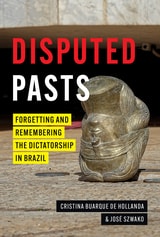
Disputed Pasts
Forgetting and Remembering the Dictatorship in BrazilCristina Buarque de Hollanda and José Szwako
University of Texas Press, 2026
How the memory of military dictatorship shapes Brazil's political divides and the far-right's rise.
Brazil’s military dictatorship ended in 1985, but its history still looms large over the country. Since the restoration of democracy, national politics have been shaped by heated contestation over the dictatorship’s legacy. Cristina Buarque de Hollanda and José Szwako examine how the state, the military, and civil society have variously mourned, celebrated, and suppressed memories of Brazil’s violent past—and to what ends.
As the dictatorship faltered under pressure from the opposition in the streets and in Congress, popular opinion favored democracy, which often meant forgetting. Today, the Brazilian left contends that the past has been silenced, paving the way for Jair Bolsonaro and the far right. Yet the past has been intensely contested: media outlets, social movements, and official commissions have long documented the dictatorship and spurred reparations. Disputed Pasts argues that the conservative ascendency is a reaction to these efforts of remembrance. The right seeks to rehabilitate the violent past by discrediting victims and elevating the dictatorship’s anti-communist ideology. Far from forgetting the past, Bolsonaro and Bolsonarismo actively remember and celebrate it.
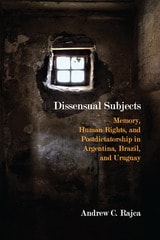
Dissensual Subjects
Memory, Human Rights, and Postdictatorship in Argentina, Brazil, and UruguayAndrew C. Rajca
Northwestern University Press, 2018
Through an engaging exploration of the concept of “never again” (nunca más/nunca mais) and close analysis of photography exhibits, audiovisual installations, and other art forms in spaces of cultural memory, the book explores how aesthetic interventions can suggest alternative ways of framing human rights subjectivity beyond the rhetoric of liberal humanitarianism. The book visits sites of memory, two of which functioned as detention and torture centers during dictatorships, to highlight the tensions between the testimonial tenor of permanent exhibits and the aesthetic interventions of temporary installations there. Rajca thus introduces perspectives that both undo common understandings of authoritarian violence and its effects as well as reconfigure who or what are made visible as subjects of memory and human rights in postdictatorship countries.
Dissensual Subjects offers much to those concerned with numerous interlocking fields: memory, human rights, political subjectivity, aesthetics, cultural studies, visual culture, Southern Cone studies, postdictatorship studies, and sites of memory.
Dreaming in Russian
The Cuban Soviet ImaginaryBy Jacqueline Loss
University of Texas Press, 2013
The specter of the Soviet Union lingers in Cuba, yet until now there has been no book-length work on the ways Cubans process their country’s relationship with the Soviet bloc. Dreaming in Russian at last brings into the light the reality that for nearly three decades, the Soviet Union subsidized the island economically, intervened in military matters, and exported distinct pedagogical and cultural models to Cuba. Drawing on interviews with Cuban artists and intellectuals, as well as treasures from cinematographic and bibliographic archives, Jacqueline Loss delivers the first book to show that Cuba remembers and retains many aspects of the Soviet era, far from shedding those cultural facets as relics of the Cold War.
Weaving together intriguing, seldom-seen images, Dreaming in Russian showcases the ways in which Cuba’s relationship to its Soviet benefactors lingered after the disintegration of the U.S.S.R. in 1991. Analyzing numerous literary texts and works of visual art, Loss also incorporates aspects of architecture, popular culture, the space race, and other strands to create a captivating new perspective on Cuban society. Among the luminaries featured are poet Reina María Rodríguez, writer Antonio José Ponte, visual artist Tonel, and novelist Wendy Guerra. A departure from traditional cultural history, Loss’s approach instead presents a kaleidoscopic series of facets, reflecting the hybrid nature of the self-images that emerged in the aftermath of the Soviet aegis. As speculations about Cuba’s future under Fidel Castro’s heir apparent continue, the portrait that emerges in Dreaming in Russian is both timely and mesmerizing.