Results by title
167 books match the query 'Colorado' and 6 start with d
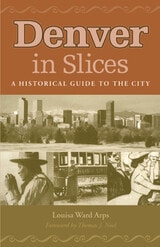
Denver In Slices
A Historical Guide to the CityLouisa Ward Arps
Ohio University Press, 1983
The Old West has been viewed from many perspectives, from the scornful to the uncritically romantic. But seldom has it been treated with the honest nostalgia of the wonderful accounts and pictures gathered in Denver in Slices.
Ohio University Press/Swallow Press is proud to reissue this Western classic, which includes a brief survey of all Denver history, some slices depicting the most fascinating places and characters. The City Ditch, Cherry Creek, River Front Park, the Denver Mint, the Tabors, the Windsor Hotel, the Baron of Montclair, Overland Park, Buffalo Bill, Elitch's Gardens, and Eugene Field—they're all here. Illustrating these stories is an array of nearly one hundred pictures of the people, buildings, and street scenes: a fascinating panorama of the gold rush camp that became the Rocky Mountain metropolis.
With a new foreword by renowned Denver historian Thomas J. Noel, this classic will once again help preserve Denver's lively past.
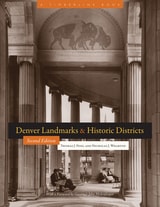
Denver Landmarks and Historic Districts
Thomas J. Noel
University Press of Colorado, 2016
Denver Landmarks and Historic Districts, Second Edition is the newest, most thorough guide to Denver’s 51 historic districts and more than 331 individually landmarked properties. This lavishly illustrated volume celebrates Denver’s oldest banks, churches, clubs, hotels, libraries, schools, restaurants, mansions, and show homes.
Denver is unusually fortunate to retain much of its significant architectural heritage. The Denver Landmark Preservation Commission (1967), Historic Denver, Inc. (1970), Colorado Preservation, Inc. (1984), and History Colorado (1879) have all worked to identify and preserve Denver buildings notable for architectural, geographical, or historical significance. Since the 1970s, Denver has designated more landmarks than any other US city of comparable size. Many of these landmarks, both well-known and obscure, are open to the public. These landmarks and districts have helped make Denver one of the healthiest and most attractive core cities in the United States, transforming what was once Skid Row into the Lower Downtown Historic District of million-dollar lofts and $7 craft beers.
Entries include the Daniels & Fisher Tower, the Brown Palace Hotel, Red Rocks Outdoor Amphitheatre, Elitch Theatre, Fire Station No. 7, the Richthofen Castle, the Washington Park Boathouse and Pavilion, and the Capitol Hill, Five Points, and Highlands historic districts. Denver Landmarks and Historic Districts highlights the many officially designated buildings and neighborhoods of note. This crisply written guide serves as a great starting point for rubbernecking around Denver, whether by motor vehicle, by bicycle, or afoot.
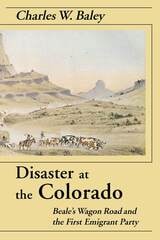
Disaster At The Colorado
Charles W. Baley
Utah State University Press, 2002
Across north-central New Mexico and Arizona, along the line of Route 66, now Interstate 40, there first ran a little-known wagon trail called Beale's Wagon Road, after Edward F. Beale, who surveyed it for the War Department in 1857. This survey became famous for employing camels. Not so well known is the fate of the first emigrants who the next year attempted to follow its tracks. The government considered the 1857 exploration a success and the road it opened a promising alternative route to California but expected such things as military posts and developed water supplies to be needed before it was ready for regular travel. Army representatives in New Mexico were more enthusiastic.
In 1858 there was a need for an alternative. Emigrants avoided the main California Trail because of a U.S. Army expedition to subdue Mormons in Utah. The Southern Route ran through Apache territory, was difficult for the army to guard, and was long. When a party of Missouri and Iowa emigrants known as the Rose-Baley wagon train arrived in Albuquerque, they were encouraged to be the first to try the new Beale road. Their journey became a rolling disaster. Beale's trail was more difficult to follow than expected; water sources and feed for livestock harder to find. Indians along the way had been described as peaceful, but the Hualapais persistently harassed the emigrants and shot their stock, and when the wagon train finally reached the Colorado River, a large party of Mojaves attacked them. Several of the emigrants were killed, and the remainder began a difficult retreat to Albuquerque. Their flight, with wounded companions and reduced supplies, became ever more arduous. Along the way they met other emigrant parties and convinced them to join the increasingly disorderly and distressed return journey.
Charles Baley tells this dramatic story and discusses its aftermath, for the emigrants, for Beale's Wagon Road, and for the Mojaves, against whom some of the emigrants pressed legal claims with the federal government.
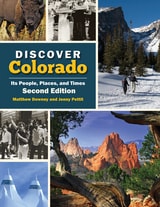
Discover Colorado, Second Edition
Matthey Downey
University Press of Colorado, 2015

Drawing to an Inside Straight
The Legacy of an Absent FatherJodi Varon
University of Missouri Press, 2006
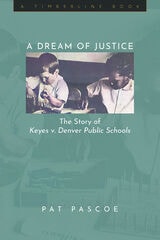
Dream of Justice
The Story of Keyes v. Denver Public Schoolsby Pat Pascoe
University Press of Colorado, 2023
Pascoe details Denver’s desegregation battle, beginning with the citizen studies that exposed the inequities of segregated schools and Rachel Noel’s resolution to integrate the system, followed by the momentous pro-integration Benton-Pascoe campaign of Ed Benton and Monte Pascoe for the school board in 1969. When segregationists won that election and reversed the integration plan for northeast Denver, Black, white, and Latino parents filed Keyes v. School District No. 1. This book follows the arguments in the case through briefs, transcripts, and decisions from district court to the Supreme Court of the United States and back, to its ultimate order to desegregate all Denver schools “root and branch.” It was the first northern city desegregation suit to be brought before the Supreme Court. However, with the end of court-ordered busing in 1995, schools quickly resegregated and are now more segregated than before Keyes was filed.
Pascoe asserts that school integration is a necessary step toward eliminating systemic racism in our country and should be the objective of every school board. A Dream of Justice will appeal to students, scholars, and readers interested in the history of civil rights in America, Denver history, and the history of US education.