Results by title
319 books match the query 'Communication Studies' and 22 start with d
Dear World
Contemporary Uses of the DiaryKylie Cardell
University of Wisconsin Press, 2014
In Dear World, Kylie Cardell is sensitive to how changes to our notions of privacy and the personal—spurred by the central presence the Internet has come to occupy in our daily lives—impact how and why diaries are written, and for whom. She considers what these new uses of the diary tell us about the cultural politics of self-representation in a time of mass attention to (and anxiety about) the personal. Cardell sees the twenty-first-century diary as a vibrant and popular cultural practice as much as a literary form, one that plays a key role in mass-mediated notions of authenticity, subjectivity, and truth. Dear World provides much-needed new attention to the innovation, evolution, and persistence of a familiar yet complex autobiographical mode.
Decoding the Digital Church
Evangelical Storytelling and the Election of Donald J. TrumpStephanie A. Martin
University of Alabama Press, 2021
"This investigation tries to understand why many Evangelical pastors were blamed for endorsing Trump when, in fact, most did not. This book joins other attempts by scholars and journalists to analyze the relationship between Trump and Evangelicals. Recommended.” —CHOICE
Tracing the digital narratives that shaped evangelical identity in a pivotal political moment.
As a political constituency, white conservative evangelicals are generally portrayed as easy to dupe, disposed to vote against their own interests, and prone to intolerance and knee-jerk reactions. In Decoding the Digital Church: Evangelical Storytelling and the Election of Donald J. Trump, Stephanie A. Martin challenges this assumption and moves beyond these overused stereotypes to develop a refined explanation for this constituency’s voting behavior.
This volume offers a fresh perspective on the study of religion and politics and stems from the author’s personal interest in the ways her experiences with believers differ from how scholars often frame this group’s rationale and behaviors. To address this disparity, Martin examines sermons, drawing on her expertise in rhetoric and communication studies with the benefits of ethnographic research in an innovative hybrid approach she terms a “digital rhetorical ethnography.” Martin’s thorough research surveys more than 150 online sermons from America’s largest evangelical megachurches in 37 different states. Through listening closely to the words of the pastors who lead these conservative congregations, Martin describes a gentler discourse less obsessed with issues like abortion or marriage equality than stereotypes of evangelicals might suggest. Instead, the politicaleconomic sermons and stories from pastors encourage true believers
to remember the exceptional nature of the nation’s founding while also deemphasizing how much American citizenship really means.
Martin grapples with and pays serious, scholarly attention to a seeming contradiction: while the large majority of white conservative evangelicals voted in 2016 for Donald J. Trump, Martin shows that many of their pastors were deeply concerned about the candidate, the divisive nature of the campaign, and the potential effect of the race on their congregants’ devotion to democratic process itself. In-depth chapters provide a fuller analysis of our current political climate, recapping previous scholarship on the history of this growing divide and establishing the groundwork to set up the dissonance between the political commitments of evangelicals and their faith that the rhetorical ethnography addresses.
Decolonial Conversations in Posthuman and New Material Rhetorics
Edited by Jennifer Clary-Lemon and David M. Grant
The Ohio State University Press, 2022
Demosthenes' "On the Crown"
Rhetorical PerspectivesEdited by James J. Murphy
Southern Illinois University Press, 2016
The volume includes biographical and historical background on Demosthenes and his political situation; a structural analysis of On the Crown; and an abstract of Aeschines’ speech Against Ctesiphon to which Demosthenes was responding. Four essays by contributors analyze Demosthenes’ speech using key elements of rhetoric defined by Aristotle: ēthos, the speaker’s character or authority; pathos, or emotional appeals; logos, or logical appeals; and lexis, a speaker’s style. An introduction and an epilogue by Murphy frame the speech and the rhetorical analysis of it.
By bringing together contextual material about Demosthenes and his speech with a translation and astute rhetorical analyses, Demosthenes’“On the Crown”:Rhetorical Perspectives highlights the oratorical artistry of Demosthenes and provides scholars and students with fresh insights into a landmark speech.
Desiring the Bomb
Communication, Psychoanalysis, and the Atomic AgeCalum L. Matheson
University of Alabama Press, 2019
Every culture throughout history has obsessed over various “end of the world” scenarios. The dawn of the Atomic Age marked a new twist in this tale. For the first time, our species became aware of its capacity to deliberately destroy itself. Since that time the Bomb has served as an organizing metaphor, a symbol of human annihilation, a stand-in for the unspeakable void of extinction, and a discursive construct that challenges the limits of communication itself. The parallel fascination with and abhorrence of nuclear weapons has metastasized into a host of other end-of-the-world scenarios, from global pandemics and climate change to zombie uprisings and asteroid collisions.
Desiring the Bomb: Communication, Psychoanalysis, and the Atomic Age explores these world-ending fantasies through the lens of psychoanalysis to reveal their implications for both contemporary apocalyptic culture and the operations of language itself. What accounts for the enduring power of the Bomb as a symbol? What does the prospect of annihilation suggest about language and its limits? Thoroughly researched and accessibly written, this study expands on the theories of Kenneth Burke, Jacques Lacan, Sigmund Freud, and many others from a variety of disciplines to arrive at some answers to these questions.
Calum L. Matheson undertakes a series of case studies—including the Trinity test site, nuclear war games, urban shelter schemes, and contemporary survivalism—and argues that contending with the anxieties (individual, social, cultural, and political) born of the Atomic Age depends on rhetorical conceptions of the “real,” an order of experience that cannot be easily negotiated in language. Using aspects of media studies, rhetorical theory, and psychoanalysis, the author deftly engages the topics of Atomic Age survival, extinction, religion, and fantasy, along with their enduring cultural legacies, to develop an account of the Bomb as a signifier and to explore why some Americans have become fascinated with fantasies of nuclear warfare and narratives of postapocalyptic rebirth.

Development as Communication
A Perspective on IndiaUma Narula
Southern Illinois University Press, 1986
This book applies a systematic communication theory to the 30-plus years of development experience in India.
Never before has development been treated from a communication perspective. This perspective demonstrates that the role of communication in development is not limited to the technology of satellites or to the economics of mass media; it is a way of thinking about the interaction among all agents involved.
The empirical data describe patterns of social realities, actions, and communication networks among planners, contact agents, and the masses in two Indian communities. The result is an analytical review of development theories and practice in India.
This study is practical as well as theoretical. The authors show how the theory of the “coordinated management of meaning” applies to large-scale social interactions. They also offer specific recommendations for Indian development planners.

Dialectic
A Scholarly Journal of Thought Leadership, Education and Practice in the Discipline of Visual Communication Design Volume I, Issue I - Winter 2016-17Keith M Owens and Michael Gibson
Michigan Publishing Services, 2017
examination of issues that affect design education, research,
and inquiry into their effects on the practice of design. Michigan
Publishing, the hub of scholarly publishing at the University of Michigan,
publishes Dialectic on behalf of the AIGA (American Institute of
Graphic Arts) Design Educators Community (DEC).
Dialectic
A Scholarly Journal of Thought Leadership, Education and Practice in the Discipline of Visual Communication Design Volume I, Issue II - Fall 2017Michael R. Gibson and Keith M. Owens (Editors)
Michigan Publishing Services, 2017
examination of issues that affect design education, research,
and inquiry into their effects on the practice of design. Michigan
Publishing, the hub of scholarly publishing at the University of Michigan,
publishes Dialectic on behalf of the AIGA (American Institute of
Graphic Arts) Design Educators Community (DEC).
Dialogic Confession
Bonhoeffer's Rhetoric of ResponsibilityRonald C. Arnett. Foreword by Clifford Christians
Southern Illinois University Press, 2005
In this landmark volume of contemporary communication theory, Ronald C. Arnett applies the metaphor of dialogic confession—which enables historical moments to be addressed from a confessed standpoint and through a communicative lens—to the works of German theologian Dietrich Bonhoeffer, who pointed to an era of postmodern difference with his notion of "a world come of age." Arnett’s interpretations of Bonhoeffer’s life and scholarship in contention with Nazi dominance offer implications for a dialogic confession that engages the complexity of postmodern narrative contention.
Rooted in classical theory, the field of communication ethics is abstract and arguably outmoded. In Dialogic Confession: Bonhoeffer’s Rhetoric of Responsibility, Arnett locates cross-cultural and comparative anchors that not only bring legitimacy and relevance to the field but also develop a conceptual framework that will advance and inspire future scholarship.
Dialogue, Dialectic and Conversation
A Social Perspective on the Function of WritingGregory Clark. Foreword by Robert J. Connors
Southern Illinois University Press, 1990
This book articulates an ethics for reading that places primary responsibility for the social influences of a text on the response of its readers.
We write and read as participants in a process through which we negotiate with others whom we must live or work with and with whom we share values, beliefs, and actions. Clark draws on current literary theory, rhetoric, philosophy, communication theory, and composition studies as he builds on this argument.
Because reading and writing are public actions that address and direct matters of shared belief, values, and action, reading and writing should be taught as public discourse. We should teach not writing or reading so much as the larger practice of public discourse—a discourse that sustains the many important communities of which students are and will be active members.
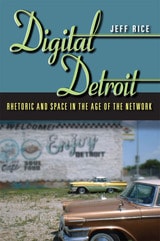
Digital Detroit
Rhetoric and Space in the Age of the NetworkJeff Rice
Southern Illinois University Press, 2012
Since the 1967 riots that ripped apart the city, Detroit has traditionally been viewed either as a place in ruins or a metropolis on the verge of rejuvenation. In Digital Detroit: Rhetoric and Space in the Age of the Network, author Jeff Rice goes beyond the notion of Detroit as simply a city of two ideas. Instead he explores the city as a web of multiple meanings which, in the digital age, come together in the city’s spaces to form a network that shapes the writing, the activity, and the very thinking of those around it.
Rice focuses his study on four of Detroit’s most iconic places—Woodward Avenue, the Maccabees Building, Michigan Central Station, and 8 Mile—covering each in a separate chapter. Each of these chapters explains one of the four features of network rhetoric: folksono(me), the affective interface, response, and decision making. As these rhetorical features connect, they form the overall network called Digital Detroit. Rice demonstrates how new media, such as podcasts, wikis, blogs, interactive maps, and the Internet in general, knit together Detroit into a digital network whose identity is fluid and ever-changing. In telling Detroit’s spatial story, Rice deftly illustrates how this new media, as a rhetorical practice, ultimately shapes understandings of space in ways that computer applications and city planning often cannot. The result is a model for a new way of thinking and interacting with space and the imagination, and for a better understanding of the challenges network rhetorics pose for writing.
Digital Platforms and Algorithmic Subjectivities
Emiliana Armano, Marco Briziarelli and Elisabetta Risi
University of Westminster Press, 2022
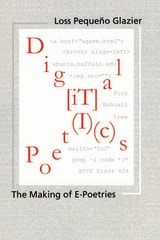
Digital Poetics
Hypertext, Visual-Kinetic Text and Writing in Programmable MediaLoss Pequeño Glazier
University of Alabama Press, 2001
Glazier investigates the ways in which computer technology has influenced and transformed the writing and dissemination of poetry.
In Digital Poetics, Loss Pequeño Glazier argues that the increase in computer technology and accessibility, specifically the World Wide Web, has created a new and viable place for the writing and dissemination of poetry. Glazier’s work not only introduces the reader to the current state of electronic writing but also outlines the historical and technical contexts out of which electronic poetry has emerged and demonstrates some of the possibilities of the new medium.
Glazier examines three principal forms of electronic textuality: hypertext, visual/kinetic text, and works in programmable media. He considers avant-garde poetics and its relationship to the on-line age, the relationship between web “pages” and book technology, and the way in which certain kinds of web constructions are in and of themselves a type of writing. With convincing alacrity, Glazier argues that the materiality of electronic writing has changed the idea of writing itself. He concludes that electronic space is the true home of poetry and, in the 20th century, has become the ultimate “space of poesis.”
Digital Poetics will attract a readership of scholars and students interested in contemporary creative writing and the potential of electronic media for imaginative expression.
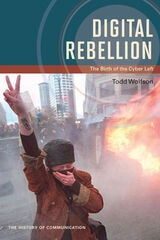
Digital Rebellion
The Birth of the Cyber LeftTodd Wolfson
University of Illinois Press, 2014
Todd Wolfson reveals how aspects of the mid-1990s Zapatistas movement--network organizational structure, participatory democratic governance, and the use of communication tools as a binding agent--became essential parts of Indymedia and other Cyber Left organizations. From there he uses oral interviews and other rich ethnographic data to chart the media-based think tanks and experiments that continued the Cyber Left's evolution through the Independent Media Center's birth around the 1999 WTO protests in Seattle.
Melding virtual and traditional ethnographic practice to explore the Cyber Left's cultural logic, Wolfson maps the social, spatial and communicative structure of the Indymedia network and details its operations on the local, national and global level. He looks at the participatory democracy that governs global social movements and the ways democracy and decentralization have come into tension, and how "the switchboard of struggle" conducts stories from the hyper-local and disperses them worldwide. As he shows, understanding the intersection of Indymedia and the Global Social Justice Movement illuminates their foundational role in the Occupy struggle and other emergent movements that have re-energized radical politics.
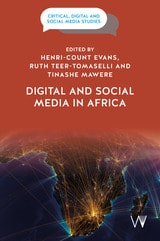
Digital and Social Media in Africa
Edited by Henri-Count Evans, Ruth Teer-Tomaselli, and Tinashe Mawere
University of Westminster Press, 2025
Further, the book examines the human rights challenges posed by state control and monitoring of digital and social media forms of communication. In the context of a digital surveillance state, it questions how digital and social media can possibly enhance the democratisation of both the communicative and political spaces.
The book focuses on questions of censorship and control of digital and social media in ‘supposedly’ democratic societies. It discusses regulation and how governments have imposed their state power by ‘switching off’ the internet and blocking social media sites under the guise of national security and order maintenance.

Dirty Words
The Rhetoric of Public Sex Education, 1870-1924Robin E. Jensen
University of Illinois Press, 2010
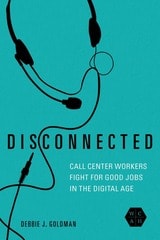
Disconnected
Call Center Workers Fight for Good Jobs in the Digital AgeDebbie J. Goldman
University of Illinois Press, 2024
Call center employees once blended skill and emotional intelligence to solve customer problems while the workplace itself encouraged camaraderie and job satisfaction. Ten years after telecom industry deregulation, management had isolated the largely female workforce in cubicles, imposed quotas to sell products, and installed surveillance systems that tracked every call and keystroke.
Debbie J. Goldman explores how call center employees and their union fought for good, humane jobs in the face of degraded working conditions and lowered wages. As the workforce coalesced to resist the changes, it demanded the Communications Workers of America (CWA) fight for safe and secure good-paying jobs. But trends in technology, capitalism, and corporate governance--combined with the decline of unions--narrowed the negotiating options for workers. Goldman describes how the actions of workers, management, and policymakers shaped the social impact of the new digital technologies and gave new form to the telecommunications industry in a time of momentous change.
Perceptive and nuanced, Disconnected tells an overlooked story of service workers in a time of change.

Divine Signs
Connecting Spirit to CommunityH. L. Goodall, Jr.
Southern Illinois University Press, 1996
Divine Signs is the concluding volume of the ethnographic trilogy about the communicative tensions in everyday American cultural life H. L. Goodall, Jr., began with Casing a Promised Land and continued with Living in the Rock n Roll Mystery.
In this final work, the terms for understanding these tensions are found in a historical and mythological drama featuring Power (as the embodiment of the modern), Other (as the embodiment of the postmodern), and Spirit (as the unifying power capable of connecting disparate selves to dangerously fragmented communities). For this study, the localized site of interpretation is in and around Pickens and Oconee Counties, South Carolina, where every day street signs, business advertisements on billboards, signs that announce church themes, Internet postings, and other forms of public communication that invite private meanings are read as rhetorical invitations to participate in these myths and mysteries.
Using themes discoverable in such public forms of communication, Goodall deconstructs a variety of communal experiences—from annual community celebrations to weekly therapy sessions in local beauty salons to the fall audience rituals of Clemson University football games—to gain a deeper appreciation of the unifying symbolic orders that enrich the interpretive possibilities of our lives and that serve as signs of our deeply spiritual connections to each other and to the planet.
In the last sections of the book, the interplays of Power, Other, and Spirit are read into and against a wide variety of everyday interpretive contexts, from Rush Limbaugh and talk radio to narratives about angels and stories about the transformative powers of spiritual practices in organizations. Goodall then asks the important question: Where are the themes of this mythological drama leading us? In the stunning conclusion, Goodall creates communicative, cultural, and spiritual challenges for us all.

Double Crossover
Gender, Media, and Politics in Global BasketballCourtney M. Cox
University of Illinois Press, 2025
As they compete in leagues around the world, elite women’s basketball players continually adjust to new cultures, rules, and contracts.
Courtney M. Cox follows athletes, coaches, journalists, and advocates of women’s basketball as they pursue careers within the sport. Despite all attempts to contain them or prevent forward momentum, they circumvent expectations and open new possibilities within and outside of the game. Throughout the book, Cox explores the intersection of race and gender against the backdrop of the WNBA, NCAA, and other leagues within the United States and around the world. Blending interviews and participant observation with content analysis, she charts how athletes and advocates of women’s hoops illuminate new forms of navigating the global sports-media complex.
Timely and original, Double Crossover takes readers into the lived world of women’s basketball to shed light on the struggles, triumphs, and contributions of today’s players and those around them.

Drone Warfare and Lawfare in a Post-Heroic Age
Marouf Hasian Jr.
University of Alabama Press, 2016
With a growing fleet of more than 7,500 drones, these emblems of what one commentary has dubbed “push-button, bloodless wars” comprise as much as a third of the US aircraft force. Their use is hotly debated, some championing air power that doesn’t risk the lives of pilots, others arguing that drone strikes encourage cycles of violence against the United States, its allies, and interests.
In this landmark study, Hasian illuminates both the discursive and visual argumentative strategies that drone supporters and critics both rely on. He comprehensively reviews how advocates and detractors parse and re-contextualize drone images, casualty figures, governmental “white papers,” NGO reports, documentaries, and blogs to support their points of view. He unpacks the ideological reflexes and assumptions behind these legal, ethical, and military arguments.
Visiting both formal legal language used by legislators, political leaders, and policy makers as well as public, vernacular commentaries about drones, Drone Warfare and Lawfare in a Post-Heroic Age dispassionately illuminates the emotive, cognitive, and behavioral strategies partisans use to influence public and official opinion.
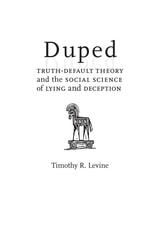
Duped
Truth-Default Theory and the Social Science of Lying and DeceptionTimothy R. Levine
University of Alabama Press, 2020
Unmasking the science of deception—and why truth wins by default.
From the advent of fake news to climate-science denial and Bernie Madoff’s appeal to investors, people can be astonishingly gullible. Some people appear authentic and sincere even when the facts discredit them, and many people fall victim to conspiracy theories and economic scams that should be dismissed as obviously ludicrous. This happens because of a near-universal human tendency to operate within a mindset that can be characterized as a “truth-default.” We uncritically accept most of the messages we receive as “honest.” We all are perceptually blind to deception. We are hardwired to be duped. The question is, can anything be done to militate against our vulnerability to deception without further eroding the trust in people and social institutions that we so desperately need in civil society?
Timothy R. Levine’s Duped: Truth-Default Theory and the Social Science of Lying and Deception recounts a decades-long program of empirical research that culminates in a new theory of deception—truth-default theory. This theory holds that the content of incoming communication is typically and uncritically accepted as true, and most of the time, this is good. Truth-default allows humans to function socially. Further, because most deception is enacted by a few prolific liars, the so called “truth-bias” is not really a bias after all. Passive belief makes us right most of the time, but the catch is that it also makes us vulnerable to occasional deceit.
Levine’s research on lie detection and truth-bias has produced many provocative new findings over the years. He has uncovered what makes some people more believable than others and has discovered several ways to improve lie-detection accuracy. In Duped, Levine details where these ideas came from, how they were tested, and how the findings combine to produce a coherent new understanding of human deception and deception detection.
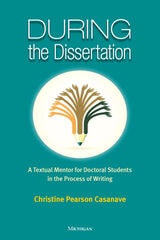
During the Dissertation
A Textual Mentor for Doctoral Students in the Process of WritingChristine Pearson Casanave
University of Michigan Press, 2020
This volume is a sequel to Casanave’s popular Before the Dissertation. Like that volume, this book is designed as a companion for doctoral dissertation writers of qualitative or mixed methods work in fields related to language education. It could also benefit those writing master’s theses and those writing in other social science fields. It is meant to be consulted once the writing has begun—once students have settled on a topic, designed the project, or collected the data—because this is the time when they are analyzing, drafting, revising, polishing, and probably fretting, deleting, reconstructing, and even losing sleep. Also, like its predecessor, it is not designed to teach anyone how to write a dissertation as there are plenty of those available elsewhere.
For most doctoral students, writing will happen at different stages of the project. Strategies for timing of these kinds of writing differ across students, and also across supervisors and advisers. If dissertation writers do not know by the time they start writing which strategies and issues pertain to them, this book can help them craft some approaches to suit their own personalities, preferred practices, and individual goals and visions, as well as help them figure out how dissertation writing might fit into the real-life intrusions of work and family.
Issues covered in the book are: starting to write, envisioning the project as a whole, relationships with supervisors, perfectionism and other maladies, health, low- and high-IQ days, loneliness and isolation, distractions and interruptions, revising, and knowing when to stop.