Results by title
198 books match the query 'Community' and 5 start with d
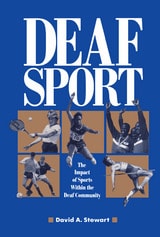
Deaf Sport
The Impact of Sports within the Deaf CommunityDavid A. Stewart
Gallaudet University Press, 1991
Deaf Sport describes the full ramifications of athletics for Deaf people, from the meaning of individual participation to the cultural bonding resulting from their organization. Deaf Sport profiles noted deaf sports figures and the differences particular to Deaf sports, such as the use of sign language for score keeping, officiating, and other communication.
This important book analyzes the governing and business aspects of Deaf sport, both local deaf groups and the American Athletic Association of the Deaf and the World Games for the Deaf. It shows the positive psychological and educational impact of Deaf sport, and how it serves to socialize further the geographically dispersed members of the Deaf community.
Diasporas in the New Media Age
Identity, Politics, and CommunityAndoni Alonso
University of Nevada Press, 2010
The explosion of digital information and communication technologies has influenced almost every aspect of contemporary life. Diasporas in the New Media Age is the first book-length examination of the social use of these technologies by emigrants and diasporas around the world. The eighteen original essays in the book explore the personal, familial, and social impact of modern communication technology on populations of European, Asian, African, Caribbean, Middle Eastern, and Latin American emigrants. It also looks at the role and transformation of such concepts as identity, nation, culture, and community in the era of information technology and economic globalization. The contributors, who represent a number of disciplines and national origins, also take a range of approaches—empirical, theoretical, and rhetorical—and combine case studies with thoughtful analysis. Diasporas in the New Media Age is both a discussion of the use of communication technologies by various emigrant groups and an engaging account of the immigrant experience in the contemporary world. It offers important insights into the ways that dispersed populations are using digital media to maintain ties with their families and homeland, and to create new communities that preserve their culture and reinforce their sense of identity. In addition, the book is a significant contribution to our understanding of the impact of technology on society in general.
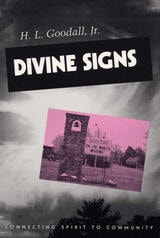
Divine Signs
Connecting Spirit to CommunityH. L. Goodall, Jr.
Southern Illinois University Press, 1996
Divine Signs is the concluding volume of the ethnographic trilogy about the communicative tensions in everyday American cultural life H. L. Goodall, Jr., began with Casing a Promised Land and continued with Living in the Rock n Roll Mystery.
In this final work, the terms for understanding these tensions are found in a historical and mythological drama featuring Power (as the embodiment of the modern), Other (as the embodiment of the postmodern), and Spirit (as the unifying power capable of connecting disparate selves to dangerously fragmented communities). For this study, the localized site of interpretation is in and around Pickens and Oconee Counties, South Carolina, where every day street signs, business advertisements on billboards, signs that announce church themes, Internet postings, and other forms of public communication that invite private meanings are read as rhetorical invitations to participate in these myths and mysteries.
Using themes discoverable in such public forms of communication, Goodall deconstructs a variety of communal experiences—from annual community celebrations to weekly therapy sessions in local beauty salons to the fall audience rituals of Clemson University football games—to gain a deeper appreciation of the unifying symbolic orders that enrich the interpretive possibilities of our lives and that serve as signs of our deeply spiritual connections to each other and to the planet.
In the last sections of the book, the interplays of Power, Other, and Spirit are read into and against a wide variety of everyday interpretive contexts, from Rush Limbaugh and talk radio to narratives about angels and stories about the transformative powers of spiritual practices in organizations. Goodall then asks the important question: Where are the themes of this mythological drama leading us? In the stunning conclusion, Goodall creates communicative, cultural, and spiritual challenges for us all.
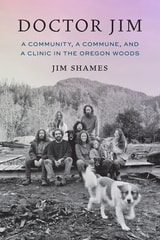
Doctor Jim
A Community, a Commune, and a Clinic in the Oregon WoodsJim Shames
Oregon State University Press, 2027
In 1973 Jim Shames, a young doctor questioning life in a country divided by the Vietnam War, learned of a counterculture community in Southern Oregon interested in establishing its own medical clinic. A recent graduate from medical school, with limited hands-on experience as a doctor, Jim found the promise and opportunity of a community in the woods, far from the turmoil of the times, appealing. In a leap of faith, he joined the back-to-the-earth movement and became a country doctor.
In the impoverished Illinois River Valley of Southern Oregon, Shames moved to Takilma and the Mystic Mountain commune. There Shames found a home, family, and fulfilling work at the Takilma People’s Clinic. It was a different world, offering an alternative journey and self-reflection. Surrounded by uninhibited friendliness, joy, and music, Doctor Jim cared for the patients of the community. Collectively the clinic treated rattlesnake bites, gunshot wounds, obstetrical complications, meningitis, cancer, and more for the residents of Southern Oregon.
Doctor Jim offers a window into communal life and the challenges of healthcare in rural Oregon. Shames highlights the struggles and rewards to be found in simple daily activities with like-minded souls sharing emotional and physical work. In reflecting on his unique medical career, Shames teaches that healing is about the intimate interaction between the patient and the doctor rather than medications or procedures. What started as an experiment evolved into a medical practice caring for a broader community beyond its counterculture brethren.
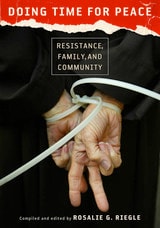
Doing Time for Peace
Resistance, Family, and CommunityRosalie G. Riegle
Vanderbilt University Press, 2013
In their own words, the narrators describe their motivations and their preparations for acts of resistance, the actions themselves, and their trials and subsequent jail time. We hear from those who do their time by caring for their families and managing communities while their partners are imprisoned. Spouses and children talk frankly of the strains on family ties that a life of working for peace in the world can cause.
The voices range from a World War II conscientious objector to those protesting the recent war in Iraq. The book includes sections on resister families, the Berrigans and Jonah House, the Plowshares Communities, the Syracuse Peace Council, and Catholic Worker houses and communities.
The introduction by Dan McKanan situates these activists in the long tradition of resistance to war and witness to peace.