Results by title
77 books match the query 'Congress' and 3 start with d
Deliberative Choices
Debating Public Policy in CongressGary Mucciaroni and Paul J. Quirk
University of Chicago Press, 2006
The task of deliberating public policy falls preeminently to Congress. But decisions on matters ranging from budget deficits to the war with Iraq, among others, raise serious doubts about its performance. In Deliberative Choices, Gary Mucciaroni and Paul J. Quirk assess congressional deliberation by analyzing debate on the House and Senate floors. Does debate genuinely inform members of Congress and the public? Or does it mostly mislead and manipulate them?
Mucciaroni and Quirk argue that in fashioning the claims they use in debate, legislators make a strategic trade-off between boosting their rhetorical force and ensuring their ability to withstand scrutiny. Using three case studies—welfare reform, repeal of the estate tax, and telecommunications deregulation—the authors show how legislators’ varying responses to such a trade-off shape the issues they focus on, the claims they make, and the information they provide in support of those claims.
Mucciaroni and Quirk conclude that congressional debate generally is only moderately realistic and informed. It often trades in half-truths, omissions, and sometimes even outright falsehoods. Yet some debates are highly informative. Moreover, the authors believe it’s possible to improve congressional deliberation, and they recommend reforms designed to do so.
[more]
Designing Judicial Review
Interest Groups, Congress, and Communications PolicyCharles R. Shipan
University of Michigan Press, 2000
Members of Congress and interest groups fiercely struggle over the seemingly unimportant procedural details of legislation such as the provisions for judicial review. Charles R. Shipan, in a study based on a detailed consideration of congressional debates over communications legislation, argues that the actors realize that current procedural choices will structure future alternatives and thus are willing to expend considerable resources over these issues. Using a rational choice framework, Shipan argues that provisions for judicial review, such as the specification of which agency actions are reviewable and which courts have review authority, are among the issues over which interested parties struggle because these issues will significantly affect the outcome of important future court action. Shipan tests his theory in a detailed exploration of the development of communications legislation during the 1920s and 1930s. This is a rich period in which to study the importance of judicial review provisions, for, while most political actors accepted the courts as part of the regulatory process, the concept of assigning broad decision-making powers to agencies was new and controversial. In addition, regulation of radio was both an important issue and one fraught with uncertainty, thus inducing members of Congress and interest groups to attempt to plan ahead for future actions. Shipan examines the motivations, actions, and choices of both interest groups and members of Congress. He then looks at the impact of the choices made on later court action in the communications legislation. This book will appeal to political scientists and legal scholars interested in the politics of judicial review, the courts, legislative politics, and communication policy.
[more]
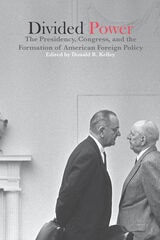
Divided Power
The Presidency, Congress, and the Formation of American Foreign PolicyDonald R. Kelley
University of Arkansas Press, 2005
Divided Power is a collection of eight original essays written for the Fulbright Institute of International Relations that focuses on timely yet unanswerable questions about the relationship between the executive and legislative branches in the formation of American foreign policy. In trying to answer questions about what the nation’s foreign policy is, and who has the upper hand in making it, these essays examine the struggle between the constant of the division of powers mandated by the Constitution (ambiguous though it may be) and the ever-changing political realities and conventional wisdoms of the day. Within that context, the authors also examine the society and culture in which those realities and wisdoms are nested. The goal of these essays is to offer a snapshot in time of the interaction of the executive and legislative branches in the shaping of our foreign policy, framed and informed by the intellectual and political realities that characterize the post–Cold War, post–September 11 world.
[more]