Results by title
365 books match the query 'Correspondence' and 20 start with d

Dawn of Industrial Agriculture in Iowa
Anthropology, Literature, and HistoryE. Paul Durrenberger
University Press of Colorado, 2021
Durrenberger tells the story that Corey aimed to record and preserve of the industrialization of Iowa’s agriculture and the death of its family farms. He analyzes Corey’s regionalist focus on Iowa farming and regionalism’s contemporaneous association in Europe with rising fascism. He explores Corey’s adoption of naturalism, evident in his resistance to heroes and villains, to plot structure and resolution, and to moral judgment, as well as his ethnographic tendency to focus on groups rather than individuals.
An unusual and wide-ranging study, The Dawn of Industrial Agriculture in Iowa offers important insight into the relationships among fiction, individual lives, and anthropological practice, as well as into a pivotal period in American history.
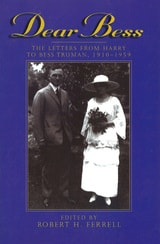
Dear Bess
The Letters from Harry to Bess Truman, 1910-1959Edited by Robert H. Ferrell
University of Missouri Press, 1998
Once again available is the critically acclaimed Dear Bess, a collection of more than 600 letters that Harry S. Truman wrote to his beloved wife, Bess, from 1910 to 1959. Selected from 1,268 letters discovered in Bess's house after her death in 1982, this extraordinary collection provides an inside look at Truman's life, his thoughts, and his dreams.
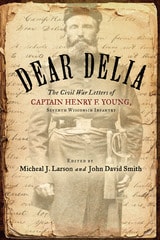
Dear Delia
The Civil War Letters of Captain Henry F. Young, Seventh Wisconsin InfantryHenry F. Young, edited by Micheal J. Larson and John David Smith
University of Wisconsin Press, 2019
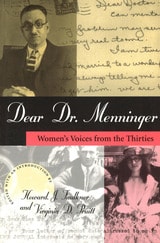
Dear Dr. Menninger
Women's Voices from the ThirtiesHoward J. Faulkner and Virginia D. Pruitt, eds.
University of Missouri Press, 1997
In 1930 Dr. Karl A. Menninger, one of America's most distinguished psychiatrists, was asked by the editor of Ladies' Home Journal to write a monthly column that would address mental health issues and answer questions from readers. The result was the widely popular column "Mental Hygiene in the Home," which ran for eighteen months at a time when the American public was just beginning to popularize the idea of mental hygiene and psychotherapy.
Of the thousands of letters Dr. Menninger received, only a small number were printed in the Journal. However, he wrote personal responses to all of them, over two thousand of which have been preserved. For this book, Howard J. Faulkner and Virginia D. Pruitt have selected more than eighty exchanges that provide intimate glimpses into the personal lives of women from across the country.
Most notable in this fascinating collection is the precision and clarity of the women's voices, as well as Dr. Menninger's incisive, analytical, and elegantly phrased replies. The topics that were of major concern to these women included their own sexuality, cheating husbands, problem children, and interfering in-lawsþin other words, the same issues that many women still face today. Although Dr. Menninger's advice may sometimes be questionable by modern standards, these letters provide a useful look at the social assumptions of the 1930s.
Included in the book is an excellent introduction by the editors that traces America's affection for advice columns, chronicles Dr. Menninger's life and work, and provides an overview of the development of psychotherapy. Entertaining as well as informative, these letters not only offer a valuable reflection of women's issues during the Depression era but also invite comparison and contrast with contemporary problems, attitudes, and values.

Dear Elizabeth
May Swenson
Utah State University Press, 2000
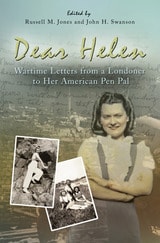
Dear Helen
Wartime Letters from a Londoner to Her American Pen PalEdited by Russell M. Jones & John H. Swanson
University of Missouri Press, 2009
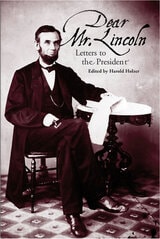
Dear Mr. Lincoln
Letters to the PresidentEdited by Harold Holzer
Southern Illinois University Press, 2006
During the Civil War, Americans felt themselves to be on intimate terms with their commander in chief, sending President Abraham Lincoln between two hundred and five hundred pieces of mail every day—letters that expressed the concerns, aspirations, grievances, and obsessions of the nation. Ranging from weighty political tomes to greetings accompanying homespun gifts, the letters reflect the pulse of the country in a time of upheaval. This illuminating collection includes straightforward correspondence from ordinary Americans requesting autographs and favors as well as pleas from the influential, such as the anguished open letter from New York Tribune publisher Horace Greeley imploring Lincoln to end his “remiss” policy of caution on emancipation. This new paperback edition, featuring twenty-two illustrations, portrays a president clearly eager to review and respond to the advice, criticism, and requests of the nation’s citizens.
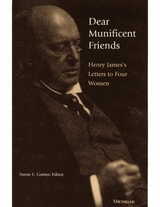
Dear Munificent Friends
Henry James's Letters to Four WomenSusan E. Gunter, Editor
University of Michigan Press, 2000
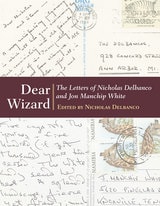
Dear Wizard
The Letters of Nicholas Delbanco and Jon Manchip Whiteedited by Nicholas Delbanco
University of Michigan Press, 2014
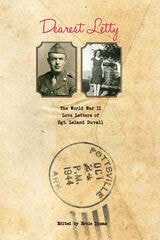
Dearest Letty
The World War II Love Letters of Sgt. Leland DuvallLeland Duvall
University of Arkansas Press, 2011

Dearly Beloved Friends
Henry James's Letters to Younger MenSusan E. Gunter and Steven H. Jobe, Editors
University of Michigan Press, 2004
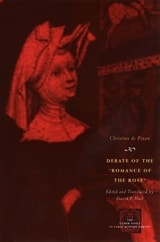
Debate of the Romance of the Rose
Christine de Pizan
University of Chicago Press, 2010
In 1401, Christine de Pizan (1365–1430?), one of the most renowned and prolific woman writers of the Middle Ages, wrote a letter to the provost of Lille criticizing the highly popular and widely read Romance of the Rose for its blatant and unwarranted misogynistic depictions of women. The debate that ensued, over not only the merits of the treatise but also of the place of women in society, started Europe on the long path to gender parity. Pizan’s criticism sparked a continent-wide discussion of issues that is still alive today in disputes about art and morality, especially the civic responsibility of a writer or artist for the works he or she produces.
In Debate of the “Romance of the Rose,” David Hult collects, along with the debate documents themselves, letters, sermons, and excerpts from other works of Pizan, including one from City of Ladies—her major defense of women and their rights—that give context to this debate. Here, Pizan’s supporters and detractors are heard alongside her own formidable, protofeminist voice. The resulting volume affords a rare look at the way people read and thought about literature in the period immediately preceding the era of print.
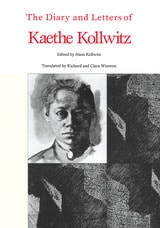
Diary and Letters of Kaethe Kollwitz
Kaethe Kollwitz
Northwestern University Press, 1988

Dispatches from the Revolution
Russia 1916-1918Morgan Philips Price
Duke University Press, 1998
This collection includes Price’s pre-censored observations and comment, written for a range of British publications, as well as letters, postcards, and other writings. A foreword by Eric Hobsbawm and introductory material by Rose place Price’s observations in biographical and historical context. Dispatches from the Revolution offers an account of the Russian Revolution from an eyewitness whose political commitment, fluency in Russian, and extensive travel far beyond the cities permitted him to write, uniquely, not only of metropolitan news and politics, but also of the experiences and issues signficant to ordinary peasants, workers, and soldiers in remote areas of the Russian empire.
An important source to scholars of Russian history, this book will also appeal to general readers with interests in Russia, journalism, and world affairs.
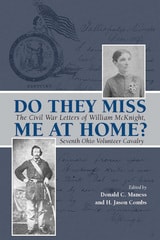
Do They Miss Me at Home?
The Civil War Letters of William McKnight, Seventh Ohio Volunteer CavalryDonald C. Maness
Ohio University Press, 2010
William McKnight was a member of the Seventh Ohio Volunteer Cavalry from September 1862 until his death in June of 1864. During his time of service, McKnight penned dozens of emotion-filled letters, primarily to his wife, Samaria, revealing the struggles of an entire family both before and during the war.
This collection of more than one hundred letters provides in-depth accounts of several battles in Kentucky and Tennessee, such as the Cumberland Gap and Knoxville campaigns that were pivotal events in the Western Theater. The letters also vividly respond to General John Hunt Morgan’s raid through Ohio and correct claims previously published that McKnight was part of the forces chasing Morgan. By all accounts Morgan did stay for a period of time at McKnight’s home in Langsville during his raid through Ohio, much to McKnight’s horror and humiliation, but McKnight was in Kentucky at the time. Tragically, McKnight was killed in action nearly a year later during an engagement with Morgan’s men near Cynthiana, Kentucky.
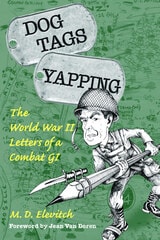
Dog Tags Yapping
The World War II Letters of a Combat GIM.D. Elevitch. Foreword by Jean Van Doren
Southern Illinois University Press, 2003
A chronicle of war infused with uncommon cheer, Dog Tags Yapping: The World War II Letters of a Combat GI is a young man’s education in life and death and a narrative of war told completely in letters.
During World War II, thousands of high school graduates were drafted into the army to be trained in colleges as engineers or other technicians but instead were assigned to fighting units and joined the great assault in Europe after D-Day. One of those reprogrammed combat infantrymen was Morton Elevitch from Duluth, Minnesota. Elevitch’s cartoons, drawings, and extremely unconventional letters home—rescued from box-in-the-basement oblivion after a more than fifty-year dormancy—recover the story of one rerouted GI in a voice that is compelling and new. Embellished with a boyish flair, the quirky and playful documents collected here impart a distinctly personal and uncalculated record of war, family, and coming of age. “It’s much easier to wield a melancholy pen than to sit down and cry,” Elevitch declares to his father.
Sparkling with a patina of wit and the bittersweet allure of lost innocence, the words and letters of “Privitch Elevate” offer the immediacy of the events as they unfolded. With the ease and expertise expected of a more seasoned storyteller, the young Elevitch escorts readers through his basic training and departure for Europe, duty in Brittany with the 94th Division and departure for Germany, combat under Patton’s command, wounding by mortar fragments, convalescence in England, and his return to France with the Signal Corps to guard prisoners and await demobilization. But along with these letters are the stories of his relationships with his parents, his brother, the men of his company and even the prisoners of war. The author’s perspectives on the war radically change. Both comic and tragic in its treatment of war’s chaos and tedium, this sensitive personal history covers experiences from the adjustment to military life and the temptations of flesh to the pain of wounds and recovery and the exposure to foreign countries and cultures.
Presaging his career as a novelist and editor, Elevitch’s words and drawings sketch an audacious and highly imaginative portrait of a young man during an exceptional time in world history. Evocative of life lived and nearly lost, his jarring accounts of combat reveal a soldier who was wounded not only in body but also in soul, in a war that changed him forever—just as it changed everyone it touched. Reproduced here as they were originally written, alongside a gallery of photos and hand-drawn battle maps, Elevitch’s cartoons and letters were initially intended for only three persons. But with their unique historical value and affecting exploration of the human spirit, they resurface in Dog Tags Yapping and result in an exhilarating ride for all readers through his “wild bivouac of the mind.”

Dolly and Zane Grey
Letters from a MarriageCandace C. Kant
University of Nevada Press, 2011
Popular western writer Zane Grey was a literary celebrity during his lifetime and the center of a huge enterprise based on his writing, which included books, magazine serials, film and stage versions of his stories, even comic strips. His wife, Dolly, closely guided Grey's career almost from its beginning, editing and sometimes revising his work, negotiating with publishers and movie studios, and skillfully managing the considerable fortune derived from these activities.
Dolly maintained the facade of a conventional married life that was essential to Grey's public image and the traditional middle-class values his work reflected. This facade was constantly threatened by Grey's numerous affairs with other women. The stress of hiding these dalliances placed a huge strain on their relationship, and much of Zane and Dolly's union was sustained largely by correspondence. Their letters--thousands of them--reveal the true nature of this complex partnership. As edited by Candace Kant, the letters offer an engrossing portrait of an extremely unorthodox marriage and its times.
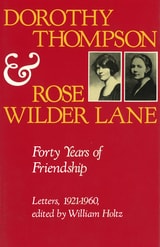
Dorothy Thompson and Rose Wilder Lane
Forty Years of Friendship, Letters, 1921-1960Edited by William Holtz
University of Missouri Press, 1991
The friendship between Dorothy Thompson and Rose Wilder Lane began in 1920 in the publicity office of the American Red Cross in Paris and continued until Thompson’s death in 1961. Although both women are today remembered primarily for their connections with others —Thompson as the wife of Sinclair Lewis, and Lane as the daughter of Laura Ingalls Wilder, author of the “Little House” books —each was remarkable in her own right.
Both women had a vital engagement with life that led them in fearless pursuit of experience. In 1939, Thompson appeared on the cover of Time, which judged her second only to Eleanor Roosevelt among influential women of the day. Typical of Lane were her travels through the mountains of Albania, the deserts of Syria, and Soviet Georgia in the 1920s and her visit as a journalist to Vietnam in 1965 at the age of seventy-eight.
The correspondence of these two talented and articulate women reveals their personal concerns, social ideas, and political/economic philosophies and how they changed over time. Their letters tell the story of the first generation of women to come of age during the twentieth century, as they tried to cope with problems that women still face today. Along with the letters themselves, Holtz has included annotations and footnotes that provide biographical information, as well as explaining personal and topical references.
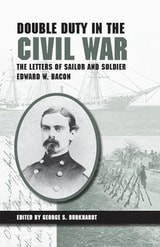
Double Duty in the Civil War
The Letters of Sailor and Soldier Edward W. BaconEdited by George S. Burkhardt
Southern Illinois University Press, 2009
In 1861 at the age of eighteen, Edward Woolsey Bacon, a Yale student and son of well-known abolitionist minister Leonard Bacon, left his home in New Haven, Connecticut, to fight for the United States. Over the next four years Bacon served in both the Union navy and army, which gave him a sweeping view of the Civil War. His postings included being a captain’s clerk on the USS Iroquois, a hospital clerk in his hometown, a captain in the 29th Connecticut Infantry (Colored), and a major in the 117th U.S. Colored Infantry, and he described these experiences in vibrant letters to his friends and family. Historian George S. Burkhardt has compiled these letters, as well as Bacon’s diary in the impressive Double Duty in the Civil War: The Letters of Sailor and Soldier Edward W. Bacon.
Bacon tells of hunting Confederate commerce raiders on the high seas, enduring the tedium of blockade duty, and taking part in riverine warfare on the Mississippi. He recalls sweating in South Carolina as an infantry officer during drill and picket duty, suffering constant danger in the battlefield trenches of Virginia, marching victoriously on fallen Richmond, and tolerating the boredom of occupation duty in Texas.
His highly entertaining letters shed new light on naval affairs and reveal a close-knit family life. The narrative of his duty with black troops is especially valuable, since few first-hand accounts from white officers of the U.S. Colored Troops exist. Furthermore, his beliefs about race, slavery, and the Union cause were unconventional for the time and stand in contrast to those held by many of his contemporaries.
Double Duty in the Civil War is filled with lively descriptions of the men Bacon met and the events he experienced. With Burkhardt’s careful editing and useful annotations, Bacon’s letters and diary excerpts give rare insight into areas of the Civil War that have been neglected because of a lack of available sources. Given the scarcity of eyewitness testimonies to navy life and life in African American regiments, this book is a rarity indeed.
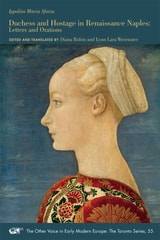
Duchess and Hostage in Renaissance Naples
Letters and OrationsIppolita Maria Sforza
Iter Press, 2017