Results by title
244 books match the query 'Crime' and 8 start with d

Dark Film, Blood Money
The Economic Unconscious of American Neo-Noir CinemaVernon Shetley
Intellect Books, 2027
Neo-noir films exert their fascination not only through their suspense, shadowy atmosphere, and moral ambiguity, but also through their registration of the experience of American life in the long twilight of the American Dream. With a sharp curatorial eye and an elegant critical voice, Vernon Shetley interprets landmark works from the noir revival of the early 1970s to the present, showing how neo-noir reflects the darkening national mood as postwar prosperity gave way to economic stagnation and inequality, social alienation, and a deepening sense of crisis.
Through close readings of key films and overviews of neo-noir’s treatment of the genre’s defining themes and archetypes—desire and betrayal, corruption and alienation, the private detective and the femme fatale—Shetley delineates neo-noir’s exploration of anxieties about work, money, trust, and exchange. From Chinatown to Mulholland Drive, from Night Moves to Nightmare Alley, neo-noir’s marginalized characters and extreme situations emerge in Shetley’s account as powerful representations of concerns central to economic and social life. Combining illuminating analysis with lucid prose, this book offers scholars and general readers alike a fresh, penetrating understanding of the dynamics of neo-noir filmmaking and its continually renewed vitality over the last five decades.
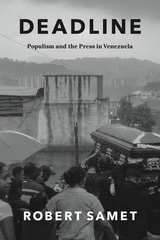
Deadline
Populism and the Press in VenezuelaRobert Samet
University of Chicago Press, 2019
In Deadline, anthropologist Robert Samet answers this question by focusing on the relationship between populism, the press, and what he calls “the will to security.” Drawing on nearly a decade of ethnographic research alongside journalists on the Caracas crime beat, he shows how the media shaped the politics of security from the ground up. Paradoxically, Venezuela’s punitive turn was not the product of dictatorship, but rather an outgrowth of practices and institutions normally associated with democracy. Samet reckons with this apparent contradiction by exploring the circulation of extralegal denuncias (accusations) by crime journalists, editors, sources, and audiences. Denuncias are a form of public shaming or exposé that channels popular anger against the powers that be. By showing how denuncias mobilize dissent, Deadline weaves a much larger tale about the relationship between the press, popular outrage, and the politics of security in the twenty-first century.
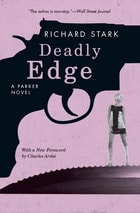
Deadly Edge
A Parker NovelRichard Stark
University of Chicago Press, 2010
One of the most hard-boiled and violent entries in the classic series starring Parker, the toughest heister out there
Richard Stark's Parker novels are the hardest of hard-boiled, classic crime novels where the heists are huge, the body counts are high, and the bad guys usually win.
The Parker novels have been a huge influence on countless writers and filmmakers, including Quentin Tarantino, Stephen King, George Pelecanos, Colson Whitehead, Lucy Sante, John Banville, and many more. Their stripped-down language and hard-as-nails amorality create an unforgettable world where the next score could be the big one, but your next mistake could also be your last. There's nothing else like them.
Deadly Edge bids a brutal adieu to the 1960s as Parker robs a rock concert, and the heist goes south. Soon Parker finds himself—and his woman, Claire—menaced by a pair of sadistic, strung-out killers who want anything but a Summer of Love. Parker has a score to settle while Claire’s armed with her first rifle—and they’re both ready to usher in the end of the Age of Aquarius.

Death Before Compline
Short Stories by Sharan NewmanSharan Newman
Arizona Center for Medieval and Renaissance Studies, 2012

Delinquency, crime, and society
James F. Short Jr.
University of Chicago Press, 1978
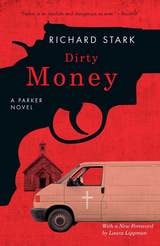
Dirty Money
A Parker NovelRichard Stark
University of Chicago Press, 2017
Richard Stark's Parker novels are the hardest of hard-boiled, classic crime novels where the heists are huge, the body counts are high, and the bad guys usually win.
The Parker novels have been a huge influence on countless writers and filmmakers, including Quentin Tarantino, Stephen King, George Pelecanos, Colson Whitehead, Lucy Sante, John Banville, and many more. Their stripped-down language and hard-as-nails amorality create an unforgettable world where the next score could be the big one, but your next mistake could also be your last. There's nothing else like them.
In this, the final Parker novel, Parker’s got a new fence and a new plan to get the loot back from a botched job in Dirty Money, but a bounty hunter, the FBI, and the local cops are on his tail. Only his brains, his cool, and the help of his lone longtime dame, Claire, can keep him one step ahead of the cars and the guns. One of the best books in the whole series, full of action and surprises, Diry Money closes Parker's career with a bang. (And with a perfect final line.)
Written over the course of almost sixty years, the Parker novels are pure artistry, adrenaline, and logic both brutal and brilliant. Join Parker on his jobs and read them all again or for the first time. But don’t talk to the law.
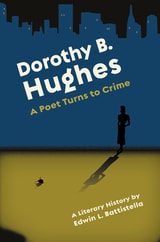
Dorothy B. Hughes
A Poet Turns to CrimeEdwin L. Battistella
University of Missouri Press, 2026
Hailed by critics and fans as “The Queen of Noir” and “a prescient feminist,” Dorothy B. Hughes (1904-1993) challenged the conventions of the crime fiction genre by exploring race, class, and social justice across her fourteen novels. Edwin Battistella’s new work weaves discussion of Hughes’s literary output with the story of her life. Dorothy B. Hughes: A Poet Turns to Crime examines her work as a poet, journalist, novelist, screenwriter, and critic as well as her family and personal relationships.
Beginning with her upbringing in Kansas City, Missouri, Battistella follows the writer’s time studying journalism at the University of Missouri, her subsequent work as a newspaper reporter, the eventual publication of her first book, a volume of poetry, and her prolific output of mystery novels that spanned two decades. Battistella situates her work in the broader context of twentieth-century crime fiction and its connection to various political and social movements, including her life-long concern with racial equality, which culminated in the 1963 publication of her final novel, The Expendable Man, which appeared at the height of the Civil Rights movement and is considered by many to be her best work.
In addition to drawing from Hughes’s own work and its reception by contemporary critics, Battistella examines later critical commentaries, scholarly articles, published interviews, archival material, and interviews with friends and family to tell her life story and literary legacy. More importantly, Battistella provides insights into why Dorothy B. Hughes still matters today, making his new work an important contribution to the history of popular culture and literary history.
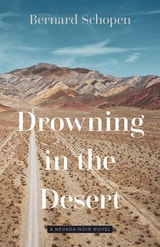
Drowning in the Desert
A Nevada Noir NovelBernard Schopen
University of Nevada Press, 2023
Norman “Fats” Rangle, an ex–deputy sheriff, operates a horse stabling and excursion business with his brother and sister-in-law on their family ranch in the small rural community of Blue Lake, a few hours outside of Las Vegas. But fate has other plans for him when, high on a southern Nevada mountain range, Fats discovers the wreckage of a plane that crashed two years earlier. Although he reports his find to the sheriff, he does not disclose that someone had already been to the crash site—evidence that Fats deliberately destroyed.
Soon, Fats is tracking back and forth between Las Vegas and Blue Lake in a search for a missing cousin, a briefcase full of cash, and, finally, for a killer. Along the way, Fats also begins to understand that he’s searching for himself and his place in a rapidly changing West.
Angry and alienated, Fats distrusts everyone he meets, from sleaze-merchants and political power brokers to two women: one he wants to believe in, a retired judge; and the other, a police sergeant, he can’t quite believe isn’t deceiving him. After all, in this Nevada, corruption is a given. Everybody lies. Much is uncertain—motives, loyalties, affections. But in Drowning in the Desert, one thing is certain: water is a precious resource that can both kill and be killed for.