Results by title
476 books match the query 'Criticism' and 22 start with d
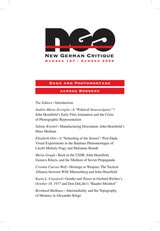
Dada and Photomontage across Borders, Volume 36
David Bathrick, Andreas Huyssen, and Anson Rabinbach, eds.
Duke University Press, 0
The central figure of the issue is John Heartfield, a Dadaist who influenced much of the art world in Europe after World War I. The collection investigates Heartfield’s lesser-known early work with cinema in the service of the German High Command. Believing that photographic cinema was akin to war propaganda, Heartfield rejected live-action war footage in favor of American cinematic animation to promote an honest discussion about the horror and realities of war. One essay explores Heartfield’s photomontages while turning to film theory as a way of interpreting the politics of his work, demonstrating how his photomontages retain the organic and traditional nature of photography even as they produce cognitive dissonance and satire. Another essay on Heartfield’s role in Soviet discussions of the 1930s offers fascinating insights based on new archival research. The issue also looks at the relationship between Heartfield and the illustrated German magazine Arbeiter-Illustrierte-Zeitung and how that magazine influenced photomontage across Europe.
Dark Deleuze
Andrew Culp
University of Minnesota Press, 2016
French philosopher Gilles Deleuze is known as a thinker of creation, joyous affirmation, and rhizomatic assemblages. In this short book, Andrew Culp polemically argues that this once-radical canon of joy has lost its resistance to the present. Concepts created to defeat capitalism have been recycled into business mantras that joyously affirm “Power is vertical; potential is horizontal!”
Culp recovers the Deleuze’s forgotten negativity. He unsettles the prevailing interpretation through an underground network of references to conspiracy, cruelty, the terror of the outside, and the shame of being human. Ultimately, he rekindles opposition to what is intolerable about this world.
Forerunners is a thought-in-process series of breakthrough digital works. Written between fresh ideas and finished books, Forerunners draws on scholarly work initiated in notable blogs, social media, conference plenaries, journal articles, and the synergy of academic exchange. This is gray literature publishing: where intense thinking, change, and speculation take place in scholarship.

Dark Lens
Imaging Germany, 1945Françoise Meltzer
University of Chicago Press, 2019
The ruins of war have long held the power to stupefy and appall. Can such ruins ever be persuasively depicted and comprehended? Can images of ruins force us to identify with the suffering of the enemy and raise uncomfortable questions about forgiveness and revenge?
Françoise Meltzer explores these questions in Dark Lens, which uses the images of war ruins in Nazi Germany to investigate problems of aestheticization and the representation of catastrophe. Through texts that give accounts of bombed-out towns in Germany in the last years of the war, painters’ attempts to depict the destruction, and her own mother’s photographs taken in 1945, Meltzer asks if any medium offers a direct experience of war ruins for the viewer. Refreshingly accessible and deeply personal, Dark Lens is a compelling look at the role images play in constructing memory.
Deadly Biocultures
The Ethics of Life-makingNadine Ehlers
University of Minnesota Press, 2019
A trenchant analysis of the dark side of regulatory life-making today
In their seemingly relentless pursuit of life, do contemporary U.S. “biocultures”—where biomedicine extends beyond the formal institutions of the clinic, hospital, and lab to everyday cultural practices—also engage in a deadly endeavor? Challenging us to question their implications, Deadly Biocultures shows that efforts to “make live” are accompanied by the twin operation of “let die”: they validate and enhance lives seen as economically viable, self-sustaining, productive, and oriented toward the future and optimism while reinforcing inequitable distributions of life based on race, class, gender, and dis/ability. Affirming life can obscure death, create deadly conditions, and even kill.
Deadly Biocultures examines the affirmation to hope, target, thrive, secure, and green in the respective biocultures of cancer, race-based health, fatness, aging, and the afterlife. Its chapters focus on specific practices, technologies, or techniques that ostensibly affirm life and suggest life’s inextricable links to capital but that also engender a politics of death and erasure. The authors ultimately ask: what alternative social forms and individual practices might be mapped onto or intersect with biomedicine for more equitable biofutures?
Dearth
Deconstruction After Speculative Realism. Art and DwellingPhilippe Lynes
Northwestern University Press, 2026
Proposing new insight into the legacies of Derridean thought for contemporary philosophy
In Art and Dwelling, the second volume of his Dearth sequence, Philippe Lynes sheds new light on the most enduring offshoot of the speculative realist movement, object-oriented ontology. Through careful readings of Graham Harman and Timothy Morton, Lynes shows how Jacques Derrida’s seminars offer critical insights into the spacing and distancing that precede and exceed all human practices of art and dwelling, with a deep sensitivity to the ecological and ethico-political consequences that follow.
Dearth: Deconstruction After Speculative Realism argues that Derrida’s seminars on Martin Heidegger and Maurice Blanchot, La Chose (The Thing), anticipated many of the philosophical, literary, and aesthetic questions animating speculative realism today: an anti-anthropocentric critique of Kantian correlationism; an overcoming of the apocalyptic nihilism of extinction through a deeper, affirmative habituation to nothingness; and poignant reflections on the literary and poetic aspects of living and dying in impossible worlds. His is an anti-correlationist plea that resounds now more urgently than ever.
Dearth
Deconstruction After Speculative Realism. The Nothing and NothingnessPhilippe Lynes
Northwestern University Press, 2026
Proposing a radical reconceptualization of deconstruction and nothingness
The first of two volumes exploring Jacques Derrida’s prefiguration of speculative realism, The Nothing and Nothingness examines the transcendental naturalism of Ray Brassier and Iain Hamilton Grant and the speculative materialism of Quentin Meillassoux. Philippe Lynes proposes nothing less than a radical reconceptualization of deconstruction as a call to bear witness to nothingness: let the earth be the earth, let nature be nature, and leave them to their reality, secrecy, and withdrawal without us.
Dearth: Deconstruction After Speculative Realism argues that Derrida’s seminars on Martin Heidegger and Maurice Blanchot, La Chose (The Thing), anticipated many of the philosophical, literary, and aesthetic questions animating speculative realism today: an anti-anthropocentric critique of Kantian correlationism; an overcoming of the apocalyptic nihilism of extinction through a deeper, affirmative habituation to nothingness; and poignant reflections on the literary and poetic aspects of living and dying in impossible worlds. His is an anti-correlationist plea that resounds now more urgently than ever.
Death of a Nation
American Culture and the End of ExceptionalismDavid W. Noble
University of Minnesota Press, 2002
A trenchant examination of epic shifts in American thought by a major scholar in the field.
In the 1940s, American thought experienced a cataclysmic paradigm shift. Before then, national ideology was shaped by American exceptionalism and bourgeois nationalism: elites saw themselves as the children of a homogeneous nation standing outside the history and culture of the Old World. This view repressed the cultures of those who did not fit the elite vision: people of color, Catholics, Jews, and immigrants. David W. Noble, a preeminent figure in American studies, inherited this ideology. However, like many who entered the field in the 1940s, he rejected the ideals of his intellectual predecessors and sought a new, multicultural, postnational scholarship. Throughout his career, Noble has examined this rupture in American intellectual life. In Death of a Nation, he presents the culmination of decades of thought in a sweeping treatise on the shaping of contemporary American studies and an eloquent summation of his distinguished career.
Exploring the roots of American exceptionalism, Noble demonstrates that it was a doomed ideology. Capitalists who believed in a bounded nationalism also depended on a boundless, international marketplace. This contradiction was inherently unstable, and the belief in a unified national landscape exploded in World War II. The rupture provided an opening for alternative narratives as class, ethnicity, race, and region were reclaimed as part of the nation’s history. Noble traces the effects of this shift among scholars and artists, and shows how even today they struggle to imagine an alternative postnational narrative and seek the meaning of local and national cultures in an increasingly transnational world. While Noble illustrates the challenges that the paradigm shift created, he also suggests solutions that will help scholars avoid romanticized and reductive approaches toward the study of American culture in the future.
Debates in the Digital Humanities 2016
Matthew K. Gold
University of Minnesota Press, 2016
Pairing full-length scholarly essays with shorter pieces drawn from scholarly blogs and conference presentations, as well as commissioned interviews and position statements, Debates in the Digital Humanities 2016 reveals a dynamic view of a field in negotiation with its identity, methods, and reach. Pieces in the book explore how DH can and must change in response to social justice movements and events like #Ferguson; how DH alters and is altered by community college classrooms; and how scholars applying DH approaches to feminist studies, queer studies, and black studies might reframe the commitments of DH analysts. Numerous contributors examine the movement of interdisciplinary DH work into areas such as history, art history, and archaeology, and a special forum on large-scale text mining brings together position statements on a fast-growing area of DH research. In the multivalent aspects of its arguments, progressing across a range of platforms and environments, Debates in the Digital Humanities 2016 offers a vision of DH as an expanded field—new possibilities, differently structured.
Published simultaneously in print, e-book, and interactive webtext formats, each DH annual will be a book-length publication highlighting the particular debates that have shaped the discipline in a given year. By identifying key issues as they unfold, and by providing a hybrid model of open-access publication, these volumes and the Debates in the Digital Humanities series will articulate the present contours of the field and help forge its future.
Contributors: Moya Bailey, Northeastern U; Fiona Barnett; Matthew Battles, Harvard U; Jeffrey M. Binder; Zach Blas, U of London; Cameron Blevins, Rutgers U; Sheila A. Brennan, George Mason U; Timothy Burke, Swarthmore College; Rachel Sagner Buurma, Swarthmore College; Micha Cárdenas, U of Washington–Bothell; Wendy Hui Kyong Chun, Brown U; Tanya E. Clement, U of Texas–Austin; Anne Cong-Huyen, Whittier College; Ryan Cordell, Northeastern U; Tressie McMillan Cottom, Virginia Commonwealth U; Amy E. Earhart, Texas A&M U; Domenico Fiormonte, U of Roma Tre; Paul Fyfe, North Carolina State U; Jacob Gaboury, Stony Brook U; Kim Gallon, Purdue U; Alex Gil, Columbia U; Brian Greenspan, Carleton U; Richard Grusin, U of Wisconsin, Milwaukee; Michael Hancher, U of Minnesota; Molly O’Hagan Hardy; David L. Hoover, New York U; Wendy F. Hsu; Patrick Jagoda, U of Chicago; Jessica Marie Johnson, Michigan State U; Steven E. Jones, Loyola U; Margaret Linley, Simon Fraser U; Alan Liu, U of California, Santa Barbara; Elizabeth Losh, U of California, San Diego; Alexis Lothian, U of Maryland; Michael Maizels, Wellesley College; Mark C. Marino, U of Southern California; Anne B. McGrail, Lane Community College; Bethany Nowviskie, U of Virginia; Julianne Nyhan, U College London; Amanda Phillips, U of California, Davis; Miriam Posner, U of California, Los Angeles; Rita Raley, U of California, Santa Barbara; Stephen Ramsay, U of Nebraska–Lincoln; Margaret Rhee, U of Oregon; Lisa Marie Rhody, Graduate Center, CUNY; Roopika Risam, Salem State U; Stephen Robertson, George Mason U; Mark Sample, Davidson College; Jentery Sayers, U of Victoria; Benjamin M. Schmidt, Northeastern U; Scott Selisker, U of Arizona; Jonathan Senchyne, U of Wisconsin, Madison; Andrew Stauffer, U of Virginia; Joanna Swafford, SUNY New Paltz; Toniesha L. Taylor, Prairie View A&M U; Dennis Tenen; Melissa Terras, U College London; Anna Tione; Ted Underwood, U of Illinois, Urbana–Champaign; Ethan Watrall, Michigan State U; Jacqueline Wernimont, Arizona State U; Laura Wexler, Yale U; Hong-An Wu, U of Illinois, Urbana–Champaign.
Debates in the Digital Humanities 2019
Matthew K. Gold
University of Minnesota Press, 2019
The latest installment of a digital humanities bellwether
Contending with recent developments like the shocking 2016 U.S. Presidential election, the radical transformation of the social web, and passionate debates about the future of data in higher education, Debates in the Digital Humanities 2019 brings together a broad array of important, thought-provoking perspectives on the field’s many sides. With a wide range of subjects including gender-based assumptions made by algorithms, the place of the digital humanities within art history, data-based methods for exhuming forgotten histories, video games, three-dimensional printing, and decolonial work, this book assembles a who’s who of the field in more than thirty impactful essays.
Contributors: Rafael Alvarado, U of Virginia; Taylor Arnold, U of Richmond; James Baker, U of Sussex; Kathi Inman Berens, Portland State U; David M. Berry, U of Sussex; Claire Bishop, The Graduate Center, CUNY; James Coltrain, U of Nebraska–Lincoln; Crunk Feminist Collective; Johanna Drucker, U of California–Los Angeles; Jennifer Edmond, Trinity College; Marta Effinger-Crichlow, New York City College of Technology–CUNY; M. Beatrice Fazi, U of Sussex; Kevin L. Ferguson, Queens College–CUNY; Curtis Fletcher, U of Southern California; Neil Fraistat, U of Maryland; Radhika Gajjala, Bowling Green State U; Michael Gavin, U of South Carolina; Andrew Goldstone, Rutgers U; Andrew Gomez, U of Puget Sound; Elyse Graham, Stony Brook U; Brian Greenspan, Carleton U; John Hunter, Bucknell U; Steven J. Jackson, Cornell U; Collin Jennings, Miami U; Lauren Kersey, Saint Louis U; Kari Kraus, U of Maryland; Seth Long, U of Nebraska, Kearney; Laura Mandell, Texas A&M U; Rachel Mann, U of South Carolina; Jason Mittell, Middlebury College; Lincoln A. Mullen, George Mason U; Trevor Muñoz, U of Maryland; Safiya Umoja Noble, U of Southern California; Jack Norton, Normandale Community College; Bethany Nowviskie, U of Virginia; Élika Ortega, Northeastern U; Marisa Parham, Amherst College; Jussi Parikka, U of Southampton; Kyle Parry, U of California, Santa Cruz; Brad Pasanek, U of Virginia; Stephen Ramsay, U of Nebraska–Lincoln; Matt Ratto, U of Toronto; Katie Rawson, U of Pennsylvania; Ben Roberts, U of Sussex; David S. Roh, U of Utah; Mark Sample, Davidson College; Moacir P. de Sá Pereira, New York U; Tim Sherratt, U of Canberra; Bobby L. Smiley, Vanderbilt U; Lauren Tilton, U of Richmond; Ted Underwood, U of Illinois, Urbana-Champaign; Megan Ward, Oregon State U; Claire Warwick, Durham U; Alban Webb, U of Sussex; Adrian S. Wisnicki, U of Nebraska–Lincoln.

Decolonisation and Criticism
The Construction of Irish LiteratureGerry Smyth
Pluto Press, 1998

Deconstruction
An American InstitutionGregory Jones-Katz
University of Chicago Press, 2021
Deconstruction begins well before Jacques Derrida’s initial American presentation of his deconstructive work in a famed lecture at Johns Hopkins University in 1966 and continues through several decades of theoretic growth and tumult. While much of the subsequent story remains focused, inevitably, on Yale University and the personalities and curriculum that came to be lumped under the “Yale school” umbrella, Deconstruction makes clear how crucial feminism, queer theory, and gender studies also were to the lifeblood of this mode of thought. Ultimately, Jones-Katz shows that deconstruction in the United States—so often caricatured as a French infection—was truly an American phenomenon, rooted in our preexisting political and intellectual tensions, that eventually came to influence unexpected corners of scholarship, politics, and culture.

Demarcating the Disciplines
Philosophy, Literature, ArtSamuel Weber, Henry Sussman, and Wlad Godzich, Editors
University of Minnesota Press, 1986
Demarcating the Disciplines was first published in 1986. Minnesota Archive Editions uses digital technology to make long-unavailable books once again accessible, and are published unaltered from the original University of Minnesota Press editions.
With publication of this volume, Glyph begins a new stage in its existence: the move from Johns Hopkins University Press to the University of Minnesota Press is accompanied by a change in focus. In its first incarnation Glyph provided a forum in which established notions of reading, writing, and criticism could be questioned and explored. Since then, the greater currency of such concerns has brought with it new problems and priorities. Setting aside the battles of the past, the new Glyph looks ahead - to confront historical issues and to address the institutional and pedagogical questions emerging from the contemporary critical landscape.
Each volume in the new Glyph series is organized around a specific issue. The essays in this first volume explore the relations between the practice of reading and writing and the operations of the institution. Though their approaches differ from one another, the authors of these essays all recognize that the questions of the institution - most notably the university - points toward a series of constraints that define, albeit negatively, the possibilities for change.
The contributors: Samuel Weber, Jacques Derrida, Tom Conley, Malcolm Evans, Ruth Salvaggio, Robert Young, Henry Sussman, Peter Middleton, David Punter, and Donald Preziosi.
Descartes and the Resilience of Rhetoric
Varieties of Cartesian Rhetorical TheoryThomas M. Carr, Jr.
Southern Illinois University Press, 2009
A careful analysis of the rhetorical thought of René Descartes and of a distinguished group of post-Cartesians. Covering a unique range of authors, including Bernard Lamy and Nicolas Malebranche, Carr attacks the idea, which has become commonplace in contemporary criticism, that the Cartesian system is incompatible with rhetoric.
Carr analyzes the writings of Balzac, the Port-Royalists Arnauld and Nicole, Malebranche, and Lamy, exploring the evolution of Descartes’ thought into their different theories of rhetoric. He constructs his arguments, probing each author’s writings on rhetoric, persuasion, and attention, to demonstrate the basis for rhetorical thought present in Descartes’ theory of persuasion when it is combined with his psychophysiology of attention.
Descent Into Discourse
The Reification of Language and the Writing of Social HistoryBryan Palmer
Temple University Press, 1990
"Critical theory is no substitute for historical materialism; language is not life." With this statement, Bryan Palmer enters the debate that is now transforming and disrupting a number of academic disciplines, including political science, women’s studies, and history. Focusing on the ways in which literary or critical theory is being promoted within the field of social history, he argues forcefully that the current reliance on poststructuralism—with its reification of discourse and avoidance of the structures of oppression and struggles of resistance—obscures the origins, meanings, and consequences of historical events and processes.
Palmer is concerned with the emergence of "language" as a central focus of intellectual work in the twentieth century. He locates the implosion of theory that moved structuralism in the direction of poststructuralism and deconstruction in what he calls the descent into discourse. Few historians who champion poststructuralist thought, according to Palmer, appreciate historical materialism’s capacity to address discourse meaningfully. Nor do many of the advocates of language within the field of social history have an adequate grounding in the theoretical making of the project they champion so ardently. Palmer roots his polemical challenge in an effort to "introduce historians more fully to the theoretical writing that many are alluding to and drawing from rather cavalierly."
Descent into Discourse counters current intellectual fashion with an eloquent argument for the necessity to analyze and appreciate lived experience and the structures of subordination and power in any quest for historical meaning.
Developing Animals
Wildlife and Early American PhotographyMatthew Brower
University of Minnesota Press, 2010
Developing Animals compellingly investigates the way photography changed our perception of animals. Brower analyzes how photographers created new ideas about animals as they moved from taking pictures of taxidermic specimens in so-called natural settings to the emergence of practices such as camera hunting, which made it possible to capture images of creatures in the wild.
By combining approaches in visual cultural studies and the history of photography, Developing Animals goes further to argue that photography has been essential not only to the understanding of wildlife but also to the conceptual separation of humans and animals.
Devouring One's Own Tail
Autopoiesis in PerspectiveEdited by Vojtech Kolman and Tomáš Murár
Karolinum Press, 2022
Inspired by Niklas Luhmann’s theories on social systems, this book examines the concept of autopoiesis, or self-creation, as it relates to society and culture. Approaching the concept from a variety of fields—philosophy, philology, aesthetics, linguistics, archaeology, and religious and media studies—the contributors present the products of humanity as self-referential, self-sustaining, and self-creating systems. Through four sections, the book addresses the philosophical concept of autopoiesis and its relations to creativity, destruction, and self-organization; autopoiesis in literature and art history; autopoiesis in religion; and autopoiesis in historiography, cognitive linguistics, and social media. Whether exploring Hegel’s theory of knowledge or the viral spread of conspiracy theories on the internet, the authors concentrate on the ouroboros-like nature of their subjects in the ways they feed off of themselves.
Diller Scofidio + Renfro
Architecture after ImagesEdward Dimendberg
University of Chicago Press, 2013
Discerning The Subject
Paul Smith
University of Minnesota Press, 1988
Discourse and the Other
The Production of the Afro-American TextW. Lawrence Hogue
Duke University Press, 1986
Hogue presents an illuminating discussion of the publication and review history of "major" and neglected texts. He illustrates the acceptance of texts as exotica, as sociological documents, or as carriers of sufficient literary conventions to receive approbation. Although the sixties movement allowed the text to move to the periphery of the dominant ideology, providing some new myths about the Afro-American historical past, this marginal position was subsequently sabotaged, co-opted, or appropriated (Afros became a fad; presidents gave the soul handshake; the hip-talking black was dressing one style and talking another.)
This study includes extended discussion of four works; Ernest J. Gaines's The Autobiography of Miss Jane Pittman, Alice Walker's The Third Life of Grange Copeland, Albert Murray's Train Whistle Guitar, and Toni Morrison's Sula. Hogue assesses the informing worldviews of each and the extent and nature of their acceptance by the dominant American cultural apparatus.
Discourse, Figure
lyotard
University of Minnesota Press, 2019
Choice Outstanding Academic Title
Jean-François Lyotard is recognized as one of the most significant French philosophers of the twentieth century. Although nearly all of his major writing has been translated into English, one important work has until now been unavailable. Discourse, Figure is Lyotard’s thesis. Provoked in part by Lacan’s influential seminars in Paris, Discourse, Figure distinguishes between the meaningfulness of linguistic signs and the meaningfulness of plastic arts such as painting and sculpture. Lyotard argues that because rational thought is discursive and works of art are inherently opaque signs, certain aspects of artistic meaning such as symbols and the pictorial richness of painting will always be beyond reason’s grasp.

Disfiguring
Art, Architecture, ReligionMark C. Taylor
University of Chicago Press, 1992
Dispositional Properties
David Weissman
Southern Illinois University Press, 1965
In Dispositional Properties, David Weissman attacks a problem central to the philosophy of mind and, by implication, to the theory of being: Are there potentialities, capabilities, which dispose the mind to think in one way rather than another?
The volume is arranged in the form of four arguments that converge upon a single point. First, there is an intricate discussion of the shortcomings of Hume's account of mind as ideas and impressions. Next comes a brief treatment of the arguments of some of Weissman's contemporaries, including Carnap and Braithwaite. Third, Weissman discusses Wittgenstein's theories of learning and knowledge. Finally, there is a full discussion of Aristotle and his doctrine of potentialities.
The question this book ultimately raises is how to steer between a doctrine of mind as no more than a series of acts, on the one hand, and a doctrine of mind as a kind of unitary object, on the other. The solution is to show first of all that there must be a potentiality in the universe, and then to show clearly and in detail that the mind is shot through with that potentiality.