Results by title
87 books match the query 'Criticism, Textual' and 3 start with d
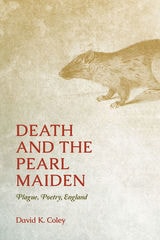
Death and the Pearl Maiden
Plague, Poetry, EnglandDavid K. Coley
The Ohio State University Press, 2019
Death and the Pearl Maiden: Plague, Poetry, England asks why one of the singular historical traumas of the later Middle Ages appears to be evoked so fleetingly in fourteenth-century Middle English poetry, a body of work as daring and socially engaged as any in English literary history. By focusing on under-recognized pestilential discourses in Pearl, Cleanness, Patience, and Sir Gawain and the Green Knight—the four poems uniquely preserved British Library MS Cotton Nero A.x —this study resists the idea that the Black Death had only a slight impact on medieval English literature, and it strives to account for the understated shape of England’s literary response to the plague and our contemporary understandings of it.

Dickinson's Fascicles
A Spectrum of PossibilitiesPaul Crumbley and Eleanor Elson Heginbotham
The Ohio State University Press, 2014
The collection opens with a central portion of Sharon Cameron’s 1992 book that was the first to abandon the until-then popular search for a single unifying narrative to explain the fascicles, inaugurating a new era of fascicle scholarship. Eight prominent Dickinson scholars contribute essays to this volume and respond vigorously and variously to Cameron's argument, proposing, for instance, that the fascicles represent Dickinson's engagement with the world around her, particularly with the Civil War, and that they demonstrate her continued experimentation with poetic form.
Dickinson’s Fascicles is edited by Paul Crumbley and Eleanor Elson Heginbotham. Other contributors include Paula Bernat Bennett, Martha Nell Smith, Domhnall Mitchell, Ellen Louise Hart, Melanie Hubbard, and Alexandra Socarides who assess what constitutes a vast final frontier in the Dickinson literary landscape. Susan Howe provides a coda.
Digital Critical Editions
Edited by Daniel Apollon, Claire Belisle, and Philippe Regnier
University of Illinois Press, 2014
Provocative yet sober, Digital Critical Editions examines how transitioning from print to a digital milieu deeply affects how scholars deal with the work of editing critical texts. On one hand, forces like changing technology and evolving reader expectations lead to the development of specific editorial products, while on the other hand, they threaten traditional forms of knowledge and methods of textual scholarship.
Using the experiences of philologists, text critics, text encoders, scientific editors, and media analysts, Digital Critical Editions ranges from philology in ancient Alexandria to the vision of user-supported online critical editing, from peer-directed texts distributed to a few to community-edited products shaped by the many. The authors discuss the production and accessibility of documents, the emergence of tools used in scholarly work, new editing regimes, and how the readers' expectations evolve as they navigate digital texts. The goal: exploring questions such as, What kind of text is produced? Why is it produced in this particular way?
Digital Critical Editions provides digital editors, researchers, readers, and technological actors with insights for addressing disruptions that arise from the clash of traditional and digital cultures, while also offering a practical roadmap for processing traditional texts and collections with today's state-of-the-art editing and research techniques thus addressing readers' new emerging reading habits.