Results by title
289 books match the query 'Dance' and 55 start with d

DJing in New York
Learning Processes of Underground Club DJsEva J. Egolf
Intellect Books, 2025
DJing in New York offers a rare, behind-the-scenes look at how underground Electronic Dance Music DJs in New York learn their craft, build careers, and navigate the ever-shifting world of nightlife.
Through immersive research, Eva J. Egolf reveals how DJing is more than a technical skill—it’s a deeply social process, rooted in friendships, enculturation, and access to professional networks. From honing beatmatching techniques to navigating the politics of club culture, these DJs rely on community as much as individual talent. Situating DJ learning within broader conversations on race, gender, and LGBTQ+ identities, this book expands our understanding of popular music education and the role of electronic music in shaping urban cultural history. It will be an illuminating resource for music educators, scholars of EDM and club culture, and those fascinated by the intersection of music, identity, and underground nightlife.
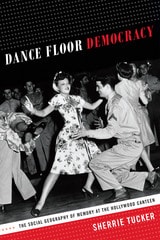
Dance Floor Democracy
The Social Geography of Memory at the Hollywood CanteenSherrie Tucker
Duke University Press, 2014
Dance Studies in China
Selected Writings from the Journal of Beijing Dance AcademyEdited by Deng Youling and Zhang Yanjie
Intellect Books, 2022
Officially founded in 1978, the Beijing Dance School was the first professional dance school established after the creation of the People’s Republic of China. In the years since, the Beijing Dance Academy has become the only institution of higher learning for professional dance education in the country, as well as the largest prestigious dance school in the world. It is a full-time institution of higher learning with commitments to developing excellent professional dancers, choreographers, and dance researchers. Dance Studies in China is a collection of articles selected from issues of the Journal of Beijing Dance Academy, the only academic journal of dance studies in China. The collection also includes an interview with Shen Wei, the Chinese American choreographer, painter, and director living in New York.
Dance a Little Longer
The Third Novel in a TrilogyJane Roberts Wood
University of North Texas Press, 2000
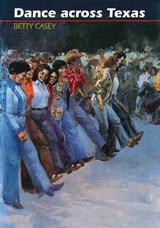
Dance across Texas
By Betty Casey
University of Texas Press, 1985
Generations of Texans have believed that “to dance is to live.” At rustic “play parties” and elegant cotillions, in tiny family dance halls and expansive urban honky-tonks, from historic beginnings to next Saturday night, Texans have waltzed, polkaed, schottisched, and shuffled their way across the state.
In Dance across Texas, internationally known dance instructor and writer Betty Casey takes an informal look at the history of Texas dancing and, in clear diagrams, photos, and detailed instructions, tells “how to” do more than twenty Texas dances.
Previously, little had been recorded about the history of dancing on the frontier. Journal and diary entries, letters, and newspaper clippings preserve enticing, if sketchy, descriptions of the types of dances that were popular. Casey uses a variety of sources, including interviews and previously unpublished historical materials, such as dance cards, invitations, and photographs, to give us a delightful look at the social context of dance. The importance of dance to early Texans is documented through colorful descriptions of clothing worn to the dances, of the various locations where dances were held, ranging from a formal hall to a wagon sheet spread on the ground, and of the hardships endured to get to a dance.
Also included in the historical section of Dance across Texas are notes on the “morality” of dance, the influence of country music on modern dance forms, and the popularity of such Texas dance halls and clubs as Crider’s and Gilley’s.
The instruction section of the book diagrams twenty-two Texas dances, including standard waltzes and two-steps as well as the Cotton-Eyed Joe, Put Your Little Foot, Herr Schmidt, the Western Schottische, and such “whistle’” or mixer dances as Paul Jones, Popcorn, and Snowball. Clear and detailed directions for each dance, along with suggested musical selections, accompany the diagrams and photos. Dance and physical education teachers and students will find this section invaluable, and aspiring urban cowboys can follow the easy-to-read diagrammed footsteps to a satisfying spin around the honky-tonk floor. Anyone interested in dance or in the history of social customs in Texas will find much to enjoy in this refreshing and often amusing look at a Texas “national” pastime.
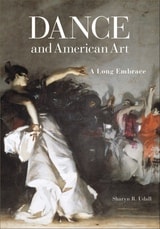
Dance and American Art
A Long EmbraceSharyn R. Udall
University of Wisconsin Press, 2012
From ballet to burlesque, from the frontier jig to the jitterbug, Americans have always loved watching dance, whether in grand ballrooms, on Mississippi riverboats, or in the streets. Dance and American Art is an innovative look at the elusive, evocative nature of dance and the American visual artists who captured it through their paintings, sculpture, photography, and prints from the early nineteenth century through the mid-twentieth century. The scores of artists discussed include many icons of American art: Winslow Homer, George Caleb Bingham, Mary Cassatt, James McNeill Whistler, Alexander Calder, Joseph Cornell, Edward Steichen, David Smith, and others.
As a subject for visual artists, dance has given new meaning to America’s perennial myths, cherished identities, and most powerful dreams. Their portrayals of dance and dancers, from the anonymous to the famous—Anna Pavlova, Isadora Duncan, Loïe Fuller, Josephine Baker, Martha Graham—have testified to the enduring importance of spatial organization, physical pattern, and rhythmic motion in creating aesthetic form.
Through extensive research, sparkling prose, and beautiful color reproductions, art historian Sharyn R. Udall draws attention to the ways that artists’ portrayals of dance have defined the visual character of the modern world and have embodied culturally specific ideas about order and meaning, about the human body, and about the diverse fusions that comprise American culture.
Dance and Authoritarianism
These Boots are Made for DancingAnthony Shay
Intellect Books, 2021
Using dance as a lens through which to study political, ethnic, and gendered phenomena, Anthony Shay shows us how dance and mass movement have served as important political tools throughout history and across a variety of authoritarian regimes. Dance and Authoritarianism is a significant and original contribution to the scholarship at the intersection of dance, ethnology, anthropology, cultural studies, and history.
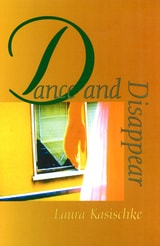
Dance and Disappear
Laura Kasischke
University of Massachusetts Press, 2002
Dance and Ethics
Moving Towards a More Humane Dance CultureNaomi M. Jackson
Intellect Books, 2022
This work examines ethics and the changing values in the world of dance, especially as faced by young dancers entering the profession. Since the 1960s, scholars and practitioners from the fields of dance education, somatics, and the realms of postmodern dance and ballet have increasingly believed that attitudes and practices involving psychological, physical, and sexual mistreatment of students and dancers must be challenged.
Dance and Ethics examines key ethical issues related to the dance field, primarily within the United States, and how those directly impact different aspects of the lives of dance artists throughout their careers. The issues discussed include the basic ethical choices facing a dance artist in terms of whether to care about ethics or separate art from morality; ethical issues involved in student–teacher and dancer–choreographer relationships; how ethical concerns relate to the creation and reception of choreographic work; ethical aspects of the critical assessment of dance and dancers; and ethical issues related to presenting systems and institutional infrastructures within the dance field.
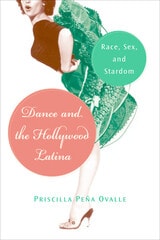
Dance and the Hollywood Latina
Race, Sex, and StardomOvalle, Priscilla P
Rutgers University Press, 2011
Introducing the concepts of "inbetween-ness" and "racial mobility" to further illuminate how racialized sexuality and the dancing female body operate in film, Priscilla Peña Ovalle focuses on the careers of Dolores Del Rio, Rita Hayworth, Carmen Miranda, Rita Moreno, and Jennifer Lopez. Dance and the Hollywood Latina helps readers better understand how the United States grapples with race, gender, and sexuality through dancing bodies on screen.
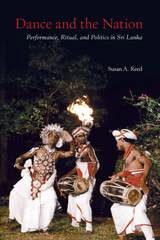
Dance and the Nation
Performance, Ritual, and Politics in Sri LankaSusan A. Reed
University of Wisconsin Press, 2010
As the national dance of Sri Lanka, Kandyan dance is identified with the majority Sinhala ethnic group and heavily supported by the state. Derived from the kohomba kankariya—an elaborate village ritual performed by men of the hereditary drummer caste—the dance was adopted by the state as a symbol of traditional Sinhala culture in the post-independence period. When state officials introduced the dance into the school curriculum, it was opened to individuals of all castes, and high-caste women have emerged as prominent teachers and performers. Reed’s evocative account traces the history and consequences of this transition from ritual to stage, situating the dance in relation to postcolonial nationalism and ethnic politics and emphasizing the voices and perspectives of the hereditary dancers and of women performers.
Although Kandyan dance is related to other south Asian dance forms, it is unique, distinguished by an elegant, energetic style, and lively displays of acrobatics and agility. The companion DVD includes unparalleled footage of this vibrant dance in ritual, stage, and training contexts, and features the most esteemed performers of the Kandyan region.
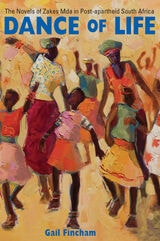
Dance of Life
The Novels of Zakes Mda in Post-apartheid South AfricaGail Fincham
Ohio University Press, 2012
In recent years, the work of Zakes Mda—novelist, painter, composer, theater director and filmmaker—has attracted worldwide critical attention. Gail Fincham’s book examines the five novels Mda has written since South Africa’s transition to democracy: Ways of Dying (1995), The Heart of Redness (2000), The Madonna of Excelsior (2002), The Whale Caller (2005), and Cion (2007). Dance of Life explores how refigured identity is rooted in Mda’s strongly painterly imagination that creates changed spaces in memory and culture. Through a combination of magic realism, African orature, and intertextuality with the Western canon, Mda rejects dualistic thinking of the past and the present, the human and the nonhuman, the living and the dead, the rural and the urban. He imbues his fictional characters with the power to orchestrate a reconfigured subjectivity that is simultaneously political, social, and aesthetic.
Dance of Values
Sergei Eisenstein’s Capital ProjectElena Vogman
Diaphanes, 2018
Dance of the Dialectic
STEPS IN MARX'S METHODBertell Ollman
University of Illinois Press, 2003
Marx made extremely creative use of dialectical method to analyze the origins, operation, and direction of capitalism. Unfortunately, his promised book on method was never written, so that readers wishing to understand and evaluate Marx's theories, or to revise or use them, have had to proceed without a clear grasp of the dialectic in which the theories are framed. The result has been more disagreement over "what Marx really meant" than over the writings of any other major thinker.
In putting Marx's philosophy of internal relations and his use of the process of abstraction--two little-studied aspects of dialectics--at the center of this account, Ollman provides a version of Marx's method that is at once systematic, scholarly, clear and eminently useful.
Ollman not only sheds important new light on what Marx really meant in his varied theoretical pronouncements, but in carefully laying out the steps in Marx's method makes it possible for a reader to put the dialectic to work in his or her own research. He also convincingly argues the case for why social scientists and humanists as well as philosophers should want to do so.
Dance of the Dolphin
Transformation and Disenchantment in the Amazonian ImaginationCandace Slater
University of Chicago Press, 1994
Candace Slater examines these stories in Dance of the Dolphin, both as folk narratives and as representations of culture and conflict in Amazonia. Her engaging study discusses the tales from the viewpoints of genre, performance, and gender, but centers on them as responses to the great changes sweeping the Amazon today. According to Slater, these surprisingly widespread tales reflect Amazonians' own mixed reactions to the ongoing destruction of the rainforest and the resulting transformations in the social as well as physical landscape. Offering an informed view of Brazilian culture, this book crosses the boundaries of folklore, literature, anthropology, and Latin American studies. It is one of the very few studies to offer an overview of the changes taking place in Amazonia through the eyes of ordinary people.
"This book is a rich collection of stories about the transformation of dolphins in the city of enchantment. . . . The joy in this book is not just its vibrant analysis and careful relating of tradition and lore, but also its uncanny accurateness in capturing the very essence of Amazonia."-Darrell Posey, Journal of Latin American Studies
"Slater's fluid prose reads like a novel for those interested in Amazonian culture and folklore, while her integrated approach makes this a must read for those interested in innovative methodology."-Lisa Gabbert, Western Folklore
Dance of the Returned
Devon A. Mihesuah
University of Arizona Press, 2022

Dance of the Sleepwalkers
The Dance Marathon FadFrank M. Calabria
University of Wisconsin Press, 1993
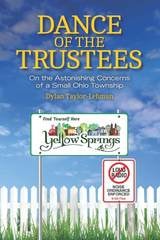
Dance of the Trustees
On the Astonishing Concerns of a Small Ohio TownshipDylan Taylor-Lehman
The Ohio State University Press, 2018
This quaint debate represents just one of many fascinating problems the trustees deal with on a daily basis. While Miami Township is small, the concerns are myriad—from cemeteries filled with unknown remains to a fire department to oversee to legal action required against properties clogged with junk. The responsibilities are doubly impressive considering no trustees have backgrounds in public office.
This book combines entertaining nonfiction vignettes with well-researched township history—including a history of religious cults and the possibility that Lee Harvey Oswald was once in town—and elucidates the processes behind an entire civic division. Dance of the Trustees documents twenty-first-century small-town life with humor, warmth, and erudition.

Dance with the Bear
The Joe Rosenblatt StoryNorman Rosenblatt
University of Utah Press, 2013
The “Little Hoover Commission” was modeled after the 1947 initiative of President Harry Truman, who created the Commission on Organization of the Executive Branch of Government to recommend administrative changes and appointed former president Herbert Hoover to chair it. Rosenblatt, a perceptive and outspoken figure, brought a much-needed dose of urgency and pragmatism to the Utah process and formulated a number of far-reaching suggestions to the legislature—many of which were adopted and still exist to this day. His work with the commission coupled with his later role on the San Francisco Federal Reserve Board did much to modernize Utah. Rosenblatt’s legacy as a perpetual champion of the community is further exemplified by his role as cultural conduit between Salt Lake’s Jewish community and the leaders of the Church of Jesus Christ of Latter-day Saints.
This readable work will serve as an integral addition to Utah business and political history, enriching the library of anyone looking for an engaging story of a remarkable and transformative figure.
Dance, Disability and Law
InVisible DifferenceEdited by Sarah Whatley, Charlotte Waelde, Shawn Harmon, Abbe Brown, Karen Wood, and Hetty Blades
Intellect Books, 2018
Dance, Politics & Co-Immunity
Current Perspectives on Politics and Communities in the Arts Vol. 1Edited by Stefan Hölscher and Gerald Siegmund
Diaphanes, 2013
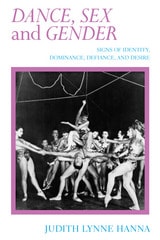
Dance, Sex, and Gender
Signs of Identity, Dominance, Defiance, and DesireJudith Lynne Hanna
University of Chicago Press, 1988
Dance, Somatics and Spiritualities
Contemporary Sacred NarrativesEdited by Amanda Williamson, Glenna Batson, Sarah Whatley, and Rebecca Weber
Intellect Books, 2014
Presenting a rich mosaic of embodied contemporary narratives in spirituality and movement studies, this book explicitly studies the relationship between spirituality and the field of Somatic Movement Dance Education. It is the first scholarly text to focus on contemporary spirituality within the domain of dance and somatic movement studies.
Dance, Somatics and Spiritualities brings together prominent authors and practitioners in order to elucidate how a wide range of sacred narratives/spiritualities are informing pedagogy, educational and therapeutic practice. As well as providing new insights and promoting creative/artistic awareness, this seminal text de-mystifies the spiritual/sacred and brings clarity and academic visibility to this largely uncharted and often misrepresented subject.
Dance
A Creative Art ExperienceMargaret N. H'Doubler; with a new essay by Mary Alice Brennan
University of Wisconsin Press, 1959
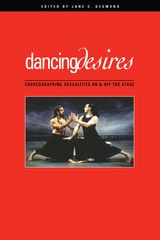
Dancing Desires
Choreographing Sexualities On And Off The StageJane C. Desmond
University of Wisconsin Press, 2001
What happens to the writing of dance history when issues of sexuality and sexual identity are made central? What happens to queer theory, and to other theoretical constructs of gender and sexuality, when a dancing body takes center stage? Dancing Desires asks these questions, exploring the relationship between dancing bodies and sexual identity on the concert stage, in nightclubs, in film, in the courts, and on the streets. From Nijinsky’s balletic prowess to Charlie Chaplin's lightfooted "Little Tramp," from lesbian go-go dancers to the swans of Swan Lake, from the postmodern works of Bill T. Jones to the dangers of same-sex social dancing at Disneyland and the ecstatic Mardi Gras dance parties of Sydney, Australia, this book tracks the intersections of dance and human sexuality in the twentieth century as the definition of each has shifted and expanded.
The contributors come from a number of fields (literature, history, theater, dance, film studies, legal studies, critical race studies) and employ methodologies ranging from textual analysis and film theory to ethnography. By embracing dance, and bodily movement more generally, as a crucial focus for investigation, together they initiate a new agenda for tracking the historical kinesthetics of sexuality.
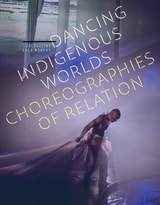
Dancing Indigenous Worlds
Choreographies of RelationJacqueline Shea Murphy
University of Minnesota Press, 2023
The vital role of dance in enacting the embodied experiences of Indigenous peoples
In Dancing Indigenous Worlds, Jacqueline Shea Murphy brings contemporary Indigenous dance makers into the spotlight, putting critical dance studies and Indigenous studies in conversation with one another in fresh and exciting new ways. Exploring Indigenous dance from North America and Aotearoa (New Zealand), she shows how dance artists communicate Indigenous ways of being, as well as generate a political force, engaging Indigenous understandings and histories.
Following specific dance works over time, Shea Murphy interweaves analysis, personal narrative, and written contributions from multiple dance artists, demonstrating dance’s crucial work in asserting and enacting Indigenous worldviews and the embodied experiences of Indigenous peoples. As Shea Murphy asserts, these dance-making practices can not only disrupt the structures that European colonization feeds upon and strives to maintain, but they can also recalibrate contemporary dance.
Based on more than twenty years of relationship building and research, Shea Murphy’s work contributes to growing, and largely underreported, discourses on decolonizing dance studies, and the geopolitical, gendered, racial, and relational meanings that dance theorizes and negotiates. She also includes discussions about the ethics of writing about Indigenous knowledge and peoples as a non-Indigenous scholar, and models approaches for doing so within structures of ongoing reciprocal, respectful, responsible action.
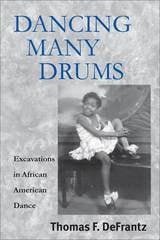
Dancing Many Drums
Excavations In African American DanceThomas F. Defrantz
University of Wisconsin Press, 2002
Few will dispute the profound influence that African American music and movement has had in American and world culture. Dancing Many Drums explores that influence through a groundbreaking collection of essays on African American dance history, theory, and practice. In so doing, it reevaluates "black" and "African American " as both racial and dance categories. Abundantly illustrated, the volume includes images of a wide variety of dance forms and performers, from ring shouts, vaudeville, and social dances to professional dance companies and Hollywood movie dancing.
Bringing together issues of race, gender, politics, history, and dance, Dancing Many Drums ranges widely, including discussions of dance instruction songs, the blues aesthetic, and Katherine Dunham’s controversial ballet about lynching, Southland. In addition, there are two photo essays: the first on African dance in New York by noted dance photographer Mansa Mussa, and another on the 1934 "African opera," Kykunkor, or the Witch Woman.
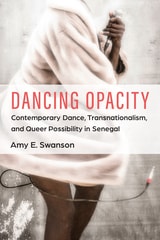
Dancing Opacity
Contemporary Dance, Transnationalism, and Queer Possibility in SenegalAmy E. Swanson
University of Michigan Press, 2025
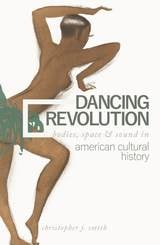
Dancing Revolution
Bodies, Space, and Sound in American Cultural HistoryChristopher J. Smith
University of Illinois Press, 2019
Dancing Revolution presents richly diverse case studies to illuminate these patterns of movement and influence in movement and sound in the history of American public life. Christopher J. Smith spans centuries, geographies, and cultural identities as he delves into a wide range of historical moments. These include the God-intoxicated public demonstrations of Shakers and Ghost Dancers in the First and Second Great Awakenings; creolized antebellum dance in cities from New Orleans to Bristol; the modernism and racial integration that imbued twentieth-century African American popular dance; the revolutionary connotations behind images of dance from Josephine Baker to the Marx Brothers; and public movement's contributions to hip hop, antihegemonic protest, and other contemporary transgressive communities’ physical expressions of dissent and solidarity.
Multidisciplinary and wide-ranging, Dancing Revolution examines how Americans turned the rhythms of history into the movement behind the movements.
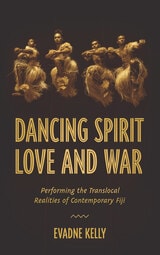
Dancing Spirit, Love, and War
Performing the Translocal Realities of Contemporary FijiEvadne Kelly
University of Wisconsin Press, 2022
Through extensive archival and ethnographic fieldwork in both Fiji and Canada, Kelly offers key insights into an underrepresented dance form, region, and culture. Her perceptive analysis of meke will be of interest in dance studies, postcolonial and Indigenous studies, anthropology and performance ethnography, and Pacific Island studies.

Dancing Wisdom
Embodied Knowledge in Haitian Vodou, Cuban Yoruba, and Bahian CandombléYvonne Daniel
University of Illinois Press, 2005
Combining her background in dance and anthropology to parallel the participant/scholar dichotomy inherent to dancing's "embodied knowledge," Daniel examines these misunderstood and oppressed performative dances in terms of physiology, psychology, philosophy, mathematics, ethics, and aesthetics.
"Dancing Wisdom offers the rare opportunity to see into the world of mystical spiritual belief as articulated and manifested in ritual by dance. Whether it is a Cuban Yoruba dance ritual, slave Ring Shout or contemporary Pentecostal Holy Ghost possession dancing shout, we are able to understand the relationship with spirit through dancing with the Divine. Yvonne Daniel's work synthesizes the cognitive empirical objectivity of an anthropologist with the passionate storytelling of a poetic artist in articulating how dance becomes prayer in ritual for Africans of the Diaspora."
--Leon T. Burrows, Protestant Chaplain, Smith College’
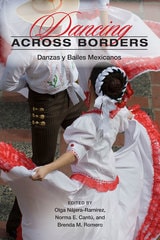
Dancing across Borders
Danzas y Bailes MexicanosEdited by Olga Najera-Ramirez, Norma E. Cantu, and Brenda M. Romero
University of Illinois Press, 2009
Contributors are Norma E. Cantú, Susan Cashion, María Teresa Ceseña, Xóchitl C. Chávez, Adriana Cruz-Manjarrez, Renée de la Torre Castellanos, Peter J. García, Rudy F. García, Chris Goertzen, Martha González, Elisa Diana Huerta, Sydney Hutchinson, Marie "Keta" Miranda, Olga Nájera-Ramírez, Shakina Nayfack, Russell Rodríguez, Brenda M. Romero, Nancy Lee Chalfa Ruyter, José Sánchez Jiménez, and Alberto Zárate Rosales.
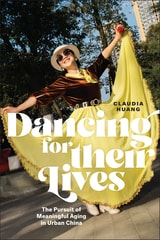
Dancing for Their Lives
The Pursuit of Meaningful Aging in Urban ChinaClaudia Huang
Rutgers University Press, 2025
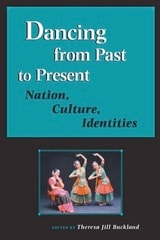
Dancing from Past to Present
Nation, Culture, IdentitiesEdited by Theresa Jill Buckland
University of Wisconsin Press, 2007
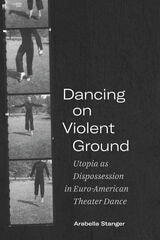
Dancing on Violent Ground
Utopia as Dispossession in Euro-American Theater DanceArabella Stanger
Northwestern University Press, 2021
Developing a new theory of choreographic space, Arabella Stanger shows how embodied forms of hope promised in ballet and progressive dance modernisms conceal and depend on spatial operations of imperial, colonial, and racial subjection. Stanger unearths dance’s violent ground by interrogating the expansionist fantasies of Marius Petipa’s imperial ballet, settler colonial and corporate land practices in the modern dance of Martha Graham and George Balanchine, reactionary discourses of the human in Rudolf von Laban’s and Oskar Schlemmer’s movement geometries; Merce Cunningham’s experimentalism as a white settler fantasy of the land of the free, and the imperial amnesia of Boris Charmatz’s interventions into metropolitan museums. Drawing on materialist thought, critical race theory, and indigenous studies, Stanger ultimately advocates for dance studies to adopt a position of “critical negativity,” an analytical attitude attuned to how dance’s exuberant modeling of certain forms of life might provide cover for life-negating practices. Bold in its arguments and rigorous in its critique, Dancing on Violent Ground asks how performance scholars can develop a practice of thinking hopefully, without expunging history from their site of analysis.
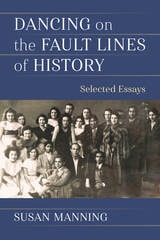
Dancing on the Fault Lines of History
Selected EssaysSusan Manning
University of Michigan Press, 2025
Like the artists at the center of her research, Manning’s writing dances on the fault lines of history. Her introduction and annotations to the essays reflect on how and why these keywords became central to her research, revealing the autobiographical resonances of her scholarship as she confronts the cultural politics of the late twentieth and early twenty-first centuries.
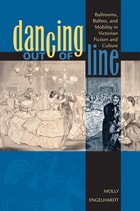
Dancing out of Line
Ballrooms, Ballets, and Mobility in Victorian Fiction and CultureMolly Engelhardt
Ohio University Press, 2009
Dancing out of Line transports readers back to the 1840s, when the craze for social and stage dancing forced Victorians into a complex relationship with the moving body in its most voluble, volatile form.
By partnering cultural discourses with representations of the dance and the dancer in novels such as Jane Eyre, Bleak House, and Daniel Deronda, Molly Engelhardt makes explicit many of the ironies underlying Victorian practices that up to this time have gone unnoticed in critical circles. She analyzes the role of the illustrious dance master, who created and disseminated the manners and moves expected of fashionable society, despite his position as a social outsider of nebulous origins. She describes how the daughters of the social elite were expected to “come out” to society in the ballroom, the most potent space in the cultural imagination for licentious behavior and temptation. These incongruities generated new, progressive ideas about the body, subjectivity, sexuality, and health.
Engelhardt challenges our assumptions about Victorian sensibilities and attitudes toward the sexual/social roles of men and women by bringing together historical voices from various fields to demonstrate the versatility of the dance, not only as a social practice but also as a forum for Victorians to engage in debate about the body and its pleasures and pathologies.
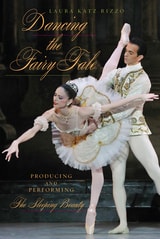
Dancing the Fairy Tale
Producing and Performing The Sleeping BeautyLaura Katz Rizzo
Temple University Press, 2015
Using extensive archival research, dance analysis, and American feminist theory, Dancing the Fairy Tale places women at the center of a historical narrative to reveal how the production and performance of The Sleeping Beauty in the years between 1937 and 2002 made significant contributions to the development and establishment of an American classical ballet. Katz Rizzo highlights not only what women have done not only behind the scenes, as administrators, producers, or directors of ballet companies and schools, but also as active interpreters embodying the ballet's title role.
In the process, Katz Rizzo also emphasizes the importance of regional sites outside of locations traditionally understood as central to the development of ballet in the United States.
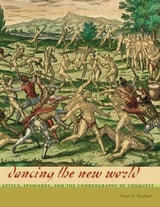
Dancing the New World
Aztecs, Spaniards, and the Choreography of ConquestBy Paul A. Scolieri
University of Texas Press, 2013
Winner, Oscar G. Brockett Book Prize in Dance Research, 2014
Honorable Mention, Sally Banes Publication Prize, American Society for Theatre Research, 2014
de la Torre Bueno® Special Citation, Society of Dance History Scholars, 2013
From Christopher Columbus to “first anthropologist” Friar Bernardino de Sahagún, fifteenth- and sixteenth-century explorers, conquistadors, clerics, scientists, and travelers wrote about the “Indian” dances they encountered throughout the New World. This was especially true of Spanish missionaries who intensively studied and documented native dances in an attempt to identify and eradicate the “idolatrous” behaviors of the Aztec, the largest indigenous empire in Mesoamerica at the time of its European discovery.
Dancing the New World traces the transformation of the Aztec empire into a Spanish colony through written and visual representations of dance in colonial discourse—the vast constellation of chronicles, histories, letters, and travel books by Europeans in and about the New World. Scolieri analyzes how the chroniclers used the Indian dancing body to represent their own experiences of wonder and terror in the New World, as well as to justify, lament, and/or deny their role in its political, spiritual, and physical conquest. He also reveals that Spaniards and Aztecs shared an understanding that dance played an important role in the formation, maintenance, and representation of imperial power, and describes how Spaniards compelled Indians to perform dances that dramatized their own conquest, thereby transforming them into colonial subjects. Scolieri’s pathfinding analysis of the vast colonial “dance archive” conclusively demonstrates that dance played a crucial role in one of the defining moments in modern history—the European colonization of the Americas.
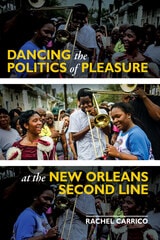
Dancing the Politics of Pleasure at the New Orleans Second Line
Rachel Carrico
University of Illinois Press, 2024
On many Sundays, Black New Orleanians dance through city streets in Second Lines. These processions invite would-be spectators to join in, grooving to an ambulatory brass band for several hours. Though an increasingly popular attraction for tourists, parading provides the second liners themselves with a potent public expression of Black resistance.
Rachel Carrico examines the parading bodies in motion as a form of negotiating and understanding power. Seeing pleasure as a bodily experience, Carrico reveals how second liners’ moves link joy and liberation, self and communal identities, play and dissent, and reclamations of place. As she shows, dancers’ choices allow them to access the pleasure of reclaiming self and city through motion and rhythm while expanding a sense of the possible in the present and for the future.
In-depth and empathetic, Dancing the Politics of Pleasure at the New Orleans Second Line blends analysis with a chorus of Black voices to reveal an indelible facet of Black culture in the Crescent City.
Dancing to Transform
How Concert Dance Becomes Religious in American ChristianityEmily Wright
Intellect Books, 2020
In response to a scarcity of writings on the intersections between dance and Christianity, Dancing to Transform examines the religious lives of American Christians who, despite the historically tenuous place of dance within Christianity, are also professional dancers.
Through a multi-site study of four professional dance companies, Wright conducted participant-observations and ethnographic interviews with artistic directors, choreographers, and company members who self-identify as Christian. She then analyzed choreography from each company to determine how concert dance becomes religious and what effects danced religious practices have for these participants. Her research reveals that the participants turn what they perceive as secular professional dance into different kinds of religious practices in order to actualize individual and communal religious identities—they dance to transform.
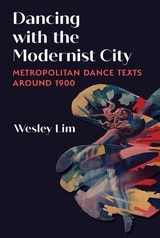
Dancing with the Modernist City
Metropolitan Dance Texts around 1900Wesley Lim
University of Michigan Press, 2024
Drawing on cultural, literary, dance, performance, and queer studies, Dancing with the Modernist City analyzes an array of material from 1896 to 1914—essays, novels, short stories, poetry, newspaper articles, photographs, posters, drawings, and early film. It argues that these writers and artists created a genre called the metropolitan dance text, which depicts dancing figures not on a traditional stage, but with the streets, advertising pillars, theaters, cafes, squares, and even hospitals of an urban setting. Breaking away from the historically male, heteronormative view, this posthumanist mode of writing highlights the visual and episodic unexpectedness of urban encounters. These literary depictions question traditional conceptualizations of space and performance by making the protagonist and the reader feel like they embody the dancer and the movement. In doing so, they upset the conventional depictions of performance and urban spaces in ways paralleling modern dance.
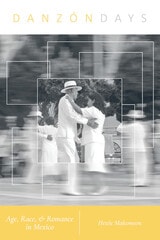
Danzón Days
Age, Race, and Romance in MexicoHettie Malcomson
University of Illinois Press, 2023
Winner of the 2024 BFE Book Prize (British Forum for Ethnomusicology)
Older people negotiating dance routines, intimacy, and racialized differences provide a focal point for an ethnography of danzón in Veracruz, the Mexican city closely associated with the music-dance genre. Hettie Malcomson draws upon on-site research with semi-professional musicians and amateur dancers to reveal how danzón connects, and does not connect, to blackness, joyousness, nostalgia, ageing, and romance. Challenging pervasive utopian views of danzón, Malcomson uses the idea of ambivalence to explore the frictions and opportunities created by seemingly contrary sentiments, ideas, sensations, and impulses. Interspersed with experimental ethnographic vignettes, her account takes readers into black and mestizo elements of local identity in Veracruz, nostalgic and newer styles of music and dance, and the friendships, romances, and rivalries at the heart of regular danzón performance and its complex social world.
Fine-grained and evocative, Danzón Days journeys to one of the genre’s essential cities to provide new perspectives on aging and romance and new explorations of nostalgia and ambivalence.
Days on Earth
The Dance of Doris HumphreyMarcia B. Siegel
Duke University Press, 1993
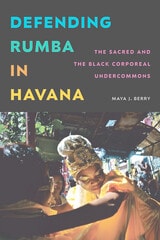
Defending Rumba in Havana
The Sacred and the Black Corporeal UndercommonsMaya J. Berry
Duke University Press, 2025
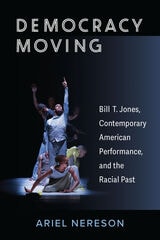
Democracy Moving
Bill T. Jones, Contemporary American Performance, and the Racial PastAriel Nereson
University of Michigan Press, 2022
The project addresses how different communities choose to commemorate historical figures, events, and places through art—whether performance, oratory, song, statuary, or portraiture—and in particular, Black US American counter-memorial practices that address histories of slavery. Advancing the theory of oscillation as Black aesthetic praxis, author Ariel Nereson celebrates Bill T. Jones as a public intellectual whose practice has contributed to the project of understanding America’s relationship to its troubled past. The book features materials from Bill T. Jones/Arnie Zane Company’s largely unexplored archive, interviews with artists, and photos that document this critical stage of Jones’s career as it explores how aesthetics, as ideas in action, can imagine more just and equitable social formations.
Democracy's Body
Judson Dance Theatre, 1962–1964Sally Banes
Duke University Press, 1993
Developing States, Shaping Citizenship
Service Delivery and Political Participation in ZambiaErin Accampo Hern
University of Michigan Press, 2019
Erin Accampo Hern draws on original data from an original large-N survey, interviews, Afrobarometer data, and archival materials collected over 12 months in Zambia. The theory underlying this book’s framework is that of policy feedback, which argues that policies, once in place, influence the subsequent political participation of the affected population. This theory has predominantly been applied to advanced industrial democracies, and this book is the first explicit effort to adapt the theory to the developing country context.
Diamond and Juba
The Raucous World of 19th-Century Challenge DancingApril F. Masten
University of Illinois Press, 2025
Directing the Dance Legacy of Doris Humphrey
The Creative Impulse of ReconstructionLesley Main
University of Wisconsin Press, 2012
Directing the Dance Legacy of Doris Humphrey looks inside four of Doris Humphrey’s major choreographic works—Water Study (1928), The Shakers (1931), With My Red Fires (1936), and Passacaglia (1938)—with an eye to how directorial strategies applied in recent contemporized stagings in the United States and Europe could work across the modern and contemporary dance genre. Author Lesley Main, a seasoned practitioner of Doris Humphrey choreography, stresses to the reader the need to balance respect for classical works from the modern dance repertory with the necessity for fresh directorial strategies, to balance between traditional practices and a creative role for the reconstructor.
Drawing upon her own dance experience, Main’s book addresses an area of dance research and practice that is becoming increasingly pertinent as the dancer-choreographers of the 20th century modern and contemporary dance are no longer alive to attend to the re-stagings of the body of their works. Insightful and thought-provoking, Directing the Dance Legacy of Doris Humphrey calls for the creation of new forms of directorial practice in dance beyond reconstruction. The radical new practices it proposes to replace the old are sure to spark debate and fresh thinking across the dance field.