Results by title
75 books match the query 'Death & Dying' and 4 start with d
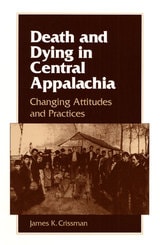
Death and Dying in Central Appalachia
Changing Attitudes and PracticesJames K. Crissman
University of Illinois Press, 1994
James Crissman explores cultural traits related to death and dying in Appalachian sections of Tennessee, Virginia, Kentucky, North Carolina, and West Virginia, showing how they have changed since the 1600s. Relying on archival materials, almost forty photographs, and interviews with more than 400 mountain dwellers, Crissman focuses on the importance of family and "neighborliness" in mountain society.
Written for both scholarly and general audiences, the book contains sections on the death watch, body preparation, selection or construction of a coffin or casket, digging the grave by hand, the wake, the funeral, and other topics. Crissman then demonstrates how technology and the encroachment of American society have turned these vital traditions into the disappearing practices of the past.
Written for both scholarly and general audiences, the book contains sections on the death watch, body preparation, selection or construction of a coffin or casket, digging the grave by hand, the wake, the funeral, and other topics. Crissman then demonstrates how technology and the encroachment of American society have turned these vital traditions into the disappearing practices of the past.
[more]
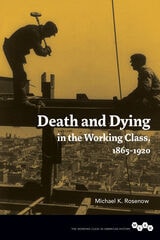
Death and Dying in the Working Class, 1865-1920
Michael K. Rosenow
University of Illinois Press, 2015
Michael K. Rosenow investigates working people's beliefs, rituals of dying, and the politics of death by honing in on three overarching questions: How did workers, their families, and their communities experience death? Did various identities of class, race, gender, and religion coalesce to form distinct cultures of death for working people? And how did people's attitudes toward death reflect notions of who mattered in U.S. society?
Drawing from an eclectic array of sources ranging from Andrew Carnegie to grave markers in Chicago's potter's field, Rosenow portrays the complex political, social, and cultural relationships that fueled the United States' industrial ascent. The result is an undertaking that adds emotional depth to existing history while challenging our understanding of modes of cultural transmission.
Drawing from an eclectic array of sources ranging from Andrew Carnegie to grave markers in Chicago's potter's field, Rosenow portrays the complex political, social, and cultural relationships that fueled the United States' industrial ascent. The result is an undertaking that adds emotional depth to existing history while challenging our understanding of modes of cultural transmission.
[more]
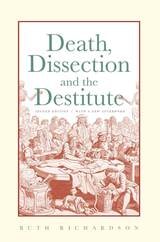
Death, Dissection and the Destitute
Ruth Richardson
University of Chicago Press, 2001
In the early nineteenth century, body snatching was rife because the only corpses available for medical study were those of hanged murderers. With the Anatomy Act of 1832, however, the bodies of those who died destitute in workhouses were appropriated for dissection. At a time when such a procedure was regarded with fear and revulsion, the Anatomy Act effectively rendered dissection a punishment for poverty. Providing both historical and contemporary insights, Death, Dissection, and the Destitute opens rich new prospects in history and history of science. The new afterword draws important parallels between social and medical history and contemporary concerns regarding organs for transplant and human tissue for research.
[more]
Dying Green
A Journey through End-of-Life Medicine in Search of Sustainable Health CareChristine Vatovec
Rutgers University Press, 2023
The slow violence being inflicted on our environment—through everything from carbon emissions to plastic pollution—also represents an impending public health catastrophe. Yet standard health care practices are more concerned with short-term outcomes than long-term sustainability. Every resource used to deliver medical care, from IV tubes to antibiotics to electricity, has a significant environmental impact. This raises an urgent ethical dilemma: in striving to improve the health outcomes of individual patients, are we damaging human health on a global scale?
In Dying Green, award-winning educator Christine Vatovec offers an engaging study that asks us to consider the broader environmental sustainability of health care. Through a comparative analysis of the care provided to terminally ill patients in a conventional cancer ward, a palliative care unit, and an acute-care hospice facility, she shows how decisions made at a patient’s bedside govern the environmental footprint of the healthcare industry. Likewise, Dying Green offers insights on the many opportunities that exist for reducing the ecological impacts of medical practices in general, while also enhancing care for the dying in particular. By envisioning a more sustainable approach to care, this book offers a way forward that is better for both patients and the planet.
In Dying Green, award-winning educator Christine Vatovec offers an engaging study that asks us to consider the broader environmental sustainability of health care. Through a comparative analysis of the care provided to terminally ill patients in a conventional cancer ward, a palliative care unit, and an acute-care hospice facility, she shows how decisions made at a patient’s bedside govern the environmental footprint of the healthcare industry. Likewise, Dying Green offers insights on the many opportunities that exist for reducing the ecological impacts of medical practices in general, while also enhancing care for the dying in particular. By envisioning a more sustainable approach to care, this book offers a way forward that is better for both patients and the planet.
[more]