Results by title
102 books match the query 'Demography' and 6 start with d
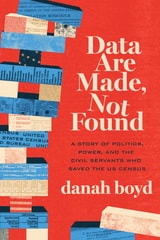
Data Are Made, Not Found
A Story of Politics, Power, and the Civil Servants Who Saved the US Censusdanah boyd
University of Chicago Press, 2026
An eye-opening story of the people who make the census, the United States’ largest and most consequential dataset, and the growing threats to their crucial work.
By many measures, the US census is the government’s largest non-wartime operation, and one of the world’s oldest and biggest data-making endeavors. The 2020 census required more than a decade of planning and technical work—not to mention managing nearly a quarter of a million temporary workers simultaneously—to collect data about the American public. That data was then processed to count each of 331,449,281 residents once—and only once—and in the right place. The operation is also one of the country’s most consequential. Census data determine how political power and federal funding are allocated. Census data make politics, and consequently, politics make census data. In this urgent book, danah boyd explores what it took for the Census Bureau to make the 2020 census, amidst a global pandemic and natural disasters, and while navigating political forces that constrained the budget, micro-managed the schedule, and attacked statisticians’ methods.
With rare insider access to the Census Bureau, boyd observed and interviewed hundreds of government civil servants who made the 2020 census. By documenting the perspectives of government workers, Data Are Made, Not Found provides a rare glimpse into what it takes to make democracy’s data. Each chapter reveals a different challenge—ranging from the last-minute fights about a citizenship question to the not-so-helpful help of well-intended stakeholders to avoid undercounts—and shows how civil servants responded to each problem, controversy, and hurdle. Boyd shows how many of the challenges that the Census Bureau faced in 2020 resulted from decades of political operatives, data users, and various stakeholders playing what boyd calls “Jenga politics,” weakening the administrative state for short-term political gains by removing support and adding more requirements.
Civil servants saved the 2020 census, but future censuses—and other data-making efforts related to elections, health, and the economy—are precarious. Boyd’s message is clear and compelling: protecting democracy means protecting the people and institutions that produce this data.
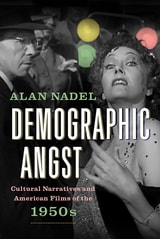
Demographic Angst
Cultural Narratives and American Films of the 1950sNadel, Alan
Rutgers University Press, 2017
Demographic Angst argues that mandated normativity—as a political agenda and a social ethic—precluded explicit expression of the anxiety produced by America’s radically reconfigured postwar population. Alan Nadel explores influential non-fiction books, magazine articles, and public documents in conjunction with films such as Singin’ in the Rain, On the Waterfront, Sunset Boulevard, and Sayonara, to examine how these films worked through fresh anxieties that emerged during the 1950s.
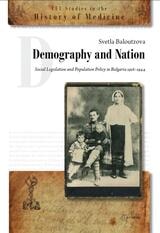
Demography and Nation
Social Legislation and Population Policy in BulgariaSvetla Baloutzova
Central European University Press, 2011
Demography and the Economy
Edited by John B. Shoven
University of Chicago Press, 2010
Demographics is a vital field of study for understanding social and economic change and it has attracted attention in recent years as concerns have grown over the aging populations of developed nations. Demographic studies help make sense of key aspects of the economy, offering insight into trends in fertility, mortality, immigration, and labor force participation, as well as age, gender, and race specific trends in health and disability.
Demography and the Economy explores the connections between demography and economics, paying special attention to what demographic trends can reveal about the sustainability of traditional social security programs and the larger implications for economic growth. The volume brings together some of the leading scholars working at the border between the two disciplines, and it provides an eclectic overview of both fields. Contributors also offer deeper analysis of a variety of issues such as the impact of greater wealth on choices about marriage and childbearing and the effects of aging populations on housing prices, Social Security, and Medicare.
Disciplining Statistics
Demography and Vital Statistics in France and England, 1830–1885Libby Schweber
Duke University Press, 2006
Tracing the introduction and promotion of vital statistics and demography, Schweber identifies the institutional conditions that account for the contrasting styles of reasoning. She shows that the different reactions to statistics stemmed from different criteria for what counted as scientific knowledge. The French wanted certain knowledge, a one-to-one correspondence between observations and numbers. The English adopted an instrumental approach, using the numbers to influence public opinion and evaluate and justify legislation.
Schweber recounts numerous attempts by vital statisticians and demographers to have their work recognized as legitimate scientific pursuits. While the British scientists had greater access to government policy makers, and were able to influence policy in a way that their French counterparts were not, ultimately neither the vital statisticians nor the demographers were able to institutionalize their endeavors. By 1885, both fields had been superseded by new forms of knowledge. Disciplining Statistics highlights how the development of “scientific” knowledge was shaped by interrelated epistemological, political, and institutional considerations.
Diversity and Disparities
America Enters a New CenturyJohn Logan is professor of sociology and director of the Research Initiative on Spatial Structures in the Social Sciences at Brown University and editor of Diversity and Disparities: America Enters a New Century.
Russell Sage Foundation, 2014