Results by title
59 books match the query 'Detective and mystery stories, American' and 3 start with d
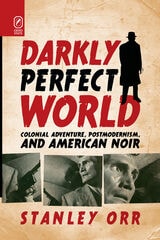
Darkly Perfect World
Colonial Adventure, Postmodernism, and American NoirStanley Orr
The Ohio State University Press, 2010
Stanley Orr’s Darkly Perfect World offers a large-scale historical narrative about the way American crime fiction and film have changed throughout the twentieth century. Orr argues that films noirs and noir fictions dramatize Raymond Chandler’s pronouncement that “Even in death, a man has a right to his own identity.” Orr illuminates a noir ethos committed to “authenticating alienation”: subjectivity managed through radical polarization of Self and Other. Distinguishing a heretofore unrecognized context for American noir, Orr demonstrates that Chandler and Dashiell Hammett arrive at this subject within and against the colonial adventure genre. While the renegades of Joseph Conrad and Louis Becke project a figure vulnerable to shifts in cultural context, the noir protagonist exemplifies alienated selfhood and often performs a “continental operation” against the slippages of the colonial adventurer. But even as Orson Welles, Billy Wilder, and other noir virtuosi persist with this revision of late Victorian adventure, Chester Himes, Dorothy Hughes, and John Okada experiment with hard-boiled alienation for a subversion of noir that resonates throughout literary postmodernism. In their respective avant-garde novels, Thomas Pynchon, Ishmael Reed, and Paul Auster expose what K.W. Jeter terms the “darkly perfect world” of noir, thus giving rise to and enabling the con men and “connected guys” of contemporary films noirs such as Bryan Singer’s The Usual Suspects, David Fincher’s Seven, Christopher Nolan’s Memento, and Quentin Tarantino’s Reservoir Dogs.
[more]
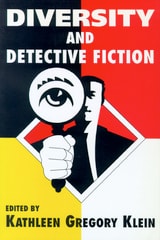
Diversity and Detective Fiction
Kathleen Gregory Klein
University of Wisconsin Press, 1999
The first collection to articulate the pedagogical strategies of using detective fiction to investigate the politics of difference. The volume examines the many ways in which diversity is posited by contemporary writers exploring distinctive American subcultures. The distinguishing characteristic of the book is its mix of essays focusing on teaching cultural diversity in the classroom and illustrating diversity through fiction to the general reader.
Among the issues addressed are definitions of diversity; what constitutes ethnicity or race, especially in terms of multiple subjectivities; how race, gender, and ethnicity are culturally constructed; and what part is played by identity politics.
Among the issues addressed are definitions of diversity; what constitutes ethnicity or race, especially in terms of multiple subjectivities; how race, gender, and ethnicity are culturally constructed; and what part is played by identity politics.
[more]
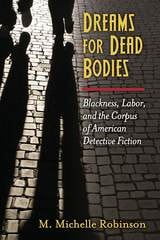
Dreams for Dead Bodies
Blackness, Labor, and the Corpus of American Detective FictionM. Michelle Robinson
University of Michigan Press, 2016
Dreams for Dead Bodies: Blackness, Labor, and the Corpus of American Detective Fiction offers new arguments about the origins of detective fiction in the United States, tracing the lineage of the genre back to unexpected texts and uncovering how authors such as Edgar Allan Poe, Mark Twain, Pauline Hopkins, and Rudolph Fisher made use of the genre’s puzzle-elements to explore the shifting dynamics of race and labor in America.
The author constructs an interracial genealogy of detective fiction to create a nuanced picture of the ways that black and white authors appropriated and cultivated literary conventions that coalesced in a recognizable genre at the turn of the twentieth century. These authors tinkered with detective fiction’s puzzle-elements to address a variety of historical contexts, including the exigencies of chattel slavery, the erosion of working-class solidarities by racial and ethnic competition, and accelerated mass production. Dreams for Dead Bodies demonstrates that nineteenth- and early twentieth-century American literature was broadly engaged with detective fiction, and that authors rehearsed and refined its formal elements in literary works typically relegated to the margins of the genre. By looking at these margins, the book argues, we can better understand the origins and cultural functions of American detective fiction.
The author constructs an interracial genealogy of detective fiction to create a nuanced picture of the ways that black and white authors appropriated and cultivated literary conventions that coalesced in a recognizable genre at the turn of the twentieth century. These authors tinkered with detective fiction’s puzzle-elements to address a variety of historical contexts, including the exigencies of chattel slavery, the erosion of working-class solidarities by racial and ethnic competition, and accelerated mass production. Dreams for Dead Bodies demonstrates that nineteenth- and early twentieth-century American literature was broadly engaged with detective fiction, and that authors rehearsed and refined its formal elements in literary works typically relegated to the margins of the genre. By looking at these margins, the book argues, we can better understand the origins and cultural functions of American detective fiction.
[more]