Results by title
239 books match the query 'Diaries' and 16 start with d

Dance of Values
Sergei Eisenstein’s Capital ProjectElena Vogman
Diaphanes, 2018
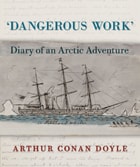
Dangerous Work
Diary of an Arctic AdventureArthur Conan Doyle
University of Chicago Press, 2012
In 1880 a young medical student named Arthur Conan Doyle embarked upon the “first real outstanding adventure” of his life, taking a berth as ship’s surgeon on an Arctic whaler, the Hope. The voyage took him to unknown regions, showered him with dramatic and unexpected experiences, and plunged him into dangerous work on the ice floes of the Arctic seas. He tested himself, overcame the hardships, and, as he wrote later, “came of age at 80 degrees north latitude.”
A special limited, numbered edition of the clothbound book is also available. In addition, a text-only e-book edition is published as Dangerous Work: Diary of an Arctic Adventure, Text-only Edition.
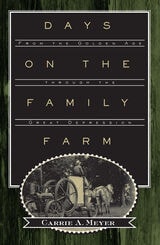
Days on the Family Farm
From the Golden Age through the Great DepressionCarrie A. Meyer
University of Minnesota Press, 2007
From the beginning of the twentieth century to World War II, farm wife May Lyford Davis kept a daily chronicle that today offers a window into a way of life that has all but disappeared. May and her husband Elmo lived through two decades of prosperity, the Great Depression, and two World Wars in their Midwestern farming community. Like many women of her time, Davis kept diaries that captured the everyday events of the family farm; she also kept meticulous farming accounts. In doing so, she left an extraordinary record that reflects not only her own experiences but also the history of early twentieth-century American agriculture.
May and Elmo’s story, engagingly told by Carrie A. Meyer, showcases the large-scale evolution of agriculture from horses to automobile and tractors, a surprisingly vibrant family and community life, and the business of commercial farming. Details such as what items were bought and sold, what was planted and harvested, the temperature and rainfall, births and deaths, and the direction of the wind are gathered to reveal a rich picture of a world shared by many small farmers.
With sustainable and small-scale farming again on the rise in the United States, Days on the Family Farm resonates with both the profound and mundane aspects of rural life—past and present—in the Midwest.
Carrie A. Meyer is associate professor of economics at George Mason University.

Dear World
Contemporary Uses of the DiaryKylie Cardell
University of Wisconsin Press, 2014
In Dear World, Kylie Cardell is sensitive to how changes to our notions of privacy and the personal—spurred by the central presence the Internet has come to occupy in our daily lives—impact how and why diaries are written, and for whom. She considers what these new uses of the diary tell us about the cultural politics of self-representation in a time of mass attention to (and anxiety about) the personal. Cardell sees the twenty-first-century diary as a vibrant and popular cultural practice as much as a literary form, one that plays a key role in mass-mediated notions of authenticity, subjectivity, and truth. Dear World provides much-needed new attention to the innovation, evolution, and persistence of a familiar yet complex autobiographical mode.

Depression
A Public FeelingAnn Cvetkovich
Duke University Press, 2012
Cvetkovich draws on an unusual archive, including accounts of early Christian acedia and spiritual despair, texts connecting the histories of slavery and colonialism with their violent present-day legacies, and utopian spaces created from lesbian feminist practices of crafting. She herself seeks to craft a queer cultural analysis that accounts for depression as a historical category, a felt experience, and a point of entry into discussions about theory, contemporary culture, and everyday life. Depression: A Public Feeling suggests that utopian visions can reside in daily habits and practices, such as writing and yoga, and it highlights the centrality of somatic and felt experience to political activism and social transformation.
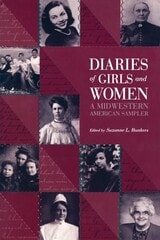
Diaries of Girls and Women
A Midwestern American SamplerSuzanne L. Bunkers
University of Wisconsin Press, 2001
Diaries of Girls and Women captures and preserves the diverse lives of forty-seven girls and women who lived in Minnesota, Iowa, and Wisconsin between 1837 and 1999—young schoolgirls, adolescents coming of age, newlywed wives, mothers grieving the loss of children, teachers, nurses, elderly women, Luxembourger immigrant nuns, and women traveling abroad. A compelling work of living history, it brings together both diaries from historical society archives and diaries still in possession of the diarists or their descendents.
Editor Suzanne L. Bunkers has selected these excerpts from more than 450 diaries she examined. Some diaries were kept only briefly, others through an entire lifetime; some diaries are the intensely private record of a life, others tell the story of an entire family and were meant to be saved and appreciated by future generations. By approaching diaries as historical documents, therapeutic tools, and a form of literature, Bunkers offers readers insight into the self-images of girls and women, the dynamics of families and communities, and the kinds of contributions that girls and women have made, past and present. As a representation of the girls and women of varied historical eras, locales, races, and economic circumstances who settled and populated the Midwest, Diaries of Girls and Women adds texture and pattern to the fabric of American history.
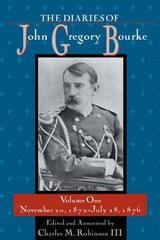
Diaries of John Gregory Bourke Volume 1
November 20, 1872--July 28, 1876Charles M. Robinson III
University of North Texas Press, 2003
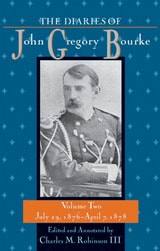
Diaries of John Gregory Bourke Volume 2
July 29, 1876--April 7, 1878Charles M. Robinson III
University of North Texas Press, 2003
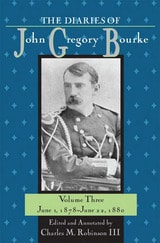
Diaries of John Gregory Bourke Volume 3
June 1, 1878--June 22, 1880Charles M. Robinson III
University of North Texas Press, 2003
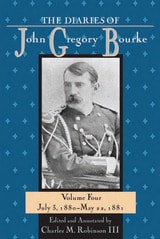
Diaries of John Gregory Bourke Volume 4
July 3, 1880--May 22, 1881Charles M. Robinson III
University of North Texas Press, 2003
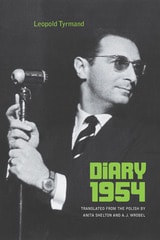
Diary 1954
Leopold Tyrmand
Northwestern University Press, 2014
Leopold Tyrmand, a Polish Jew who survived World War II by working in Germany under a false identity, would go on to live and write under Poland’s Communist regime for twenty years before emigrating to the West, where he continued to express his deeply felt anti-Communist views. Diary 1954—written after the independent weekly paper that employed him was closed for refusing to mourn Stalin’s death—is an account of daily life in Communist Poland. Like Czesław Miłosz, Václav Havel, and other dissidents who described the absurdities of Soviet-backed regimes, Tyrmand exposes the lies—big and small—that the regimes employed to stay in power. Witty and insightful, Tyrmand’s diary is the chronicle of a man who uses seemingly minor modes of resistance—as a provocative journalist, a Warsaw intellectual, the "spiritual father" of Polish hipsters, and a promoter of jazz in Poland—to maintain his freedom of thought.
Diary Volume 1
Witold Gombrowicz
Northwestern University Press, 1988
Diary of Almon Harris Thompson
Explorations of the Colorado River of the West and Its Tributaries, 1871-1875Herbert E Gregory
University of Utah Press, 2009
Originally published in 1939 as volume seven of the Utah Historical Quarterly, Thompson’s journal is reprinted here for the first time in seventy years. Co-published with the Utah State Historical Society.
Diary of Caroline Seabury
Caroline Seabury
University of Wisconsin Press, 1991
In 1854 Caroline Seabury of Brooklyn, New York, set out for Columbus, Mississippi, to teach French at its Institute for Young Ladies. She lived in Columbus until 1863, through the years of mounting sectional bitterness that preceded the Civil War and through the turmoil and hardships of the war itself. During that time, her most intimate confidant was her diary. Discovered in the archives of the Minnesota State Historical Society, it is published here for the first time.
The diary is an illuminating account of southern plantation society and the “peculiar institution” of slavery on the eve of its destruction. Seabury also records her uneasy attempts to come to terms with her position as an unmarried, white, Northern woman whose job was to educate wealthy, white, Southern girls in a setting seemingly oblivious to the horrors of slavery. The diary is not simply a chronicle of daily happenings; Seabury concentrates on remarkable events and the memorable feelings and ideas they generate, shaping them into entries that reveal her as an accomplished writer. She frames her narrative with her journey south in 1854 and the hazardous and exhausting return north through battle lines in 1863.
Disapproving of slavery, yet deeply attached to friends and her life in Columbus and also painfully conscious of the fragility of her own economic and social position, Seabury condemned privately in her diary the evils that she endured silently in public. There are striking scenes of plantation life that depict the brutalities of slavery and benumbed responses to them. Seabury also successfully captures the mood of Mississippi as it changed from a fire-eating appetite to fight the Yankees to a grim apprehension of inexorable defeat. Most impressive of all is Seabury’s poignantly honest presentation of herself, caught in the middle.

Dirty Eddie's War
Based on the World War II Diary of Harry "Dirty Eddie" March, Jr.Lee Cook
University of North Texas Press, 2021
Dominguez Escalante Journal
Their Expedition Through Colorado Utah Az & N Mex 1776Ted J. Warner
University of Utah Press, 1995
Translated by Fray Angelico Chavez, Edited by Ted J. Warner
Western History
The chronicle of Fray Francisco Atanasio Domínguez and Fray Silvestre Vélez de Escalante’s most remarkable 1776 expedition through the Rocky Mountains, the eastern Great Basin, and the Colorado Plateau to inventory new lands for the Spanish crown and to find a route from Santa Fe to Monterey, California.
Escalante’s journal wonderfully describes every detail of the rugged and scenic country through which they journeyed, along the qualities and customs of its inhabitants. Working as far north as present-day Provo, Utah, the expedition finally returned south. An approaching severe winter and mishaps among the maze of the Grand Canyon forced the party to return to Santa Fe by way of the Hopi pueblos.
This journal provides a fascinating account of over a thousand miles of wilderness exploration.