Results by title
54 books match the query 'Diaspora' and 3 start with d

Diaspora and Immigration, Volume 98
V. Y. Mudimbe and Sabine Engel
Duke University Press, 0
Experts from a variety of fields—anthropology, sociology, history, literature, and African, Hispanic, and Jewish studies—examine specific diasporas, immigrant communities, and “border identities” ranging from Muslims in Europe to Chicanos in Texas, from Chinese immigrants in California to the "peach blossom diaspora" in Taiwan. They discuss the Jewish Diaspora and the creation of the State of Israel, as well as two centuries of Irish diasporic experiences in Australia and America. Following testimonies by German, Filipino, Italian American, and South African Israeli academics, who scrutinize their respective "personal diasporas," this special issue concludes with some afterthoughts on diaspora and the potential for global unity in the face of today's global diversity.
Contributors. Jean Bazin, Louis Shabat Bethlehem, Gordon H. Chang, Ngwarsungu Chiwengo, Eileen Cheng-yin Chow, Christopher Davis, Marcel Detienne, Sabine Engel, Daphna Golan, Hans Ulrich Gumbrecht, Ramón A. Gutiérrez, Daniel Itzkovitz, Riva Kastoryano, Vassilis Lambropoulos, V. Y. Mudimbe, Peter Murphy, Richard Roberts, Aron Rodrigue, Ramón Saldívar, Kenneth J. Surin, Neferti Xina M. Tadiar, Marianna De Marco Torgovnick, Danielle Trudeau, Candice Ward, Steven Zipperstein
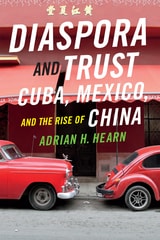
Diaspora and Trust
Cuba, Mexico, and the Rise of ChinaAdrian H. Hearn
Duke University Press, 2016
Displacement, Diaspora, and Geographies of Identity
Smadar Lavie and Ted Swedenburg, eds.
Duke University Press, 1996
This volume exemplifies a cross-disciplinary cultural studies and a concept of culture rooted in lived experience as well as textual readings. Anthropologists and scholars from related fields deploy a range of methodologies and styles of writing to blur and complicate conventional dualisms between authors and subjects of research, home and away, center and periphery, and first and third world. Essays discuss topics such as Rai, a North African pop music viewed as westernized in Algeria and as Arab music in France; the place of Sephardic and Palestinian writers within Israel’s Ashkenazic-dominated arts community; and the use and misuse of the concept “postcolonial” as it is applied in various regional contexts.
In exploring histories of displacement and geographies of identity, these essays call for the reconceptualization of theoretical binarisms such as modern and postmodern, colonial and postcolonial. It will be of interest to a broad spectrum of scholars and students concerned with postmodern and postcolonial theory, ethnography, anthropology, and cultural studies.
Contributors. Norma Alarcón, Edward M. Bruner, Nahum D. Chandler, Ruth Frankenberg, Joan Gross, Dorinne Kondo, Kristin Koptiuch, Smadar Lavie, Lata Mani, David McMurray, Kirin Narayan, Greg Sarris, Ted Swedenburg