Results by title
106 books match the query 'Dictionaries' and 7 start with d
Dictionary Of The Maya Language
As Spoken in Hocaba YucatanVictoria Bricker
University of Utah Press, 1998
The Maya language of Yucatan is known as Yucate by linguists, but its speakers refer to it as May. Dialiectical differences are minimal across the peninsula, and the more than 750,000 speakers of Maya can be understood wherever they go. Moreover, it is not only a living language but is of great use to epigraphers working on ancient Maya glyphs.
This dictionary is the culmination of fourteen years’ labor centering on the town and dialect of Hocaba. Whereas other dictionaries of may use Latin paradigms, this is the first to provide a comprehensive, systematic listing of the stems that can be derived from each root and that give Maya its distinctive character. The entries cover the full range of Maya speech, from simple expressions and idioms to compound stems. Maya sample sentences provide a window into the richness of everyday communication, with its mixture of wit, epithets, insults, riddles, aphorisms, and exchanges of information, including a wonderful assortment of metaphorical expressions like "peccary’s eyelashes" for a type of bean, "the end of the road" for marriage, and a verb meaning "to draw breath with puckered mouth after eating chili." Among the cultural domains encompassed by the dictionary are agriculture, architecture, astronomy, culinary practices and recipes, education, folklore, games, humor, medical prescriptions, ritual, toys, and weaving, many of which have roots in the Precolumbian past. In addition to the dictionary entries, this work also contains a short grammar, a botanical index, and bibliography.
Dictionary for Business & Finance
John V. Terry
University of Arkansas Press, 1995
This revised and expanded edition of the Dictionary for Business & Finance defines terms from every field of business, as well as economics, statistics, and management and many words and expressions from other fields which have been adopted for special use by the business community. In this new edition, John V. Terry has added more than two hundred terms that help define the rapidly changing global economy of the late 1990s—terms like “European Currency Unit,” “Datsu-sara,” and “Keiretsu.” Of particular value to the student and business person alike are appendices for ratios, equations, formulas, abbreviations, and general financial and investment information.
In a clear, easy-to-follow style, Dictionary for Business & Finance goes directly to the business usage of a word or term, making it unnecessary to wade through irrelevant definitions.

Dictionary of Indonesian Islam
Mis Sea#94Howard M. Federspiel
Ohio University Press, 1994
This dictionary will be indispensable to English–speaking students and researchers working in Indonesian or Southeast Asian studies. It will also be useful for scholars working in Bahasa Indonesian, reading texts written about Islam by Indonesian Muslims, as well as for Southeast Asia area scholars generally who are using sources in Western languages.
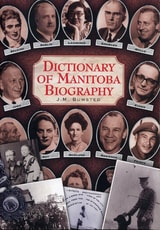
Dictionary of Manitoba Biography
J.M. Bumsted
University of Manitoba Press, 1999
Dictionary of Non-Philosophy
François Laruelle
University of Minnesota Press, 2013
In The Dictionary of Non-Philosophy, the French thinker François Laruelle does something unprecedented for philosophers: he provides an enormous dictionary with a theoretical introduction, carefully crafting his thoughts to explain the numerous terms and neologisms that he deems necessary for the project of non-philosophy. With a collective of thinkers also interested in the project, Laruelle has taken up the difficult task of creating an essential guide for entering into his non-standard, non-philosophical terrain. And for Laruelle, even the idea of a dictionary and what a dictionary is become material for his non-philosophical inquiries. As his opening note begins, “Thus on the surface and within the philosophical folds of the dictionary, identity and its effect upon meaning are what is at stake.”
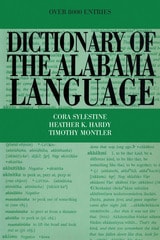
Dictionary of the Alabama Language
By Cora Sylestine, Heather K. Hardy and Timothy Montler
University of Texas Press, 1993
The Alabama language, a member of the Muskogean language family, is spoken today by the several hundred inhabitants of the Alabama-Coushatta Indian Reservation in Polk County, Texas. This dictionary of Alabama was begun over fifty years ago by tribe member Cora Sylestine. She was aided after 1980 by linguists Heather K. Hardy and Timothy Montler, who completed work on the dictionary after her death.
This state-of-the-art analytical dictionary contains over 8,000 entries of roots, stems, and compounds in the Alabama-English section. Each entry contains precise definitions, full grammatical analyses, agreement and other part-of-speech classifications, variant pronunciations, example sentences, and extensive cross-references to stem entries. The Alabama-English section is followed by a thorough English-Alabama finder list that functions as a full index to the definitions in the Alabama-English section.
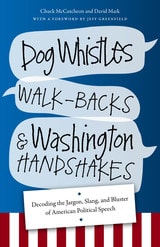
Dog Whistles, Walk-Backs, and Washington Handshakes
Decoding the Jargon, Slang, and Bluster of American Political SpeechChuck McCutcheon and David Mark
University Press of New England, 2014