Results by title
65 books match the query 'Difference' and 7 start with d

Death beyond Disavowal
The Impossible Politics of DifferenceGrace Kyungwon Hong
University of Minnesota Press, 2015
Death beyond Disavowal utilizes “difference” as theorized by women of color feminists to analyze works of cultural production by people of color as expressing a powerful antidote to the erasures of contemporary neoliberalism.
According to Grace Kyungwon Hong, neoliberalism is first and foremost a structure of disavowal enacted as a reaction to the successes of the movements for decolonization, desegregation, and liberation of the post–World War II era. It emphasizes the selective and uneven affirmation and incorporation of subjects and ideas that were formerly categorically marginalized, particularly through invitation into reproductive respectability. It does so in order to suggest that racial, gendered, and sexualized violence and inequity are conditions of the past, rather than the foundations of contemporary neoliberalism’s exacerbation of premature death. Neoliberal ideologies hold out the promise of protection from premature death in exchange for complicity with this pretense.
In Audre Lorde’s Sister Outsider, Cherríe Moraga’s The Last Generation and Waiting in the Wings, Oscar Zeta Acosta’s The Revolt of the Cockroach People, Ana Castillo’s So Far from God, Gayl Jones’s Corregidora, Isaac Julien’s Looking for Langston, Inge Blackman’s B. D. Women, Rodney Evans’s Brother to Brother, and the work of the late Barbara Christian, Death beyond Disavowal finds the memories of death and precarity that neoliberal ideologies attempt to erase.
Hong posits cultural production as a compelling rejoinder to neoliberalism’s violences. She situates women of color feminism, often dismissed as narrow or limited in its effect, as a potent diagnosis of and alternative to such violences. And she argues for the importance of women of color feminism to any critical engagement with contemporary neoliberalism.
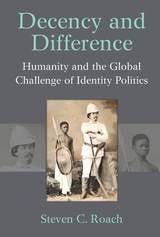
Decency and Difference
Humanity and the Global Challenge of Identity PoliticsSteven C. Roach
University of Michigan Press, 2019
Decency remains one of the most prevalent yet least understood terms in today’s political discourse. In evoking respect, kindness, courage, integrity, reason, and tolerance, it has long expressed an unquestioned duty and belief in promoting and protecting the dignity of all persons. Today this unquestioned belief is in crisis. Tribalism and identity politics have both hindered and threatened its moral stability and efficacy. Still, many continue to undertheorize its political character by isolating it from the effects of identity politics. Decency and Difference argues that decency is a primary source of the political tension that has long shaped the struggles for power, identity, and justice in the global arena. It distinguishes among basic, conservative, and liberal strands of decency to critically examine the many conflicting and competing applications of decency in global politics. Together these different strands reflect a long and uneven evolution from the British and American empires to a global network of justice. This powerful book exposes the gaps of decency and the disparate ways it is practiced, thus addressing the global challenge of configuring a diverse political ethic of decency.

Deconstruction, Feminist Theology, and the Problem of Difference
Subverting the Race/Gender DivideEllen T. Armour
University of Chicago Press, 1999
Armour shows how the writings of Jacques Derrida and Luce Irigaray can be used to uncover feminism's white presumptions so that race and gender can be thought of differently. In clear, concise terms she explores the possibilities and limitations for feminist theology of Derrida's conception of "woman" and Irigaray's "multiple woman," as well as Derrida's thinking on race and Irigaray's work on religion. Armour then points a way beyond the race/gender divide with the help of African-American theorists such as bell hooks, Hortense Spillers, and Patricia Hill Collins.
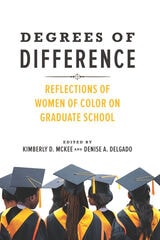
Degrees of Difference
Reflections of Women of Color on Graduate SchoolEdited by Kimberly D. McKee and Denise A. Delgado
University of Illinois Press, 2020
In Degrees of Difference, women of color from diverse backgrounds give frank, unapologetic accounts of their battles—both internal and external—to navigate grad school and fulfill their ambitions. At the same time, the authors offer strategies for surviving the grind via stories of their own hard-won successes with self-care, building supportive communities, finding like-minded mentors, and resisting racism and unsupportive faculty and colleagues.
Contributors: Aeriel A. Ashlee, Denise A. Delgado, Nwadiogo I. Ejiogu, Delia Fernández, Regina Emily Idoate, Karen J. Leong, Kimberly D. McKee, Délice Mugabo, Carrie Sampson, Arianna Taboada, Jenny Heijun Wills, and Soha Youssef
Difference and Givenness
Deleuze's Transcendental Empiricism and the Ontology of ImmanenceLevi R Bryant
Northwestern University Press, 2008
From one end of his philosophical work to the other, Gilles Deleuze consistently described his position as a transcendental empiricism. But just what is transcendental about Deleuze’s transcendental empiricism? And how does his position fit with the traditional empiricism articulated by Hume? In Difference and Givenness, Levi Bryant addresses these long-neglected questions so critical to an understanding of Deleuze’s thinking. Through a close examination of Deleuze’s independent work--focusing especially on Difference and Repetition--as well as his engagement with thinkers such as Kant, Maïmon, Bergson, and Simondon, Bryant sets out to unearth Deleuze’s transcendental empiricism and to show how it differs from transcendental idealism, absolute idealism, and traditional empiricism.
What emerges from these efforts is a metaphysics that strives to articulate the conditions for real existence, capable of accounting for the individual itself without falling into conceptual or essentialist abstraction. In Bryant’s analysis, Deleuze’s metaphysics articulates an account of being as process or creative individuation based on difference, as well as a challenging critique--and explanation--of essentialist substance ontologies. A clear and powerful discussion of how Deleuze’s project relates to two of the most influential strains in the history of philosophy, this book will prove essential to anyone seeking to understand Deleuze’s thought and its specific contribution to metaphysics and epistemology.

Dilemmas of Difference
Indigenous Women and the Limits of Postcolonial Development PolicySarah A. Radcliffe
Duke University Press, 2015

Dreams of Difference, Songs of the Same
The Musical Moment in FilmAmy Herzog
University of Minnesota Press, 2009
Musical spectacles are excessive and abstract, reconfiguring time and space and creating intense bodily responses. Amy Herzog's engaging work examines those instances where music and movement erupt from within more linear narrative frameworks. The representational strategies found in these films are often formulaic, repeating familiar story lines and stereotypical depictions of race, gender, and class. Yet she finds the musical moment contains a powerful disruptive potential.
Dreams of Difference, Songs of the Same investigates the tension and the fusion of difference and repetition in films to ask, How does the musical moment work? Herzog looks at an eclectic mix of works, including the Soundie and Scopitone jukebox films, the musicals of French director Jacques Demy, the synchronized swimming spectacles of Esther Williams, and an apocalyptic musical by Taiwanese director Tsai Ming-liang. Several refrains circulate among these texts: their reliance on clichés, their rewriting of cultural narratives, and their hallucinatory treatment of memory and history.
Drawing on the philosophical work of Gilles Deleuze, she explores all of these dissonances as productive forces, and in doing so demonstrates the transformative power of the unexpected.