Results by title
74 books match the query 'Discourse analysis' and 6 start with d
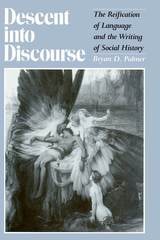
Descent Into Discourse
The Reification of Language and the Writing of Social HistoryBryan Palmer
Temple University Press, 1990
"Critical theory is no substitute for historical materialism; language is not life." With this statement, Bryan Palmer enters the debate that is now transforming and disrupting a number of academic disciplines, including political science, women’s studies, and history. Focusing on the ways in which literary or critical theory is being promoted within the field of social history, he argues forcefully that the current reliance on poststructuralism—with its reification of discourse and avoidance of the structures of oppression and struggles of resistance—obscures the origins, meanings, and consequences of historical events and processes.
Palmer is concerned with the emergence of "language" as a central focus of intellectual work in the twentieth century. He locates the implosion of theory that moved structuralism in the direction of poststructuralism and deconstruction in what he calls the descent into discourse. Few historians who champion poststructuralist thought, according to Palmer, appreciate historical materialism’s capacity to address discourse meaningfully. Nor do many of the advocates of language within the field of social history have an adequate grounding in the theoretical making of the project they champion so ardently. Palmer roots his polemical challenge in an effort to "introduce historians more fully to the theoretical writing that many are alluding to and drawing from rather cavalierly."
Descent into Discourse counters current intellectual fashion with an eloquent argument for the necessity to analyze and appreciate lived experience and the structures of subordination and power in any quest for historical meaning.
Disciplinary Discourses, Michigan Classics Ed.
Social Interactions in Academic WritingKen Hyland
University of Michigan Press, 2004
As issues of linguistic and rhetorical expression of disciplinary conventions are becoming more central to teachers, students, and researchers, the careful analysis and straightforward style of Disciplinary Discourses make it a remarkable asset.
The Michigan Classics Edition features a new preface by the author and a new foreword by John M. Swales.
Discontinuous NPs in German
A Case Study of the Interaction of Syntax, Semantics, and PragmaticsKordula De Kuthy
CSLI, 2002
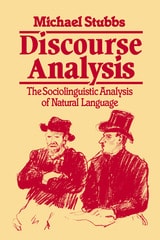
Discourse Analysis
The Sociolinguistic Analysis of Natural LanguageMichael Stubbs
University of Chicago Press, 1983
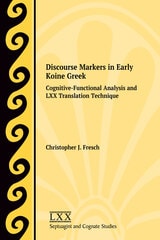
Discourse Markers in Early Koine Greek
Cognitive-Functional Analysis and LXX Translation TechniqueChristopher J. Fresch
SBL Press, 2023
Using a cognitive-functional linguistic framework and cross-linguistic research on discourse markers, Christopher J. Fresch investigates the use of five discourse markers in the documentary papyri of the third to first centuries BCE and the Greek translations of the Hebrew Bible. Through this analysis, Fresch proposes linguistically grounded descriptions for how each discourse marker uniquely functions to guide readers in how they process and comprehend the text. Based on these descriptions, he examines the instances of these discourse markers in the Greek translation of the Minor Prophets and how the translator used them to render the Hebrew text. Fresch presents a picture of a translator who selected discourse markers based on their own understanding of the structure, flow, and meaning of the underlying Hebrew text. Their use attests to a translator who was contextually aware and who desired to produce a translation in idiomatic Koine.
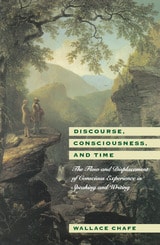
Discourse, Consciousness, and Time
The Flow and Displacement of Conscious Experience in Speaking and WritingWallace Chafe
University of Chicago Press, 1994
Chafe draws on several decades of research to demonstrate that understanding the nature of consciousness is essential to understanding many linguistic phenomena, such as pronouns, tense, clause structure, and intonation, as well as stylistic usages, such as the historical present and the free indirect style. While the book focuses on English, there are also discussions of the North American Indian language Seneca and the music of Mozart and of the Seneca people.
This work offers a comprehensive picture of the dynamic natures of language and consciousness that will interest linguists, psychologists, literary scholars, computer scientists, anthropologists, and philosophers.