138 books match the query 'Discovery and exploration' and 4 start with d
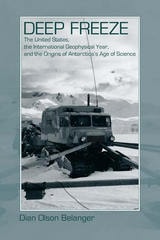
cover of Deep Freeze: The United States, the International Geophysical Year, and the Origins of Antarctica's Age of Science

Deep Freeze

The United States, the International Geophysical Year, and the Origins of Antarctica's Age of Science

Dian Olson Belanger

University Press of Colorado, 2006

In Deep Freeze, Dian Olson Belanger tells the story of the pioneers who built viable communities, made vital scientific discoveries, and established Antarctica as a continent dedicated to peace and the pursuit of science, decades after the first explorers planted flags in the ice.

In the tense 1950s, even as the world was locked in the Cold War, U.S. scientists, maintained by the Navy's Operation Deep Freeze, came together in Antarctica with counterparts from eleven other countries to participate in the International Geophysical Year (IGY). On July 1, 1957, they began systematic, simultaneous scientific observations of the south-polar ice and atmosphere. Their collaborative success over eighteen months inspired the Antarctic Treaty of 1959, which formalized their peaceful pursuit of scientific knowledge. Still building on the achievements of the individuals and distrustful nations thrown together by the IGY from mutually wary military, scientific, and political cultures, science prospers today and peace endures.

The year 2007 marked the fiftieth anniversary of the IGY and the commencement of a new International Polar Year - a compelling moment to review what a singular enterprise accomplished in a troubled time. Belanger draws from interviews, diaries, memoirs, and official records to weave together the first thorough study of the dawn of Antarctica's scientific age. Deep Freeze offers absorbing reading for those who have ventured onto Antarctic ice and those who dream of it, as well as historians, scientists, and policy makers.
[more]
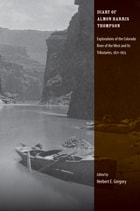
cover of Diary of Almon Harris Thompson: Explorations of the Colorado River of the West and Its Tributaries, 1871-1875

Diary of Almon Harris Thompson

Explorations of the Colorado River of the West and Its Tributaries, 1871-1875

Herbert E Gregory

University of Utah Press, 2009

In some respects the most important of the early Colorado River exploration journals, the diaries of Almon Harris Thompson can naturally be divided into three sections: navigation of the Green and Colorado rivers; exploratory traverse from Kanab to the mouth of the Fremont River; and the systematic mapping of central, eastern, and southern Utah and northern Arizona. Thompson’s maps of the Colorado drainage basin, including the first maps of southern Utah and the canyons of the Green and Colorado rivers, place him in the front rank of geographic explorers and they proved invaluable to the later Powell expedition.

Originally published in 1939 as volume seven of the Utah Historical Quarterly, Thompson’s journal is reprinted here for the first time in seventy years. Co-published with the Utah State Historical Society.
[more]
cover of Discoverers, Explorers, Settlers: The Diligent Writers of Early America

Discoverers, Explorers, Settlers

The Diligent Writers of Early America

Wayne Franklin

University of Chicago Press, 1979
"Send those on land that will show themselves diligent writers." So urged the "sailing instructions" prepared for explorer Henry Hudson. With distinctive command of the primary texts created by such "diligent writers" as Columbus, William Bradford, and Thomas Jefferson, Wayne Franklin describes how the New World was created from their new words. The long verbal discovery of America, he asserts, entailed both advance and retreat, sudden insights and blind insistence on old ways of seeing. The discoverers, explorers, and settlers depicted America in words—or via maps, tables, and landscape views—as a complex spatial and political entity, a place where ancient formula and current fact were inevitably at odds.
[more]
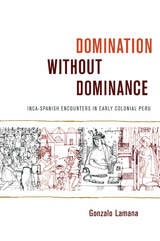
cover of Domination without Dominance: Inca-Spanish Encounters in Early Colonial Peru

Domination without Dominance

Inca-Spanish Encounters in Early Colonial Peru

Gonzalo Lamana

Duke University Press, 2008

Offering an alternative narrative of the conquest of the Incas, Gonzalo Lamana both examines and shifts away from the colonial imprint that still permeates most accounts of the conquest. Lamana focuses on a key moment of transition: the years that bridged the first contact between Spanish conquistadores and Andean peoples in 1531 and the moment, around 1550, when a functioning colonial regime emerged. Using published accounts and array of archival sources, he focuses on questions of subalternization, meaning making, copying, and exotization, which proved crucial to both the Spaniards and the Incas. On the one hand, he re-inserts different epistemologies into the conquest narrative, making central to the plot often-dismissed, discrepant stories such as books that were expected to talk and year-long attacks that could only be launched under a full moon. On the other hand, he questions the dominant image of a clear distinction between Inca and Spaniard, showing instead that on the battlefield as much as in everyday arenas such as conversion, market exchanges, politics, and land tenure, the parties blurred into each other in repeated instances of mimicry.

Lamana’s redefinition of the order of things reveals that, contrary to the conquerors’ accounts, what the Spanairds achieved was a “domination without dominance.” This conclusion undermines common ideas of Spanish (and Western) superiority. It shows that casting order as a by-product of military action rests on a pervasive fallacy: the translation of military superiority into cultural superiority. In constant dialogue with critical thinking from different disciplines and traditions, Lamana illuminates how this new interpretation of the conquest of the Incas revises current understandings of Western colonialism and the emergence of still-current global configurations.

[more]