Results by title
230 books match the query 'Doctrines' and 9 start with d
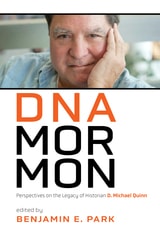
DNA Mormon
Perspectives on the Legacy of Historian D. Michael QuinnBenjamin E. Park
Signature Books, 2022
Few lives have been as consequential for modern Mormonism as D. Michael Quinn. The son of a Mexican immigrant father and a California Mormon mother, Quinn became an influential participant in the New Mormon History movement. Much of his scholarly work remains classic in the field. Yet while he was publicly celebrated for his award-winning books and articles, he privately struggled to reconcile his sexuality with his faith. Eventually, his revisionist scholarship and homosexuality placed him in the crosshairs of church leaders, and he was excommunicated as one of the September Six in 1993.
This compilation is a rigorous and riveting assessment of Quinn’s legacy. In this volume, scholars examine him as a historical figure who helps us better understand modern Mormonism. They also probe his role as a historiographical titan. These essays enable us to analyze his influence on scholarship that both preceded and followed him. More than an investigation into his life and work, DNA Mormon uncovers the world in which he lived.
This compilation is a rigorous and riveting assessment of Quinn’s legacy. In this volume, scholars examine him as a historical figure who helps us better understand modern Mormonism. They also probe his role as a historiographical titan. These essays enable us to analyze his influence on scholarship that both preceded and followed him. More than an investigation into his life and work, DNA Mormon uncovers the world in which he lived.
[more]
Dark Passages of the Bible
Matthew J. Ramage
Catholic University of America Press, 2013
Following the lead of Pope Benedict XVI, in Dark Passages of the Bible Matthew Ramage weds the historical-critical approach with a theological reading of Scripture based in the patristic-medieval tradition. Whereas these two approaches are often viewed as mutually exclusive or even contradictory, Ramage insists that the two are mutually enriching and necessary for doing justice to the Bibles most challenging texts.
[more]
Death, Judgement, Heaven, and Hell
Edward Condon
Catholic University of America Press, 2019
In this volume, canon lawyer and writer Edward Condon compiles a book full of wisdom and compelling insights. More than anything, the Fathers warn us that our life is short, and the reckoning for how we have lived it eternal. The urgency of the Church’s message, brought to life in the sayings of the Fathers, comes to remind us of our true calling and inheritance in baptism, and of the richness of the heavenly reward, which is not so much the fruit of our efforts on Earth but the fulfillment of God’s promise of love to us. The terror of hell is not the threat of the dictator, but a dire warning of the true scope of our freedom as children of God.
[more]
Decolonizing Mormonism
Approaching a Postcolonial ZionEdited by Gina Colvin and Joanna Brooks
University of Utah Press, 2018
This volume seeks nothing less than to shift the focus of Mormon studies from its historic North American, Euro-American “center” to the critical questions being raised by Mormons living at the movement’s cultural and geographic margins.
As a social institution, Mormonism is shaped around cultural notions, systems, and ideas that have currency in the United States but make less sense beyond the land of its genesis. Even as an avowedly international religion some 183 years out from its inception, it makes few allowances for diverse international contexts, with Salt Lake City prescribing programs, policies, curricula, leadership, and edicts for the church’s international regions. While Mormonism’s greatest strength is its organizational coherence, there is also a cost paid for those at the church’s peripheries.
Decolonizing Mormonism brings together the work of 15 scholars from around the globe who critically reflect on global Mormon experiences and American-Mormon cultural imperialism. Indigenous, minority, and Global South Mormons ask in unison: what is the relationship between Mormonism and imperialism and where must the Mormon movement go in order to achieve its long-cherished dream of equality for all in Zion? Their stories are both heartbreaking and heartening and provide a rich resource for thinking about the future of Mormon missiology and the possibilities inherent in the work of Mormon contextual theology.
[more]
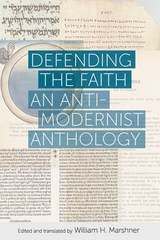
Defending the Faith
William H. Marshner
Catholic University of America Press, 2016
At the dawn of the 20th Century, several writers who were to become famous under the title of "Modernists" were advancing a deep agenda for reform in the faith and praxis of the Roman Catholic Church. But their agenda met with serious and scholarly opposition from another group of writers, whose essays are here made available in English. They include the historian and university rector Pierre Battifol, the biblical exegete M.J. Lagrange, OP, the Jesuit historical theologians Eugène Portalié and Léonce de Grandmaison, and the philosophers Eugène Franon and Joannès Wehrlé. All welcomed the historico-critical methods of research, and far from thinking them fatal to orthodoxy (as the Modernists did), they thought the Church's faith would survive and be strengthened by rigorous scholarship. These thinkers, then, are the true predecessors of Pius XII (Divino afflante Spiritu) and Vatican II (Dei Verbum). At the same time, these men thought outside the boxes drawn by 19th Century Positivism (Loisy), anti-intellectualist pragmatism (LeRoy), and romantic mysticism (Tyrrell). Their concerns hold new significance in the light of John Paul II's 1990 encyclical Fides et Ratio. Reading these too-long forgotten writers, then, deepens in a new way one's understanding of the Catholic Church's decision to decline and even condemn the Modernists' agenda, whether one ultimately applauds that decision or deplores it.
[more]
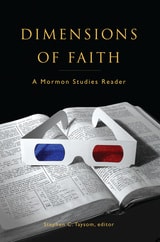
Dimensions of Faith
A Mormon Studies ReaderStephen C. Taysom
Signature Books, 2011
In the brief time between when the alarm clock rings and the start of the day, we usually cherish those few extra moments of warmth in the sheets. However, soon enough we’re happy to be up and about, exploring the world around us. Similarly with religious studies, we may cling to the comforts of the past—what we find familiar in our faith—but then curiosity and conscience pull us to new revelations and sources of knowledge.
In these seventeen articles on things Mormon—prominent people, religious experience, memory, media, literature, and investigative theory—there is an obvious respect for the past and simultaneous desire to get to the bottom of things, to test the boundaries of knowledge. For instance, Jonathan Stapley and Kristine Wright look at the history of ritual healing within Mormonism, including the use of magic handkerchiefs and blessings performed by women. Matthew Bowman’s essay on “A Mormon Bigfoot” looks at the story retold in Sunday school and elsewhere about an early Church apostle who saw the biblical Cain. Brian Stuy examines Church President Wilford Woodruff’s account of the American founding fathers reaching from beyond the grave—a summons the prophet responded favorably to—requesting temple baptisms on their behalf. Unknown to Woodruff, this ordinance had been performed the year before. And Kathleen Flake looks at how the First Vision and other founding narratives were not emphasized in the Church until the twentieth century.
Other contributors include Gary James Bergera, Martha Bradley, Newell Bringhurst, Samuel Brown, Claudia Bushman, Brian Cannon, Douglas Davies, Rebecca de Schweinitz, Lawrence Foster, Reinhold Hill, and Jacob Olmstead.
[more]
Doctrinal Sermons on the Catechism of the Catholic Church
Kenneth Baker
St. Augustine's Press, 2012
[more]
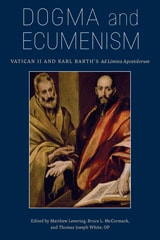
Dogma and Ecumenism
Vatican II and Karl Barth's 'Ad Limina Apostolorum'Matthew Levering
Catholic University of America Press, 2020
The conversation of this book is structured around five major documents from the Second Vatican Council, each of which Barth commented upon in his short but penetrating response to the Council, published as Ad Limina Apostolorum. In the two opening essays, Thomas Joseph White reflects upon the contribution that this book seeks to make to contemporary ecumenism rooted in awareness of the value of dogmatic theology; and Matthew Levering explores the way in which Barth’s Ad Limina Apostolorum flows from his preconciliar dialogues with Catholic representatives of the nouvelle théologie and remain relevant to the issues facing Catholic theology today. The next two essays turn to Dei Verbum, the Dogmatic Constitution on Divine Revelation; here Katherine Sonderegger (Protestant) reflects on scripture and Lewis Ayres (Catholic) reflects on tradition. The next two essays address the Dogmatic Constitution on the Church, Lumen Gentium, which touches upon central differences of Catholic and Protestant self-understanding. Christoph Schwöbel (Protestant) analyzes visible ecclesial identity as conceived in a Protestant context, while Thomas Joseph White (Catholic) engages Barth’s Reformed criticisms of the Catholic notion of the Church. The next two essays take up Nostra Aetate: Bruce Lindley McCormack (Protestant) asks whether it is true to say that Muslims worship the same God as Christians, and Bruce D. Marshall (Catholic) explores the implications of the Council’s reflections on the Jewish people. The next two essays take up the Pastoral Constitution on the Church in the Modern World, Gaudium et Spes: John Bowlin (Protestant) makes use of the thought of Aquinas to consider the promise and perils of the document, while Francesca Aran Murphy (Catholic) engages critically with George Lindbeck’s analysis of the document. The next two essays explore Unitatis Redintegratio: Hans Boersma (Protestant) asks whether the ecumenical intention of the document is impaired by its insistence that the unity of the Church is already present in the Catholic Church, and Reinhard Hütter (Catholic) systematically addresses Barth’s questions regarding the document. The noted ecumenist and Catholic theologian Richard Schenk brings the volume to a close by reflecting on “true and false ecumenism” in the post-conciliar period.
[more]
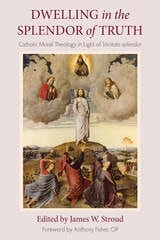
Dwelling in the Splendor of Truth
Catholic Moral Theology in Light of <i>Veritatis splendor</i>James W. Stroud
Catholic University of America Press, 2026
On August 6, 1993, Pope John Paul II promulgated the long-awaited encyclical on moral theology entitled Veritatis splendor. In this landmark encyclical, directed principally toward bishops, Pope John Paul II sought a reset of the discipline of Catholic moral theology after the Second Vatican Council in response to the theological dissent that had called into question the foundations of Catholic morality.
More than thirty years after the promulgation of Veritatis splendor, the essays in this edited volume consider the major themes and topics of this encyclical as it seeks to contribute to the revitalization of moral theology today. These themes and topics include: the rich young man and the renewal of moral theology, freedom, nature, and law, conscience, intrinsically evil acts, the state of revisionism, the moral object, martyrdom and morality, evangelization, the role of the moral theologian, and the role of scripture in moral theology.
Contributors include: William C. Mattison, III, Irene Alexander, Matthew Levering, Matthew Dugandzic, James W. Stroud, Stephen L. Brock, Patrick Clark, Timothy P. O’Malley, Jana Marguerite Bennet, John Grabowski, with a foreword by Archbishop of Sydney Anthony Fisher, OP.
[more]