Results by title
126 books match the query 'Early modern, 1500-1700' and 3 start with d
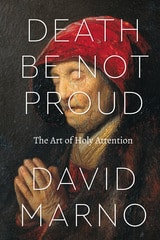
Death Be Not Proud
The Art of Holy AttentionDavid Marno
University of Chicago Press, 2016
The seventeenth-century French philosopher Nicolas Malebranche thought that philosophy could learn a valuable lesson from prayer, which teaches us how to attend, wait, and be open for what might happen next. Death Be Not Proud explores the precedents of Malebranche’s advice by reading John Donne’s poetic prayers in the context of what David Marno calls the “art of holy attention.”
If, in Malebranche’s view, attention is a hidden bond between religion and philosophy, devotional poetry is the area where this bond becomes visible. Marno shows that in works like “Death be not proud,” Donne’s most triumphant poem about the resurrection, the goal is to allow the poem’s speaker to experience a given doctrine as his own thought, as an idea occurring to him. But while the thought must feel like an unexpected event for the speaker, the poem itself is a careful preparation for it. And the key to this preparation is attention, the only state in which the speaker can perceive the doctrine as a cognitive gift. Along the way, Marno illuminates why attention is required in Christian devotion in the first place and uncovers a tradition of battling distraction that spans from ascetic thinkers and Church Fathers to Catholic spiritual exercises and Protestant prayer manuals.
If, in Malebranche’s view, attention is a hidden bond between religion and philosophy, devotional poetry is the area where this bond becomes visible. Marno shows that in works like “Death be not proud,” Donne’s most triumphant poem about the resurrection, the goal is to allow the poem’s speaker to experience a given doctrine as his own thought, as an idea occurring to him. But while the thought must feel like an unexpected event for the speaker, the poem itself is a careful preparation for it. And the key to this preparation is attention, the only state in which the speaker can perceive the doctrine as a cognitive gift. Along the way, Marno illuminates why attention is required in Christian devotion in the first place and uncovers a tradition of battling distraction that spans from ascetic thinkers and Church Fathers to Catholic spiritual exercises and Protestant prayer manuals.
[more]
Dissing Elizabeth
Negative Representations of GlorianaJulia M. Walker, ed.
Duke University Press, 1998
Dissing Elizabeth focuses on the criticism that cast a shadow on the otherwise celebrated reign of Elizabeth I. The essays in this politically and historically revealing book demonstrate the sheer pervasiveness and range of rhetoric against the queen, illuminating the provocative discourse of disrespect and dissent that existed over an eighty-year period, from her troubled days as a princess to the decades after her death in 1603.
As editor Julia M. Walker suggests, the breadth of dissent considered in this collection points to a dark side of the Cult of Elizabeth. Reevaluating neglected texts that had not previously been perceived as critical of the queen or worthy of critical appraisal, contributors consider dissent in a variety of forms, including artwork representing (and mocking) the queen, erotic and pornographic metaphors for Elizabeth in the popular press, sermons subtly critiquing her actions, and even the hostility encoded in her epitaph and in the placement of her tomb. Other chapters discuss gossip about Elizabeth, effigies of the queen, polemics against her marriage to the Duke of Alençon, common verbal slander, violence against emblems of her authority, and the criticism embedded in the riddles, satires, and literature of the period.
As editor Julia M. Walker suggests, the breadth of dissent considered in this collection points to a dark side of the Cult of Elizabeth. Reevaluating neglected texts that had not previously been perceived as critical of the queen or worthy of critical appraisal, contributors consider dissent in a variety of forms, including artwork representing (and mocking) the queen, erotic and pornographic metaphors for Elizabeth in the popular press, sermons subtly critiquing her actions, and even the hostility encoded in her epitaph and in the placement of her tomb. Other chapters discuss gossip about Elizabeth, effigies of the queen, polemics against her marriage to the Duke of Alençon, common verbal slander, violence against emblems of her authority, and the criticism embedded in the riddles, satires, and literature of the period.
[more]
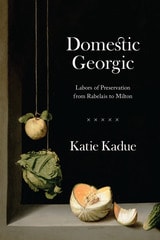
Domestic Georgic
Labors of Preservation from Rabelais to MiltonKatie Kadue
University of Chicago Press, 2021
Inspired by Virgil’s Georgics, this study conceptualizes Renaissance poetry as a domestic labor.
When is literary production more menial than inspired, more like housework than heroics of the mind? In this revisionist study, Katie Kadue shows that some of the authors we credit with groundbreaking literary feats—including Michel de Montaigne and John Milton—conceived of their writing in surprisingly modest and domestic terms. In contrast to the monumental ambitions associated with the literature of the age, and picking up an undercurrent of Virgil’s Georgics, poetic labor of the Renaissance emerges here as often aligned with so-called women’s work. Kadue reveals how male authors’ engagements with a feminized georgic mode became central to their conceptions of what literature is and could be. This other georgic strain in literature shared the same primary concern as housekeeping: the necessity of constant, almost invisible labor to keep the things of the world intact. Domestic Georgic brings into focus a conception of literary—as well as scholarly and critical—labor not as a striving for originality and fame but as a form of maintenance work that aims at preserving individual and collective life.
When is literary production more menial than inspired, more like housework than heroics of the mind? In this revisionist study, Katie Kadue shows that some of the authors we credit with groundbreaking literary feats—including Michel de Montaigne and John Milton—conceived of their writing in surprisingly modest and domestic terms. In contrast to the monumental ambitions associated with the literature of the age, and picking up an undercurrent of Virgil’s Georgics, poetic labor of the Renaissance emerges here as often aligned with so-called women’s work. Kadue reveals how male authors’ engagements with a feminized georgic mode became central to their conceptions of what literature is and could be. This other georgic strain in literature shared the same primary concern as housekeeping: the necessity of constant, almost invisible labor to keep the things of the world intact. Domestic Georgic brings into focus a conception of literary—as well as scholarly and critical—labor not as a striving for originality and fame but as a form of maintenance work that aims at preserving individual and collective life.
[more]