Results by title
104 books match the query 'Earth' and 5 start with d

Days on Earth
The Dance of Doris HumphreyMarcia B. Siegel
Duke University Press, 1993
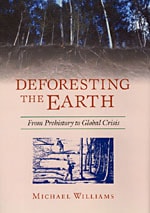
Deforesting the Earth
From Prehistory to Global CrisisMichael Williams
University of Chicago Press, 2002
Michael Williams surveys ten thousand years of history to trace how, why, and when human-induced deforestation has shaped economies, societies, and landscapes around the world. Beginning with the return of the forests to Europe, North America, and the tropics after the Ice Ages, Williams traces the impact of human-set fires for gathering and hunting, land clearing for agriculture, and other activities from the Paleolithic through the classical world and the Middle Ages. He then continues the story from the 1500s to the early 1900s, focusing on forest clearing both within Europe and by European imperialists and industrialists abroad, in such places as the New World and India, China, Japan, and Latin America. Finally, he covers the present-day and alarming escalation of deforestation, with the ever-increasing human population placing a possibly unsupportable burden on the world's forests.
Accessible and nonsensationalist, Deforesting the Earth provides the historical and geographical background we need for a deeper understanding of deforestation's tremendous impact on the environment and the people who inhabit it.
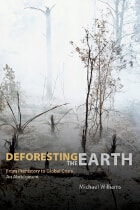
Deforesting the Earth
From Prehistory to Global Crisis, An AbridgmentMichael Williams
University of Chicago Press, 2006
Published in 2002, Deforesting the Earth was a landmark study of the history and geography of deforestation. Now available as an abridgment, this edition retains the breadth of the original while rendering its arguments accessible to a general readership.
Deforestation—the thinning, changing, and wholesale clearing of forests for fuel, shelter, and agriculture—is among the most important ways humans have transformed the environment. Surveying ten thousand years to trace human-induced deforestation’s effect on economies, societies, and landscapes around the world, Deforesting the Earth is the preeminent history of this process and its consequences.
Beginning with the return of the forests after the ice age to Europe, North America, and the tropics, Michael Williams traces the impact of human-set fires for gathering and hunting, land clearing for agriculture, and other activities from the Paleolithic age through the classical world and the medieval period. He then focuses on forest clearing both within Europe and by European imperialists and industrialists abroad, from the 1500s to the early 1900s, in such places as the New World, India, and Latin America, and considers indigenous clearing in India, China, and Japan. Finally, he covers the current alarming escalation of deforestation, with our ever-increasing human population placing a potentially unsupportable burden on the world’s forests.
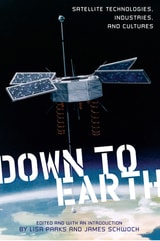
Down to Earth
Satellite Technologies, Industries, and CulturesParks, Lisa
Rutgers University Press, 2012
Down to Earth presents the first comprehensive overview of the geopolitical maneuvers, financial investments, technological innovations, and ideological struggles that take place behind the scenes of the satellite industry. Satellite projects that have not received extensive coverage—microsatellites in China, WorldSpace in South Africa, SiriusXM, the failures of USA 193 and Cosmos 954, and Iridium—are explored. This collection takes readers on a voyage through a truly global industry, from the sites where satellites are launched to the corporate clean rooms where they are designed, and along the orbits and paths that satellites traverse. Combining a practical introduction to the mechanics of the satellite industry, a history of how its practices and technologies have evolved, and a sophisticated theoretical analysis of satellite cultures, Down to Earth opens up a new space for global media studies.

Dyeing with the Earth
Textiles, Tradition, and Sustainability in Contemporary JapanCharlotte Linton
Duke University Press, 2025