453 books match the query 'Economic policy' and 13 start with d

cover of Dead Ends of Transition: Rentier Economies and Protectorates

Dead Ends of Transition

Rentier Economies and Protectorates

Edited by Michael Dauderstädt and Arne Schildberg

Campus Verlag, 2006
After war, many countries, such as Bosnia, Kosovo, Afghanistan, or Iraq, the transition to a democratic market economy extremely difficult. This failure to thrive, Dead Ends of Transition demonstrates, is often the result of national reliance on foreign aid. Rentier states, the contributors to this study argue, have few incentives to respond to the needs of their societies. Taking a closer look at the policies of rentier economies, this book further identifies new ways in which these countries and their international partners could work together to ease the critical transition to democracy.
[more]
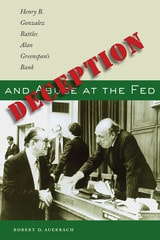
cover of Deception and Abuse at the Fed: Henry B. Gonzalez Battles Alan Greenspan's Bank

Deception and Abuse at the Fed

Henry B. Gonzalez Battles Alan Greenspan's Bank

By Robert D. Auerbach

University of Texas Press, 2008

The Federal Reserve—the central bank of the United States—is the most powerful peacetime bureaucracy in the federal government. Under the chairmanship of Alan Greenspan (1987-2006), the Fed achieved near mythical status for its part in managing the economy, and Greenspan was lauded as a genius. Few seemed to notice or care that Fed officials operated secretly with almost no public accountability. There was a courageous exception to this lack of oversight, however: Henry B. Gonzalez (D-TX)—chairman of the U.S. House of Representatives Financial Services (banking) Committee.

In Deception and Abuse at the Fed, Robert Auerbach, a former banking committee investigator, recounts major instances of Fed mismanagement and abuse of power that were exposed by Rep. Gonzalez, including:

  • Blocking Congress and the public from holding powerful Fed officials accountable by falsely declaring—for 17 years—it had no transcripts of its meetings;
  • Manipulating the stock and bond markets in 1994 under cover of a preemptive strike against inflation;
  • Allowing $5.5 billion to be sent to Saddam Hussein from a small Atlanta branch of a foreign bank—the result of faulty bank examination practices by the Fed;
  • Stonewalling Congressional investigations and misleading the Washington Post about the $6,300 found on the Watergate burglars.

Auerbach provides documentation of these and other abuses at the Fed, which confirms Rep. Gonzalez's belief that no government agency should be allowed to operate with the secrecy and independence in which the Federal Reserve has shrouded itself. Auerbach concludes with recommendations for specific, broad-ranging reforms that will make the Fed accountable to the government and the people of the United States.
[more]
cover of Deconstructing the Monolith: The Microeconomics of the National Industrial Recovery Act

Deconstructing the Monolith

The Microeconomics of the National Industrial Recovery Act

Jason E. Taylor

University of Chicago Press, 2019

The National Industrial Recovery Act (NIRA) was enacted by Congress in June of 1933 to assist the nation’s recovery during the Great Depression. Its passage ushered in a unique experiment in US economic history: under the NIRA, the federal government explicitly supported, and in some cases enforced, alliances within industries. Antitrust laws were suspended, and companies were required to agree upon industry-level “codes of fair competition” that regulated wages and hours and could implement anti-competitive provisions such as those fixing prices, establishing production quotas, and imposing restrictions on new productive capacity.
            The NIRA is generally viewed as a monolithic program, its dramatic and sweeping effects best measurable through a macroeconomic lens. In this pioneering book, however, Jason E. Taylor examines the act instead using microeconomic tools, probing the uneven implementation of the act’s codes and the radical heterogeneity of its impact across industries and time. Deconstructing the Monolith employs a mixture of archival and empirical research to enrich our understanding of how the program affected the behavior and well-being of workers and firms during the two years NIRA existed as well as in the period immediately following its demise.

 
[more]
cover of Defensive Internationalism: Providing Public Goods in an Uncertain World

Defensive Internationalism

Providing Public Goods in an Uncertain World

Davis B. Bobrow and Mark A. Boyer

University of Michigan Press, 2005

"The authors' carefully crafted analysis will influence thought and the policy debate on the tradeoff between unilateralism and multilateralism for decades to come."
-Todd Sandler, Robert R. and Katheryn A. Dockson Professor of International Relations & Economics, University of Southern California

"Boyer and Bobrow's well-written, data-rich analysis of such pressing issues as development assistance, debt management, UN peacekeeping, and environmental protection makes Defensive Internationalism a highly original and provocative contribution to the study of global governance."
-Yale H. Ferguson, Co-Director, Center for Global Change and Governance, Rutgers University

In this pathbreaking study, authors Davis B. Bobrow and Mark A. Boyer argue for "muted optimism" about the future of international cooperation. Leaders of a growing movement that integrates constructivism into traditional international studies concepts and methods, Bobrow and Boyer analyze four key international issues: development cooperation, debt management, peacekeeping operations, and environmental affairs. Their approach integrates elements of public goods theory, identity theory, new institutionalism, and rational choice. Defensive Internationalism is a well-written, creative and coherent synthesis of ideas that have up to now been considered irreconcilable. It is appropriate for upper-level undergraduate and graduate students in international relations, conflict studies, and political economy, and promises to become a foundational work in its field.

Davis B. Bobrow is Professor of Public and International Affairs and Political Science at the University of Pittsburgh.

Mark A. Boyer is Professor of Political Science at the University of Connecticut.
[more]
cover of Defusing Democracy: Central Bank Autonomy and the Transition from Authoritarian Rule

Defusing Democracy

Central Bank Autonomy and the Transition from Authoritarian Rule

Delia M. Boylan

University of Michigan Press, 2001

Many of today's new democracies are constrained by institutional forms designed by previous authoritarian rulers. In this timely and provocative study, Delia M. Boylan traces the emergence of these vestigial governance structures to strategic behavior by outgoing elites seeking to protect their interests from the vicissitudes of democratic rule.
One important outgrowth of this political insulation strategy--and the empirical centerpiece of Boylan's analysis--is the existence of new, highly independent central banks in countries throughout the developing world. This represents a striking transformation, for not only does central bank autonomy remove a key aspect of economic decision making from democratic control; in practice it has also kept many of the would-be expansionist governments that hold power today from overturning the neoliberal policies favored by authoritarian predecessors.
To illustrate these points, Defusing Democracy takes a fresh look at two transitional polities in Latin America--Chile and Mexico--where variation in the proximity of the democratic "threat" correspondingly yielded different levels of central bank autonomy.
Boylan concludes by extending her analysis to institutional contexts beyond Latin America and to insulation strategies other than central bank autonomy. Defusing Democracy will be of interest to anyone--political scientists, economists, and policymakers alike--concerned about the genesis and consolidation of democracy around the globe.
Delia M. Boylan is Assistant Professor, Harris Graduate School of Public Policy Studies, University of Chicago.
[more]
cover of Democracy, Governance, and Growth

Democracy, Governance, and Growth

Stephen Knack, Editor

University of Michigan Press, 2003

For many decades, underdevelopment in much of the world was blamed variously on capital deficits, exploitation by rich nations, and market-distorting economic policies. The chapters in this volume provide much of the evidence underpinning a growing consensus among development and growth economists that successful economic development depends more fundamentally on the way societies are organized and governed. They argue that "good governance" is a prerequisite to sustained increases in living standards.
The difference between developmental success and failure in this view has little to do with natural resource availability, climate, aid, or developed nations' policies. Rather, it is largely a function of whether incentives within a given society steer wealth-maximizing individuals toward producing new wealth or toward diverting it from others. The chapters, seminal essays written by Mancur Olson and his IRIS Center colleagues, provide theoretical and/or empirical underpinnings for the emerging consensus that differences in the way governments and societies are organized have enormous implications for the structure of incentives faced by politicians, bureaucrats, investors, and workers, which in turn determines the level of a nation's material well-being.
Overall this volume applies tools and concepts from the "New Institutional Economics" to some of the major issues in economic development. It will be of interest to scholars and students of various disciplines--including political science, law, and sociology as well as economics--interested in the determinants of economic development and global economic change. The book will also be of interest to many aid practitioners, particularly those working in anticorruption and public sector reform issues.
Stephen Knack is Senior Research Economist, Development Research Group, the World Bank.
[more]
cover of Developing Uganda

Developing Uganda

Hölger Bernt Hansen

Ohio University Press, 1998

Uganda's recovery since Museveni came to power in 1986 has been one of the heartening achievements in a continent where the media have given intense coverage to disasters. This book assesses the question of whether the reality lives up to the image that has so impressed the supporters of its recovery. What has actually happened? How successful have the reforms been thus far? What are the prospects for Uganda's future?

Essays by the top scholars in the Weld span the breadth of the issue, from Uganda's growth out of poverty to development at the grass roots level. Developing Uganda replaces the myth and misinformation the last decade has witnessed with a realistic scrutiny by those who have studied it with care and caution.

[more]
cover of Development Prospects in Cuba: An Agenda in the Making

Development Prospects in Cuba

An Agenda in the Making

Edited by Pedro Monreal

University of London Press, 2002

The 1990s witnessed significant changes in the Cuban economy. The first half of the decade focused on obtaining the adjustments necessary to enable the country to overcome the profound economic crisis that had befallen it. The second half was characterized by the reality and possibilities of economic recovery. This volume may be the first academic text specifically written to assess the development perspectives of Cuba in the new conditions that prevail. The overarching question is "What comes after recovery?" The authors deal with questions of immediate relevance to the Cuban economy and its recent past, with emphasis placed on the implications for long-term prospects for development. This reflects the conviction that solutions to the challenge of development will require longer periods of analysis and different areas of focus than those which have served as the temporal and conceptual references for recent studies of the island's economy.
Contributors include Julio Carranza, Anicia Garcia, Hiram Marquetti, Lazaro Pena, Omar Everleny Perez, and Julio Diaz Vazquez (University of Havana, Cuba), Claes Brundenius (Centre for Development Research, Copenhagen, Denmark), David Dapice (Tufts University and Harvard University, USA), Francisco Leon (United Nations Economic Commission for Latin America and the Caribbean), and Mauricio de Miranda (Pontificia Universidad Javeriana, Colombia).

[more]
cover of Development as Communication: A Perspective on India

Development as Communication

A Perspective on India

Uma Narula

Southern Illinois University Press, 1986

This book applies a systematic commu­nication theory to the 30-plus years of development experience in India.

Never before has development been treated from a communication perspec­tive. This perspective demonstrates that the role of communication in develop­ment is not limited to the technology of satellites or to the economics of mass media; it is a way of thinking about the interaction among all agents involved.

The empirical data describe patterns of social realities, actions, and commu­nication networks among planners, con­tact agents, and the masses in two Indian communities. The result is an analytical review of development theories and practice in India.

This study is practical as well as theo­retical. The authors show how the the­ory of the “coordinated management of meaning” applies to large-scale social interactions. They also offer specific rec­ommendations for Indian development planners.
[more]
cover of Digital Depression: Information Technology and Economic Crisis

Digital Depression

Information Technology and Economic Crisis

Dan Schiller

University of Illinois Press, 2014

The financial crisis of 2007-08 shook the idea that advanced information and communications technologies (ICTs) as solely a source of economic rejuvenation and uplift, instead introducing the world to the once-unthinkable idea of a technological revolution wrapped inside an economic collapse. In Digital Depression, Dan Schiller delves into the ways networked systems and ICTs have transformed global capitalism during the so-called Great Recession. He focuses on capitalism's crisis tendencies to confront the contradictory matrix of a technological revolution and economic stagnation making up the current political economy and demonstrates digital technology's central role in the global political economy. As he shows, the forces at the core of capitalism--exploitation, commodification, and inequality--are ongoing and accelerating within the networked political economy.
[more]
cover of Divide and Pacify: Strategic Social Policies and Political Protests in Post-Communist Democracies

Divide and Pacify

Strategic Social Policies and Political Protests in Post-Communist Democracies

Pieter Vanhuysse

Central European University Press, 2006

Despite dramatic increases in poverty, unemployment, and social inequalities, the Central and Eastern European transitions from communism to market democracy in the 1990s have been remarkably peaceful. This book proposes a new explanation for this unexpected political quiescence. It shows how reforming governments in Poland, Hungary and the Czech Republic have been able to prevent massive waves of strikes and protests by the strategic use of welfare state programs such as pensions and unemployment benefits.

Divide and Pacify explains how social policies were used to prevent massive job losses with softening labor market policies, or to split up highly aggrieved groups of workers in precarious jobs by sending some of them onto unemployment benefits and many others onto early retirement and disability pensions. From a narrow economic viewpoint, these policies often appeared to be immensely costly or irresponsibly populist. Yet a more inclusive social-scientific perspective can shed new light on these seemingly irrational policies by pointing to deeper political motives and wider sociological consequences.

[more]
cover of Does Business Learn?: Tax Breaks, Uncertainty, and Political Strategies

Does Business Learn?

Tax Breaks, Uncertainty, and Political Strategies

Sandra L. Suarez

University of Michigan Press, 2000

Firms in the United States have many political advantages when compared to other groups in society. They are the best-represented group in our nation's capital; they operate more Political Action Committees; and their lobbyists are among the most experienced political operatives. Yet firms are uncertain about their political power and hence about the effectiveness of their political strategies. This book deals with how firms decide which strategy to pursue among the existing alternatives when it comes to defending policies that play to their interests.
Sandra Suárez looks at the efforts of business to influence government policy in a detailed study of the efforts of major American corporations to protect the tax credit applicable to profits from investments in Puerto Rico. This rare longitudinal case-study explores the abilities of U.S. pharmaceutical and electronics companies to adapt their political strategies to a fluid and uncertain political environment. Drawing on interviews with tax lawyers, corporate lobbyists and government officials, the author follows the behavior of the same group of companies over the past twenty years.
This book advances a learning-based explanation of business political behavior, which argues that past political experience accounts for patterns of political behavior that government structures and salient issues alone cannot explain. Centered on attempts to protect an important tax break for business, the possessions tax battles provide an appropriate case for examining the value of the business learning approach.
Although written with a political science audience in mind, this book addresses issues that will resonate widely with sociologists, management researchers and students alike.
Sandra L. Suárez is Assistant Professor in the Department of Political Science, Temple University.
[more]
cover of Domestic Choices, International Markets: Dismantling National Barriers and Liberalizing Securities Markets

Domestic Choices, International Markets

Dismantling National Barriers and Liberalizing Securities Markets

Andrew C. Sobel

University of Michigan Press, 1994

The internationalization of financial markets moved to center stage in the international political economy during the 1980s. These markets affect trade, investment, venture enterprises, growth, and competitiveness. Domestic Choices, International Markets uses the internationalization and liberalization of securities markets to examine interdependence, leadership, and the mechanisms of change in an increasingly global political economy.During the 1970s and 1980s, the United States began relaxing government oversight of the security markets, promoting price competition, lowering national barriers, dismantling barriers between individual sectors of the financial industry, encouraging innovation, and easing international capital flows. The United Kingdom and Japan soon adopted similar policies, thereby transforming markets in New York, London, and Tokyo. Yet during this time, the United States’ leadership in international finance was seen to be waning. Why did Japan and the United Kingdom follow the United States’ lead so completely and quickly?Most emphasize the interdependence of the world’s financial markets to explain this phenomenon. If this were the case, though, one would expect regulation and transaction costs to converge across markets by competitive deregulation. This has not happened. Significantly, the markets have remained overwhelmingly national with only a modest increase in international activity. In an alternate explanation, Andrew Sobel argues that opening up national doors was really a secondary consequence of policy competitions among sectors of the domestic financial services industry. Changes that occurred earlier in the United States served as examples and constrained the range of choices considered by policy makers in other nations. The author shows how information and reputation networks award disproportionate influence to U.S. actors and institutions. Thus U.S. leadership persists.
[more]