Results by title
94 books match the query 'Economy' and 3 start with d
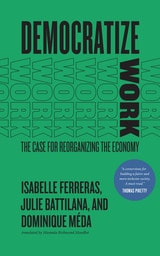
Democratize Work
The Case for Reorganizing the EconomyIsabelle Ferreras, Julie Battilana, and Dominique Méda
University of Chicago Press, 2022
What happens to a society—and a planet—when capitalism outgrows democracy? The tensions between democracy and capitalism are longstanding, and they have been laid bare by the social effects of COVID-19. The narrative of “essential workers” has provided thin cover for the fact that society’s lowest paid and least empowered continue to work risky jobs that keep our capitalism humming. Democracy has been subjugated by the demands of capitalism. For many, work has become unfair.
In Democratize Work, essays from a dozen social scientists—all women—articulate the perils and frustrations of our collective moment, while also framing the current crisis as an opportunity for renewal and transformation. Amid mounting inequalities tied to race, gender, and class—and with huge implications for the ecological fate of the planet—the authors detail how adjustments in how we organize work can lead to sweeping reconciliation. By treating workers as citizens, treating work as something other than an asset, and treating the planet as something to be cared for, a better way is attainable. Building on cross-disciplinary research, Democratize Work is both a rallying cry and an architecture for a sustainable economy that fits the democratic project of our societies.
Contributors include Alyssa Battistoni (Barnard College of Columbia University), Adelle Blackett (McGill University), Julia Cagé (Sciences Po), Neera Chandhoke (University of Delhi), Lisa Herzog (University of Groningen), Imge Kaya Sabanci (IE Business School), Sara Lafuente (European Trade Union Institute), Hélène Landemore (Yale University), Flávia Máximo (Universidade Federal de Ouro Preto, Brazil), and Pavlina R. Tcherneva (Levy Economics Institute of Bard College).
Demography and the Economy
Edited by John B. Shoven
University of Chicago Press, 2010
Demographics is a vital field of study for understanding social and economic change and it has attracted attention in recent years as concerns have grown over the aging populations of developed nations. Demographic studies help make sense of key aspects of the economy, offering insight into trends in fertility, mortality, immigration, and labor force participation, as well as age, gender, and race specific trends in health and disability.
Demography and the Economy explores the connections between demography and economics, paying special attention to what demographic trends can reveal about the sustainability of traditional social security programs and the larger implications for economic growth. The volume brings together some of the leading scholars working at the border between the two disciplines, and it provides an eclectic overview of both fields. Contributors also offer deeper analysis of a variety of issues such as the impact of greater wealth on choices about marriage and childbearing and the effects of aging populations on housing prices, Social Security, and Medicare.
Dreamers, Thinkers, Doers
Conversations on the Economy of TomorrowGovert Buijs
Amsterdam University Press, 2026
But these voices do more than imagine a better future; they show how it can be realized. They examine what it takes to turn ideas into action and take the first concrete steps toward change. The collection brings to life a new “multi-actor approach,” as outlined by Jan Peter Balkenende and Govert Buijs in Capitalism Reconnected (2024) – an approach in which everyone matters and shares responsibility: governments, businesses, civil society, and consumers alike.