Results by title
115 books match the query 'Elections' and 5 start with d
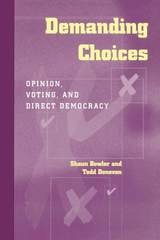
Demanding Choices
Opinion, Voting, and Direct DemocracyShaun Bowler and Todd Donovan
University of Michigan Press, 2000
Referenda on important public policy questions have come to play a central role in policy making in many states. Referenda, or ballot propositions, have resulted in limits on taxation and limits on the number of terms of elected officials, and have dealt with bilingual education, campaign finances, and affirmative action, in states all over the country.
Shaun Bowler and Todd Donovan present a searching and original examination of how voters make decisions in direct referenda. The authors ask if voters have some information about the issue easily at their disposal and if they make choices that seem sensible given their interests and the information they have. Looking at the way voters respond to different kinds of questions, the authors suggest that while direct democracy has its failings, the flaws do not necessarily lie with citizens being "duped," nor with voters approving propositions they do not want or do not understand at some basic level.
As cynicism about government has increased many have sought to take policy questions out of the hands of elected officials and put the questions directly before the voters for decision. And yet many are skeptical about the ability of voters to make intelligent decisions about complex policy issues. This important book demonstrates that voters are capable of responding thoughtfully to referenda questions.
This book will appeal to students of contemporary American politics and electoral politics.
Shaun Bowler is Associate Professor of Political Science, University of California at Irvine. Todd Donovan is Associate Professor of Political Science, Western Washington University.
[more]

Democracy After Pinochet
Politics, Parties, and Elections in ChileAlan Angell
University of London Press, 2007
This book explores how democracy has developed in Chile since the end of the military dictatorship in 1990. It brings together an examination of international influences on the country's political development with empirically based analyses of Chilean political institutions and change. Chapters one and two examine international aspects of the 1973 coup and how these influenced the development of politics inside Chile. Chapters three, four, and five provide empirical analyses of the 1989, 1993, and 1999/2000 presidential elections, respectively. Chapter six investigates how the Pinochet factor influenced developments after 1990 and the Chilean reaction to Pinochet's arrest in London in 1998. Chapter seven assesses changes in the Chilean party system and links these to similar processes elsewhere. The final chapter examines the paradox that despite economic and social advances, opinion polls report a low level of attachment to democracy and very low levels of confidence in political institutions.
[more]
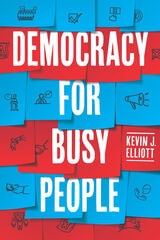
Democracy for Busy People
Kevin J. Elliott
University of Chicago Press, 2023
Advances an alternative approach to democratic reform that focuses on building institutions that empower people who have little time for politics.
How do we make democracy more equal? Although in theory, all citizens in a democracy have the right to participate in politics, time-consuming forms of participation often advantage some groups over others. Where some citizens may have time to wait in long lines to vote, to volunteer for a campaign, to attend community board meetings, or to stay up to date on national, state, and local news, other citizens struggle to do the same. Since not all people have the time or inclination to devote substantial energy to politics, certain forms of participation exacerbate existing inequalities.
Democracy for Busy People takes up the very real challenge of how to build a democracy that empowers people with limited time for politics. While many plans for democratic renewal emphasize demanding forms of political participation and daunting ideals of democratic citizenship, political theorist Kevin J. Elliott proposes a fundamentally different approach. He focuses instead on making democratic citizenship undemanding so that even busy people can be politically included. This approach emphasizes the core institutions of electoral democracy, such as political parties, against deliberative reforms and sortition. Timely and action-focused, Democracy for Busy People is necessary reading.
[more]
Dilemmas of Political Change in Mexico
Edited by Kevin J. Middlebrook
University of London Press, 2004
The victory by Vicente Fox Quesada in Mexico's July 2000 presidential election was a watershed in the country's political history. His triumph convincingly marked the consolidation of electoral democracy and, by ending seven decades of uninterrupted national rule by the "official" Institutional Revolutionary Party (PRI), symbolized a clear break with the political regime established following the 1910-1920 revolution. Nevertheless, many legacies of postrevolutionary authoritarianism persist, and Mexico's democratization process remains incomplete. The seventeen contributors to this volume assess Mexico's political dynamics at the turn of the century and the many pending challenges in the construction of a more fully democratic political order.
They examine: (1) changes affecting the party system, electoral institutions, and voting behavior; (2) the evolving role of the armed forces, organized labor, big business, and rural producers; (3) the new importance of civil society, the mass media, and cross-border social coalitions; (4) and key issues of political representation and governance, including executive-legislative relations, judicial performance, federalism, the constitutional rights of indigenous peoples, and the political role of Mexicans resident in the United States.
They examine: (1) changes affecting the party system, electoral institutions, and voting behavior; (2) the evolving role of the armed forces, organized labor, big business, and rural producers; (3) the new importance of civil society, the mass media, and cross-border social coalitions; (4) and key issues of political representation and governance, including executive-legislative relations, judicial performance, federalism, the constitutional rights of indigenous peoples, and the political role of Mexicans resident in the United States.
[more]
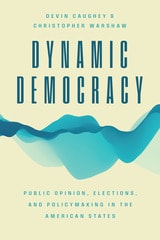
Dynamic Democracy
Public Opinion, Elections, and Policymaking in the American StatesDevin Caughey and Christopher Warshaw
University of Chicago Press, 2022
A new perspective on policy responsiveness in American government.
Scholars of American politics have long been skeptical of ordinary citizens’ capacity to influence, let alone control, their governments. Drawing on over eight decades of state-level evidence on public opinion, elections, and policymaking, Devin Caughey and Christopher Warshaw pose a powerful challenge to this pessimistic view. Their research reveals that although American democracy cannot be taken for granted, state policymaking is far more responsive to citizens’ demands than skeptics claim.
Although governments respond sluggishly in the short term, over the long term, electoral incentives induce state parties and politicians—and ultimately policymaking—to adapt to voters’ preferences. The authors take an empirical and theoretical approach that allows them to assess democracy as a dynamic process. Their evidence across states and over time gives them new leverage to assess relevant outcomes and trends, including the evolution of mass partisanship, mass ideology, and the relationship between partisanship and ideology since the mid-twentieth century; the nationalization of state-level politics; the mechanisms through which voters hold incumbents accountable; the performance of moderate candidates relative to extreme candidates; and the quality of state-level democracy today relative to state-level democracy in other periods.
[more]