Results by title
157 books match the query 'English' and 7 start with d
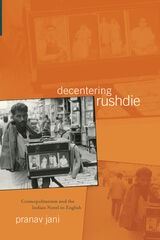
Decentering Rushdie
Cosmopolitanism and the Indian Novel in EnglishPranav Jani
The Ohio State University Press, 2010
Interrogating current theories of cosmopolitanism, nationalism, and aesthetics in Postcolonial Studies, Decentering Rushdie offers a new perspective on the Indian novel in English. Since Salman Rushdie’s Midnight’s Children won the Booker Prize in 1981, its postmodern style and postnational politics have dominated discussions of postcolonial literature. As a result, the rich variety of narrative forms and perspectives on the nation that constitute the field have been obscured, if not erased altogether.

Dictionary of Indonesian Islam
Mis Sea#94Howard M. Federspiel
Ohio University Press, 1994
This dictionary will be indispensable to English–speaking students and researchers working in Indonesian or Southeast Asian studies. It will also be useful for scholars working in Bahasa Indonesian, reading texts written about Islam by Indonesian Muslims, as well as for Southeast Asia area scholars generally who are using sources in Western languages.
Discourse Intonation
A Discourse-Pragmatic Approach to Teaching the Pronunciation of EnglishLucy Pickering
University of Michigan Press, 2018
This textbook relies heavily on the Brazil model; chapters are organized around different parts of that model and how they can be most effectively taught. Readers will learn the conventions underlying, for example, how we group words in prosodic units, how we understand turn-taking cues in conversation, and how we assess whether someone is feeling angry or sad.
This text features Check Your Learning sections, discussion questions, and hands-on activities at the end of every chapter. Chapters 3-9 also include a section on pedagogical implications. Some of the example sentences that illustrate intonation have accompanying short audio (MP3) files, which can be found online at www.press.umich.edu/elt/compsite/DI.
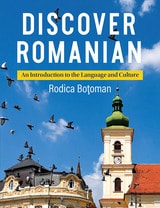
Discover Romanian
An Introduction to the Language and CultureRodica Bo?oman
The Ohio State University Press, 1995
This comprehensive introduction to Romanian for English-speaking students emphasizes communication with a complete treatment of grammar, an extensive vocabulary, and a focus on the four major language skills—listening, speaking, reading, and writing. Cultural information, an integral part of the textbook, is presented both formally, in sections on culture and civilization, and informally, as the setting for dialogues and exercises. Tables of verb conjugations and a glossary round out the book's primary materials.
Straightforward and accessible, Discover Romanian is an essential textbook for all those teaching and learning the language and provides important information for those seeking to understand Romanian culture.
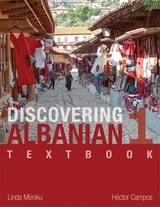
Discovering Albanian I Textbook
Linda Mëniku and Héctor Campos
University of Wisconsin Press, 2011
Approximately five million people worldwide speak Albanian. The opening of Albania in the 1990s to broader trading and diplomatic relations with other nations has created a need for better knowledge of the language and culture of this country. This book teaches the student to communicate in everyday situations in the language, with each chapter introducing a new situational context. Students learn to discuss work, vacations, health, and entertainment. Students also learn to practice basic skills such as shopping, ordering tickets, and renting an apartment. Upon completing this textbook, students will be at the A2/B1 level of proficiency on the scale provided by the Common European Framework of Reference for Languages (CEFR).
The textbook includes:
• eighteen lessons based on real-life situations, including three review lessons
• dialogues to help introduce vocabulary and grammatical structures
• comprehension questions and exercises
• related readings at the end of each chapter
• full translations for all examples discussed in grammar sections
• a series of appendixes with numerous charts summarizing main classes of nouns, adjectives, and verbs
• an appendix with the solutions to most of the exercises in the book
• a glossary with all the words in the dialogs and readings.
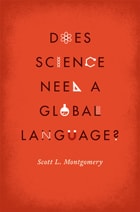
Does Science Need a Global Language?
English and the Future of ResearchScott L. Montgomery
University of Chicago Press, 2013
In Does Science Need a Global Language?, Scott L. Montgomery seeks to answer this question by investigating the phenomenon of global English in science, how and why it came about, the forms in which it appears, what advantages and disadvantages it brings, and what its future might be. He also examines the consequences of a global tongue, considering especially emerging and developing nations, where research is still at a relatively early stage and English is not yet firmly established.
Throughout the book, he includes important insights from a broad range of perspectives in linguistics, history, education, geopolitics, and more. Each chapter includes striking and revealing anecdotes from the front-line experiences of today’s scientists, some of whom have struggled with the reality of global scientific English. He explores topics such as student mobility, publication trends, world Englishes, language endangerment, and second language learning, among many others. What he uncovers will challenge readers to rethink their assumptions about the direction of contemporary science, as well as its future.
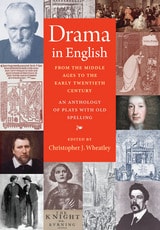
Drama in English From the Middle Ages to the Early Twentieth Century
Christopher J. Wheatley
Catholic University of America Press, 2016