Results by title
304 books match the query 'Entertainment & Performing Arts' and 10 start with d
D.A. Pennebaker
Keith Beattie
University of Illinois Press, 2011
D.W. Griffith and the Origins of American Narrative Film
The Early Years at BiographTom Gunning
University of Illinois Press, 1991
In this comprehensive historical investigation, drawing on films preserved by the Library of Congress and the Museum of Modern Art, Tom Gunning reveals that the remarkable cinematic changes between 1900 and 1915 were a response to the radical reorganization within the film industry and the evolving role of film in American society. The Motion Picture Patents Company, the newly formed Film Trust, had major economic aspirations. The newly emerging industry's quest for a middle-class audience triggered Griffith's early experiments in film editing and imagery. His unique solutions permanently shaped American narrative film.
Dario Argento
L. Andrew Cooper
University of Illinois Press, 2012
Commanding a cult following among horror fans, Italian film director Dario Argento is best known for his work in two closely related genres, the crime thriller and supernatural horror, as well as his influence on modern horror and slasher movies. In his four decades of filmmaking, Argento has displayed a commitment to innovation, from his directorial debut with 1970's suspense thriller The Bird with the Crystal Plumage to 2009's Giallo. His films, like the lurid yellow-covered murder-mystery novels they are inspired by, follow the suspense tradition of hard-boiled American detective fiction while incorporating baroque scenes of violence and excess.
While considerations of Argento's films often describe them as irrational nightmares, L. Andrew Cooper uses controversies and theories about the films' reflections on sadism, gender, sexuality, psychoanalysis, aestheticism, and genre to declare the anti-rational logic of Argento's oeuvre. Approaching the films as rhetorical statements made through extremes of sound and vision, Cooper places Argento in a tradition of aestheticized horror that includes De Sade, De Quincey, Poe, and Hitchcock. Analyzing individual images and sequences as well as larger narrative structures, he reveals how the director's stylistic excesses, often condemned for glorifying misogyny and other forms of violence, offer productive resistance to the cinema's visual, narrative, and political norms.
Dark Carnival
The Secret World of Tod Browning, Hollywood’s Master of the MacabreDavid J. Skal
University of Minnesota Press, 2025
The definitive biography of Hollywood horror legend Tod Browning—now revised and expanded with new material
One of the most original and unsettling filmmakers of all time, Tod Browning (1880–1962) began his career buried alive in a carnival sideshow and saw his Hollywood reputation crash with the box office disaster–turned–cult classic Freaks. Penetrating the secret world of “the Edgar Allan Poe of the cinema,” Dark Carnival excavates the story of this complicated, fiercely private man. In this newly revised and expanded edition of their biography first published in 1995, David J. Skal and Elias Savada researched Browning’s recently unearthed scrapbooks and photography archives to add further nuance and depth to their previous portrait of this enigmatic artist.
Skal and Savada chronicle Browning’s turn-of-the-century flight from an eccentric Louisville family into the realm of carnivals and vaudeville, his disastrous first marriage, his rapid climb to riches in the burgeoning silent film industry, and the alcoholism that would plague him throughout his life. They offer a close look at Browning’s legendary collaborations with Lon Chaney and Bela Lugosi as well as the studio politics that brought his remarkable run to an inglorious conclusion. With a revised prologue, epilogue, filmography, and new text and illustrations throughout, Dark Carnival is an unparalleled account of a singular filmmaker and an illuminating depiction of the evolution of horror and the early film industry.
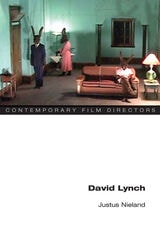
David Lynch
Justus Nieland
University of Illinois Press, 2012
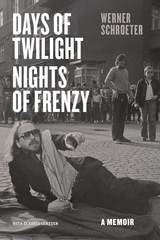
Days of Twilight, Nights of Frenzy
A MemoirWerner Schroeter and Claudia Lenssen
University of Chicago Press, 2017
Written in the last years of his life, Days of Twilight, Nights of Frenzy sees Schroeter looking back at his life with the help of film critic and friend Claudia Lenssen. Born in 1945, Schroeter grew up near Heidelberg and spent just a few weeks in film school before leaving to create his earliest works. Over the years, he would work with acclaimed artists, including Marianne Hopps, Isabelle Huppert, Candy Darling, and Christine Kaufmann. In the 1970s, Schroeter also embarked on prolific parallel careers in theater and opera, where he worked in close collaboration with the legendary diva Maria Callas. His childhood; his travels in Italy, France, and Latin America; his coming out and subsequent life as an gay man in Europe; and his run-ins with Hollywood are but a few of the subjects Schroeter recalls with insights and characteristic understated humor.
A sharp, lively, even funny memoir, Days of Twilight, Nights of Frenzy captures Schroeter’s extravagant life vividly over a vast prolific career, including many stories that might have been lost were it not for this book. It is sure to fascinate cinephiles and anyone interested in the culture around film and the arts.
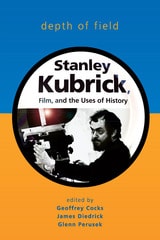
Depth of Field
Stanley Kubrick, Film, and the Uses of HistoryEdited by Geoffrey Cocks, James Diedrick, and Glenn Perusek
University of Wisconsin Press, 2006
Director of some of the most controversial films of the twentieth century, Stanley Kubrick created a reputation as a Hollywood outsider as well as a cinematic genius. His diverse yet relatively small oeuvre—he directed only thirteen films during a career that spanned more than four decades—covers a broad range of the themes that shaped his century and continues to shape the twenty-first: war and crime, gender relations and class conflict, racism, and the fate of individual agency in a world of increasing social surveillance and control.
In Depth of Field, leading screenwriters and scholars analyze Kubrick's films from a variety of perspectives. They examine such groundbreaking classics as Dr. Strangelove and 2001: A Space Odyssey and later films whose critical reputations are still in flux. Depth of Field ends with three viewpoints on Kubrick's final film, Eyes Wide Shut, placing it in the contexts of film history, the history and theory of psychoanalysis, and the sociology of sex and power. Probing Kubrick's whole body of work, Depth of Field is the first truly multidisciplinary study of one of the most innovative and controversial filmmakers of the twentieth century.
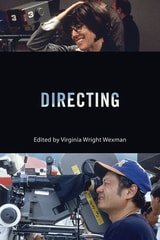
Directing
Virginia Wright Wexman
Rutgers University Press, 2017
The latest volume in the Behind the Silver Screen series, this collection provides the first comprehensive overview of how directing, as both an art and profession, has evolved in tandem with changing film industry practices. Each chapter is written by an expert on a different period of Hollywood, from the silent film era to today’s digital filmmaking, providing in-depth examinations of key trends like the emergence of independent production after World War II and the rise of auteurism in the 1970s. Challenging the myth of the lone director, these studies demonstrate how directors work with a multitude of other talented creative professionals, including actors, writers, producers, editors, and cinematographers.
Directing examines a diverse range of classic and contemporary directors, including Orson Welles, Tim Burton, Cecil B. DeMille, Steven Soderbergh, Spike Lee, and Ida Lupino, offering a rich composite picture of how they have negotiated industry constraints, utilized new technologies, and harnessed the creative contributions of their many collaborators throughout a century of Hollywood filmmaking.
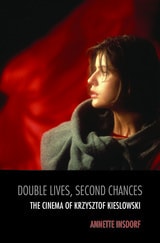
Double Lives, Second Chances
The Cinema of Krzysztof KieslowskiAnnette Insdorf
Northwestern University Press, 2013
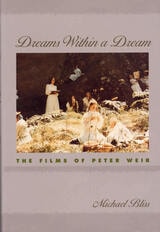
Dreams Within a Dream
The Films of Peter WeirMichael Bliss
Southern Illinois University Press, 2000
"What we see, and what we seem, are but a dream, a dream within a dream." Michael Bliss views Miranda's voice-over at the beginning of Picnic at Hanging Rock as so pivotal in explaining the films of Peter Weir that he borrows her words to create the title of his own study of the Australian filmmaker's work.
Bliss views Weir as an artist whose values are rooted in the realm of the dream, of the unconscious. Surrealistic in technique, Weir avoids the pedestrian assurances of a material realm in favor of an irresolution that, while potentially frustrating, is nonetheless for him a more truthful representation of what he considers reality. For Weir, as for Plato, Bliss demonstrates, "empirical reality is nothing more than a shadow of what is real."
Bliss also considers Weir's heritage. Australian cinema, Bliss explains, is characterized by melodramatic narratives born of a desire to see good and evil portrayed in striking opposition. Weir, for example, dramatizes the contradictory forces of light versus darkness, reason versus mystery, and rationality versus magic in such films as Picnic at Hanging Rock and The Last Wave. This melodramatic emphasis is evident as well in the polarized characterizations in such films as Witness, Dead Poets Society, and The Truman Show.
Bliss also discusses Weir's use of another staple of Australian cinema— "mateship," the celebration of the bond between male companions. But by making self-knowledge dependent on action involving one's friends, Weir gives mateship a new meaning. Moreover, like other Australian filmmakers, Weir emphasizes the starkness of the Australian landscape, which functions either as a hazard or a deadly challenge, at least until American mythology caused him to see nature in a more positive light. Also prominent in Weir's films is an Australian spirit of rebellion coupled with the Aussie ambivalence toward all aspects of British culture.
To help explain Weir's films, Bliss looks to Freud and Jung, whom Weir has studied, and also to two other prominent purveyors of myth and archetype, Northrop Frye and Joseph Campbell. Virtually all Weir characters struggle toward a new mode of awareness, a psychological awareness based on archetypal truths. Many of his films involve archetypal journeys heading through conflict to spiritual unity. Weir's quest is to find out what we really know and how we know what we know.