Results by title
59 books match the query 'Ethnoarchaeology' and 3 start with d
Decolonizing Indigenous Histories
Exploring Prehistoric/Colonial Transitions in ArchaeologyEdited by Maxine Oland, Siobhan M. Hart, and Liam Frink
University of Arizona Press, 2012
Decolonizing Indigenous Histories makes a vital contribution to the decolonization of archaeology by recasting colonialism within long-term indigenous histories. Showcasing case studies from Africa, Australia, Mesoamerica, and North and South America, this edited volume highlights the work of archaeologists who study indigenous peoples and histories at multiple scales.
The contributors explore how the inclusion of indigenous histories, and collaboration with contemporary communities and scholars across the subfields of anthropology, can reframe archaeologies of colonialism. The cross-cultural case studies employ a broad range of methodological strategies—archaeology, ethnohistory, archival research, oral histories, and descendant perspectives—to better appreciate processes of colonialism. The authors argue that these more complicated histories of colonialism contribute not only to understandings of past contexts but also to contemporary social justice projects.
In each chapter, authors move beyond an academic artifice of “prehistoric” and “colonial” and instead focus on longer sequences of indigenous histories to better understand colonial contexts. Throughout, each author explores and clarifies the complexities of indigenous daily practices that shape, and are shaped by, long-term indigenous and local histories by employing an array of theoretical tools, including theories of practice, agency, materiality, and temporality.
Included are larger integrative chapters by Kent Lightfoot and Patricia Rubertone, foremost North American colonialism scholars who argue that an expanded global perspective is essential to understanding processes of indigenous-colonial interactions and transitions.
[more]
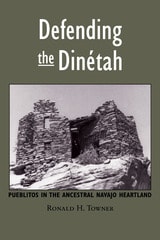
Defending The Dinetah
Ronald H Towner
University of Utah Press, 2003
Among the most striking features of the northwestern New Mexico landscape are the more than 130 fortresses and towers built on boulders, promontories, and mesa rims. These "pueblitos" in the traditional Navajo homeland of Dinétah have been a key piece of evidence used by archaeologists to infer a massive immigration of Puebloans into the Navajo country following the Spanish re-conquest of New Mexico (ca. 1700), yet they have never been comprehensively analyzed.
Using a database of tree-ring dates taken from beams and wood used to construct these pueblitos, Ronald Towner shows in this volume that most pueblitos are unrelated to Puebloan immigration or the re-conquest. He concludes that Navajos constructed the masonry structures and hogans contemporaneously for protection against Ute raiders and later Spanish entradas. Further, most were occupied for relatively brief periods and population density was much lower than has been assumed.
Towner points to a new model of Navajo ethnogenesis, based on a revised early population distribution and a variety of other means of incorporating non-Athapaskan elements into Navajo culture, making Defending the Dinétah a major contribution to Navajo studies.
[more]
Domestic Life in Prehispanic Capitals
A Study of Specialization, Hierarchy, and EthnicityEdited by Linda R. Manzanilla and Claude Chapdelaine
University of Michigan Press, 2009
With major differences in size, urban plans, and population density, the capitals of New World states had large heterogeneous societies, sometimes multiethnic and highly specialized, making these cities amazing backdrops for complex interactions.
[more]