Results by title
81 books match the query 'Farm life' and 7 start with d
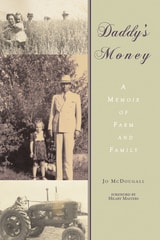
Daddy’s Money
A Memoir of Farm and FamilyJo McDougall
University of Arkansas Press, 2011
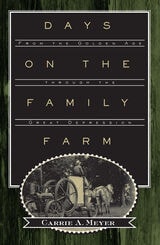
Days on the Family Farm
From the Golden Age through the Great DepressionCarrie A. Meyer
University of Minnesota Press, 2007
From the beginning of the twentieth century to World War II, farm wife May Lyford Davis kept a daily chronicle that today offers a window into a way of life that has all but disappeared. May and her husband Elmo lived through two decades of prosperity, the Great Depression, and two World Wars in their Midwestern farming community. Like many women of her time, Davis kept diaries that captured the everyday events of the family farm; she also kept meticulous farming accounts. In doing so, she left an extraordinary record that reflects not only her own experiences but also the history of early twentieth-century American agriculture.
May and Elmo’s story, engagingly told by Carrie A. Meyer, showcases the large-scale evolution of agriculture from horses to automobile and tractors, a surprisingly vibrant family and community life, and the business of commercial farming. Details such as what items were bought and sold, what was planted and harvested, the temperature and rainfall, births and deaths, and the direction of the wind are gathered to reveal a rich picture of a world shared by many small farmers.
With sustainable and small-scale farming again on the rise in the United States, Days on the Family Farm resonates with both the profound and mundane aspects of rural life—past and present—in the Midwest.
Carrie A. Meyer is associate professor of economics at George Mason University.
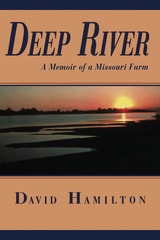
Deep River
A Memoir of a Missouri FarmDavid Hamilton
University of Missouri Press, 2014
Deep River uncovers the layers of history—both personal and regional—that have accumulated on a river-bottom farm in west-central Missouri. This land was part of a late frontier, passed over, then developed through the middle of the last century as the author's father and uncle cleared a portion of it and established their farm.
Hamilton traces the generations of Native Americans, frontiersmen, settlers, and farmers who lived on and alongside the bottomland over the past two centuries. It was a region fought over by Union militia and Confederate bushwhackers, as well as by their respective armies; an area that invited speculation and the establishment of several small towns, both before and after the Civil War; land on which the Missouri Indians made their long last stand, less as a military force than as a settlement and civilization; land that attracted French explorers, the first Europeans to encounter the Missouris and their relatives, the Ioways, Otoes, and Osage, a century before Lewis and Clark. It is land with a long history of occupation and use, extending millennia before the Missouris. Most recently it was briefly and intensively receptive to farming before being restored in large part as state-managed wetlands.
Deep River is composed of four sections, each exploring aspects of the farm and its neighborhood. While the family story remains central to each, slavery and the Civil War in the nineteenth century and Native American history in the centuries before that become major themes as well. The resulting portrait is both personal memoir and informal history, brought up from layers of time, the compound of which forms an emblematic American story.
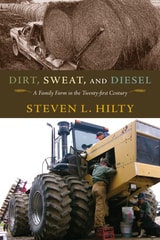
Dirt, Sweat, and Diesel
A Family Farm in the Twenty-first CenturySteven L. Hilty
University of Missouri Press, 2016
With very few people engaged in agriculture today, it is no surprise that most Americans have little understanding of the challenges that modern farmers face. This book provides readers a glimpse into life on a modern Missouri farm where a variety of grains, grass seed, corn, and cattle are produced. All of the conversations, events, and descriptions are drawn from the author’s experience working alongside and observing this father and son family farm operation during the course of a year.
Farming today is technologically complex and requires a broad set of skills that range from soil conservation, animal husbandry, and mechanics to knowledge of financial markets and computer technology. The focus on skills, in addition to the size of the financial risks, and the number of unexpected challenges along the way provides readers with a new perspective and appreciation for modern farm life.
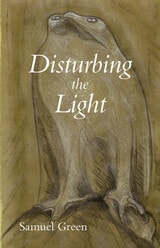
Disturbing the Light
Samuel Green
Carnegie Mellon University Press, 2020
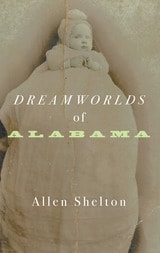
Dreamworlds of Alabama
Allen Shelton
University of Minnesota Press, 2007
“I speak in what others often hear as a strange accent. My past can’t be located. I live in Buffalo, New York, an exile from the South. But these aren’t Yankee dreams, even though my past seems like a fabrication, a dreamworld in which I’m a paper character and not a historical participant, with scars from barbed wire ripping under the pressure and flying through the air like a swarm of bees, or a horse rearing up and banging its head into mine from within, exploding my forehead.” —from the Preface
Wisteria draped on a soldier’s coffin, sent home to Alabama from a Virginia battlefield. The oldest standing house in the county, painted gray and flanked by a pecan orchard. A black steel fence tool, now perched atop a pile of books like a prehistoric bird of prey. In Dreamworlds of Alabama, Allen Shelton explores physical, historical, and social landscapes of northeastern Alabama. His homeplace near the Appalachian foothills provides the setting for a rich examination of cultural practices, a place where the language of place and things resonates with as much vitality and emotional urgency as the language of humans.
Throughout the book, Shelton demonstrates how deeply culture is inscribed in the land and in the most intimate spaces of the person—places of belonging and loss, insight and memory.
Born and raised in Jacksonville, Alabama, Allen Shelton is associate professor of sociology at Buffalo State College.
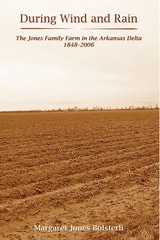
During Wind and Rain
The Jones Family Farm in the Arkansas Delta 1848-2006Margaret Jones Bolsterli
University of Arkansas Press, 2008