Results by title
183 books match the query 'Feminist' and 6 start with d
Deconstruction, Feminist Theology, and the Problem of Difference
Subverting the Race/Gender DivideEllen T. Armour
University of Chicago Press, 1999
Armour shows how the writings of Jacques Derrida and Luce Irigaray can be used to uncover feminism's white presumptions so that race and gender can be thought of differently. In clear, concise terms she explores the possibilities and limitations for feminist theology of Derrida's conception of "woman" and Irigaray's "multiple woman," as well as Derrida's thinking on race and Irigaray's work on religion. Armour then points a way beyond the race/gender divide with the help of African-American theorists such as bell hooks, Hortense Spillers, and Patricia Hill Collins.

Delia's Doctors; or, A Glance behind the Scenes
Hannah Gardner Creamer
University of Illinois Press, 2002
This early feminist novel is a wickedly funny slice of mid-nineteenth-century Americana peppered with details of the era’s freakish medical tactics and leavened with a smart and sassy commentary about the societal restraints on women’s physical and intellectual abilities.
First published in 1852, Delia’s Doctors is one of four known novels by Hannah Gardner Creamer, an American writer whose life and career have been all but absent from the annals of American history. In the book, eighteen-year-old Delia Thornton is ill. Her condition, more psychological than physical, worsens during the bitter winter, even as doctor after doctor attempts to cure her.
As Delia typifies the female heroine whose sickness is aggravated by listlessness and inactivity, her brother’s fiancée, Adelaide Wilmot, is Delia’s more robust counterpart. Adelaide thinks she could do anything, if only she were a man, and she dreams of being a physician. Quick to point out the shortcomings of male doctors in treating female illnesses, Adelaide saves Delia and delivers a series of arguments against New England patriarchy.
Descent
Arria Deepwater
Omnidawn, 2025
Arria Deepwater’s Descent is a modern fairy tale exploring the vulnerability and strength that come with living in an unconventional body, especially for those living with the experience of disabilities, chronic illness, hyper-medicalization, objectification, and 2SLGBTQIA+ identities. The reader is invited to become an observer of isolation, violation, and the magic of secret joy. Descent moves through entangled connections and dissolving boundaries between humanity and the natural world as it seeks to weave a spell of protection for those whose bodies do not conform, for whom existence is a radical act of rebellion and creativity.
Exploring boundaries of intimacy, fluidity, and grief, Deepwater brings an eco-feminist speculative twist to the growing canon of writers with marginalized identities. Deepwater considers the fractured reality of living in a queer disabled body and how we might find freedom, safety, and spiritual healing despite grief.
Descent is the winner of Omnidawn’s 2022 Fabulist Fiction Contest, chosen by Michelle Ruiz Keil.
Disciplining Gender
Rhetorics of Sex Identity in Contemporary U.S. CultureJohn M. Sloop
University of Massachusetts Press, 2004
An expert on the rhetoric of the mass media, John M. Sloop has written several books on how the spoken and written word can influence political and cultural debate. In Disciplining Gender, he turns his attention to a topic that has attracted widespread public discussion—the treatment of gender ambiguity in American culture. He offers critical readings of five cases, showing the extent to which, in each instance, public discourse and media representations have served to reinforce dominant norms and constrain or “discipline” any behavior that blurs or subverts conventional gender boundaries.
The five cases include John/Joan or David Reimer, Brandon Teena, k.d. lang, Janet Reno, and Barry Winchell/Calpernia Addams. Sloop draws on queer theory and research in the field of critical rhetoric to examine representations of “gender trouble” in these much-publicized stories. In each case, he provides a comprehensive analysis of the public discussions of their significance. In short, rather than simply study the people and circumstances involved in each case, he examines the public meanings attached to them and the implications of those meanings for how contemporary culture comes to understand what “man” and “woman” mean and which sexual behaviors are appropriate and inappropriate.
In highlighting the ideological constraints imposed by our society, Sloop also suggests the ways that these constraints might be loosened and understandings of gender and sexuality diversified.
Domestications
American Empire, Literary Culture, and the Postcolonial LensHosam Aboul-Ela
Northwestern University Press, 2018
Domestications traces a genealogy of American global engagement with the Global South since World War II. Hosam Aboul-Ela reads American writers contrapuntally against intellectuals from the Global South in their common—yet ideologically divergent—concerns with hegemony, world domination, and uneven development. Using Edward Said’s Culture and Imperialism as a model, Aboul-Ela explores the nature of U.S. imperialism’s relationship to literary culture through an exploration of five key terms from the postcolonial bibliography: novel, idea, perspective, gender, and space.
Within this framework the book examines juxtapositions including that of Paul Bowles’s Morocco with North African intellectuals’ critique of Orientalism, the global treatment of Vietnamese liberation movements with the American narrative of personal trauma in the novels of Tim O’Brien and Hollywood film, and the war on terror’s philosophical idealism with Korean and post-Arab nationalist materialist archival fiction.
Domestications departs from other recent studies of world literature in its emphases not only on U.S. imperialism but also on intellectuals working in the Global South and writing in languages other than English and French. Although rooted in comparative literature, its readings address issues of key concern to scholars in American studies, postcolonial studies, literary theory, and Middle Eastern studies.
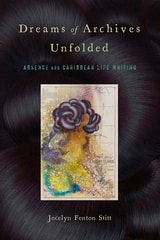
Dreams of Archives Unfolded
Absence and Caribbean Life WritingJocelyn Fenton Stitt
Rutgers University Press, 2021