Results by title
91 books match the query 'Feminists' and 3 start with d
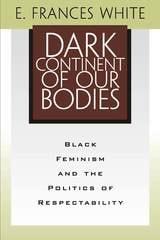
Dark Continent Of Our Bodies
Black Feminism & Politics Of RespectabilityE. Frances White
Temple University Press, 2001
In this provocative book, a black lesbian feminist looks at black feminism -- its roots, its role, and its implications. From Charles Darwin and nineteenth-century racism to black nationalism and the Nation of Islam, from Baptist women's groups to James Baldwin, E. Frances White takes on one institution after another as she re-centers the role of black women in the United States' intellectual heritage. White presents identity politics as a complex activity, with entangled branches of race and gender, of invisibility and voyeurism, of defiance and passivity and conformism.
White's powerful introduction draws on oral narratives from her own family history to illuminate the nature of narrative, both what is said and what is left unsaid. She then sets the historical stage with a helpful history of the inception and development of black feminism and a critique of major black feminist writings. In the three chapters that follow, she addresses the obstacles black feminism has already surmounted and must continue to traverse. Confronting what White calls "the politics of respectability," these chapters move the reader from simplistic views of race and gender in the nineteenth century through black nationalism and the radical movements of the sixties, and their relationship to feminist thought, to the linkages between race, gender, and sexuality in the works of such giants as Toni Morrison and James Baldwin. No one who finishes Dark Continent of Our Bodies will look at race and gender in the same way again.
White's powerful introduction draws on oral narratives from her own family history to illuminate the nature of narrative, both what is said and what is left unsaid. She then sets the historical stage with a helpful history of the inception and development of black feminism and a critique of major black feminist writings. In the three chapters that follow, she addresses the obstacles black feminism has already surmounted and must continue to traverse. Confronting what White calls "the politics of respectability," these chapters move the reader from simplistic views of race and gender in the nineteenth century through black nationalism and the radical movements of the sixties, and their relationship to feminist thought, to the linkages between race, gender, and sexuality in the works of such giants as Toni Morrison and James Baldwin. No one who finishes Dark Continent of Our Bodies will look at race and gender in the same way again.
[more]

Don't Call Me Inspirational
A Disabled Feminist Talks BackHarilyn Rousso
Temple University Press, 2013
For psychotherapist, painter, feminist, filmmaker, writer, and disability activist Harilyn Rousso, hearing well-intentioned people tell her, "You're so inspirational!" is patronizing, not complimentary.
In her empowering and at times confrontational memoir, Don't Call Me Inspirational, Rousso, who has cerebral palsy, describes overcoming the prejudice against disability--not overcoming disability. She addresses the often absurd and ignorant attitudes of strangers, friends, and family.Rousso also examines her own prejudice toward her disabled body, and portrays the healing effects of intimacy and creativity, as well as her involvement with the disability rights community. She intimately reveals herself with honesty and humor and measures her personal growth as she goes from "passing" to embracing and claiming her disability as a source of pride, positive identity, and rebellion.
A collage of images about her life, rather than a formal portrait, Don't Call Me Inspirational celebrates Rousso's wise, witty, productive, outrageous life, disability and all.
[more]

Dressed for Freedom
The Fashionable Politics of American FeminismEinav Rabinovitch-Fox
University of Illinois Press, 2021
Often condemned as a form of oppression, fashion could and did allow women to express modern gender identities and promote feminist ideas. Einav Rabinovitch-Fox examines how clothes empowered women, and particularly women barred from positions of influence due to race or class. Moving from 1890s shirtwaists through the miniskirts and unisex styles of the 1970s, Rabinovitch-Fox shows how the rise of mass media culture made fashion a vehicle for women to assert claims over their bodies, femininity, and social roles. She also highlights how trends in women’s sartorial practices expressed ideas of independence and equality. As women employed new clothing styles, they expanded feminist activism beyond formal organizations and movements and reclaimed fashion as a realm of pleasure, power, and feminist consciousness.
A fascinating account of clothing as an everyday feminist practice, Dressed for Freedom brings fashion into discussions of American feminism during the long twentieth century.
[more]