Results by title
75 books match the query 'Folk & Traditional' and 4 start with d
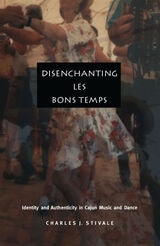
Disenchanting Les Bons Temps
Identity and Authenticity in Cajun Music and DanceCharles J. Stivale
Duke University Press, 2003
Stivale combines his personal knowledge and love of Cajun music and dance with the theoretical insights of Gilles Deleuze and Félix Guattari to consider representations of things Cajun. He examines the themes expressed within the lyrics of the Cajun musical repertoire and reflects on the ways Cajun cultural practices are portrayed in different genres including feature films, documentaries, and instructional dance videos. He analyzes the dynamic exchanges between musicians, dancers, and spectators at such venues as bars and music festivals. He also considers a number of thorny socio-political issues underlying Cajun culture, including racial tensions and linguistic isolation. At the same time, he describes various efforts by contemporary musicians and their fans to transcend the limitations of cultural stereotypes and social exclusion.
Disenchanting Les Bons Temps will appeal to those interested inCajun culture, issues of race and ethnicity, music and dance, and the intersection of French and Francophone studies with Anglo and American cultural studies.
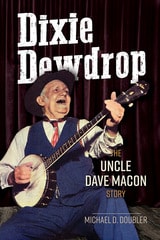
Dixie Dewdrop
The Uncle Dave Macon StoryMichael D. Doubler
University of Illinois Press, 2018
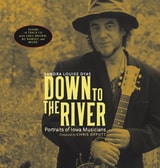
Down to the River
Portraits of Iowa MusiciansSandra Louise Dyas
University of Iowa Press, 2007
Dyas’s photographs present both the sweaty intensity of live performances and the more contemplative moments of individual portraits. They are complemented by Chris Offutt’s empathetic essay, which also encapsulates the experience of connecting with a new home through its music. A companion CD with eighteen tracks by Iowa’s finest singer/songwriters, including Dave Moore, Greg Brown, Bo Ramsey, David Zollo, and Pieta Brown, add up to an unmatched perspective on Iowa music and musicians.
CD Tracks
1. Iowa Crawl, Joe Price
2. Poor Back Slider, Greg Brown
3. Parnell, David Zollo
4. #807, Pieta Brown
5. Wheels of Steel, Radoslav Lorkovic
6. Down to the River, Dave Moore
7. Lucy and Andy Drive to Arkansas, Kevin Gordon
8. Chuck Brown, Mike and Amy Finders
9. Nobody But You, Joe Price
10. Earleton, BeJae Fleming
11. Ceremonial Child, High and Lonesome
12. Sidetrack Lounge, Bo Ramsey
13. On the Edge, Pieta Brown
14. One Wrong Turn, Greg Brown
15. Not in Iowa, Kelly Pardekooper
16. Living in a Cornfield, Bo Ramsey
17. ’57 Chevy, Tom Jessen’s Dimestore Outfit
18. Roll on John, the Pines

Drones, Tones, and Timbres
Sounding Place among Nomads of the Inner Asian Mountain-SteppesCarole Pegg
University of Illinois Press, 2024
Based on more than twenty years of collaborative research, Carole Pegg’s long-awaited participatory ethnography explores how Indigenous nomadic peoples of Russia’s southern Siberian republics (Altai, Khakassia, Tyva) sound multiphonies of place in a post-Soviet global world. Inspired by the mountain-steppe ecology and pathways of nomadism, soundscapes created in performative ritual events cross political and multiple-world boundaries in a shamanic-animist universe, enabling human and spirit actor interactions in a series of sensuous worlds. As with the “throat-singing” for which Indigenous Altai-Sayan peoples are famous, senses of place involve sonic relations, rootedness, movement, and plurality. Pegg echoes their drone-partials musical and ontological models in an innovative theoretical entwinement. Three strands form the book’s multivocal drone, the partials of which sound in each chapter: ontological sonicality and musicality that enables emplacement and movement; the importance of shamanism-animism--at the core of Indigenous spiritual practices--for personhood and community; and the agency of sonic performances. Sounding place, Pegg demonstrates, is essential to the identities, ways of life, and very senses of being of Indigenous Altai-Sayan peoples.