Results by title
377 books match the query 'French' and 12 start with d
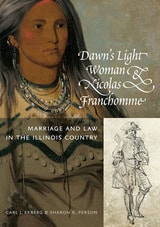
Dawn's Light Woman & Nicolas Franchomme
Marriage and Law in the Illinois CountryCarl J. Ekberg and Sharon K. Person
Southern Illinois University Press, 2022
Native women’s marital rights and roles in colonial Illinois society
Kaskaskia, Illinois, once the state’s capital, torn from the state by flood waters, and now largely forgotten, was once the home to a couple who helped transform the region in the 1720s from a frontier village to a civil society. In the heart of France’s North American empire, the village was a community of French-Canadian fur traders and Kaskaskia Indians who not only lived together but often intermarried. These Indigenous and French intermarriages were central to colonial Illinois society, and the coupling of Marguerite 8assecam8c8e (Dawn’s Light Woman) and Nicolas Franchomme, in particular, was critical to expanding the jurisdiction of French law.
While the story of Marguerite and Nicolas is unknown today, it is the story of how French customary law (Coutume de Paris) governed colonial marriage, how mixed Indian-French marriages stood at the very core of early colonial Illinois society, and how Illinois Indian women benefited, socially and legally, from being married to French men. All of this came about due to a lawsuit in which Nicolas successfully argued that his wife had legal claim to her first husband’s estate—a legal decision that created a precedent for society in the Illinois Country.
Within this narrative of a married couple and their legal fight—based on original French manuscripts and supported by the comprehensively annotated 1726 Illinois census—is also the story of the village of Kaskaskia during the 1720s, of the war between Fox Indians and French settlers, with their Indian allies, in Illinois, and of how the spread of plow agriculture dramatically transformed the Illinois Country’s economy from largely fur trade–based to expansively agricultural.
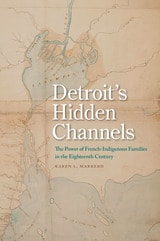
Detroit's Hidden Channels
The Power of French-Indigenous Families in the Eighteenth CenturyKaren L. Marrero
Michigan State University Press, 2020
Didactic Poetries
Philippe Beck
University of Minnesota Press, 2016
Complex, haunting, imaginative and profoundly literary, Didactic Poetries is Beck’s response to Schiller’s statement: “We are still waiting for a didactic poem where thought itself would be and would remain poetic,” and Hegel’s claim that, “strictly speaking, didactic poetry isn’t poetry.”
For the acclaimed French poet, Philippe Beck, Schiller’s task of attempting a didactic poetry remains as vital today as it was for Schiller’s time. Is there a way to construct a poetry built and chiseled, hammered and stitched, from out of past narratives and poetries, condensed in such a manner as to make new poetic verses sing new truths? Forging a singular attempt to echo the poets and tales of a bygone age, Beck’s didactic poetries perhaps carve out the path for renewing a poetic thought as a quasi-musical atmosphere where the reader can glimpse “A small country “sculpted” as spiritual, supposed to be so at home in the Bygone Country. Alluvial layers so light, that weather disappeared, weary of variety a priori.” Beck’s deftly textured poems interweave contemporary commentary with cultural, historical, literary, and philosophical allusions, drawing the reader into a world of lived poetic experience.

Discourse on the Origins of Inequality (Second Discourse), Polemics, and Political Economy
Jean-Jacques Rousseau
Dartmouth College Press, 1993
Discourse on the Sciences and Arts (First Discourse) and Polemics
Jean-Jacques Rousseau
Dartmouth College Press, 1992

Dissemination
Jacques Derrida
University of Chicago Press, 1981
Dissemination
Jacques Derrida
University of Chicago Press, 1981
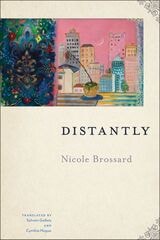
Distantly
Nicole Brossard
Omnidawn, 2022
This bilingual edition of Nicole Brossard’s lyrical poetry is a sequence of lush, taut cityscapes. Known for her elliptical and materially grounded poetics, Brossard creates an intimate series of poems drawn loosely from urban experience. The poems comprise an evocative distillation of postmodern urban life with a sharp sense of cultural and gendered histories of violence and beauty and struggles for survival and intimacy. The poems capture the emotional and ecological surroundings of each city and its people. The cities in Brossard’s poems feel surreal and in them dwell survivors of “misfortunes,” living in urban landscapes with their “gleaming debris” and “bridges, ghats, / rivers in a time of peace and torture.” These poems gesture toward a transmuted social context and toward a quest “to meet the horizon the day after the horizon.”

Dramatic Proverbs
Françoise d’Aubigné, Marquise de Maintenon
Iter Press, 2025
Madame de Maintenon’s Dramatic Proverbs provides unprecedented access to an important transitional marker between the society games of the salon and the education theater of the eighteenth century. Composed for the impoverished female pupils at the boarding school she and King Louis XIV founded at Saint-Cyr, Maintenon’s dramatic proverbs crucially reveal the values emphasized in female education at the end of the seventeenth century—a period plagued by economic crisis and growing aristocratic poverty. Some of the first to exclusively express a woman’s point of view, Maintenon’s dramatic proverbs challenged traditional female education and promoted improved conditions for women. The proverbs contributed uniquely to improvisational educational theater, inaugurating a tradition that continued well into the eighteenth century.
This edition of the plays aims to privilege accessibility and accuracy so that twenty-first-century students can act out, interpret, and discuss these historical texts.
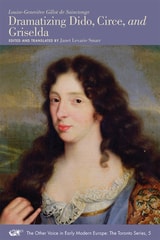
Dramatizing Dido, Circe, and Griselda
Louise-Geneviève Gillot de Sainctonge
Iter Press, 2010
—Perry Gethner
Norris Professor of French, Oklahoma State University
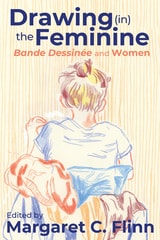
Drawing (in) the Feminine
Bande Dessinée and WomenEdited by Margaret C. Flinn
The Ohio State University Press, 2024
Winner, Eisner Award for Best Academic/Scholarly Work 2025
Finalist, Comics Studies Society Edited Book Prize 2025
Drawing (in) the Feminine celebrates and examines the richness of contemporary women's production in French and Francophone comics art and considers the history of representations made by both dominant and marginalized creators. Bridging historical and contemporary comics output, these essays illuminate the interfaces among genre, gender, and cultural history. Contributors from both sides of the Atlantic, and across a variety of methodologies and disciplinary orientations, challenge prevailing claims about the absence of women creators, characters, and readers in bande dessinée, arguing that women have always been part of its history. While still far from achieving parity with their male counterparts, female creators are occupying an increasingly significant portion of the French-language comics publishing industry, and creators of all genders are putting forth stories that reflect on the diversity and richness of women's and gender-nonconforming people's experiences. In the essays collected here, contributors push back against the ways in which the marginalization of women within bande dessinée history has overshadowed their significant contributions, extending avenues for further exploring the true diversity of a flourishing contemporary production.
Contributors:
Armelle Blin-Rolland, Véronique Bragard, Michelle Bumatay, Benoît Crucifix, Isabelle Delorme, Jacques Dürrenmatt, Margaret C. Flinn, Alexandra Gueydan-Turek, Jennifer Howell, Jessica Kohn, Sylvain Lesage, Catriona MacLeod, Mark McKinney
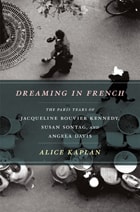
Dreaming in French
The Paris Years of Jacqueline Bouvier Kennedy, Susan Sontag, and Angela DavisAlice Kaplan
University of Chicago Press, 2012
All three women would go on to become icons, key figures in American cultural, intellectual, and political life, but when they embarked for France, they were young, little-known, uncertain about their future, and drawn to the culture, sophistication, and drama that only Paris could offer. Yet their backgrounds and their dreams couldn’t have been more different. Jacqueline Bouvier was a twenty-year-old debutante, a Catholic girl from a wealthy East Coast family. Susan Sontag was twenty-four, a precocious Jewish intellectual from a North Hollywood family of modest means, and Paris was a refuge from motherhood, a failing marriage, and graduate work in philosophy at Oxford. Angela Davis, a French major at Brandeis from a prominent African American family in Birmingham, Alabama, found herself the only black student in her year abroad program—in a summer when all the news from Birmingham was of unprecedented racial violence.
Kaplan takes readers into the lives, hopes, and ambitions of these young women, tracing their paths to Paris and tracking the discoveries, intellectual adventures, friendships, and loves that they found there. For all three women, France was far from a passing fancy; rather, Kaplan shows, the year abroad continued to influence them, a significant part of their intellectual and cultural makeup, for the rest of their lives. Jackie Kennedy carried her love of France to the White House and to her later career as a book editor, bringing her cultural and linguistic fluency to everything from art and diplomacy to fashion and historic restoration—to the extent that many, including Jackie herself, worried that she might seem “too French.” Sontag found in France a model for the life of the mind that she was determined to lead; the intellectual world she observed from afar during that first year in Paris inspired her most important work and remained a key influence—to be grappled with, explored, and transcended—the rest of her life. Davis, meanwhile, found that her Parisian vantage strengthened her sense of political exile from racism at home and brought a sense of solidarity with Algerian independence. For her, Paris was a city of political commitment, activism, and militancy, qualities that would deeply inform her own revolutionary agenda and soon make her a hero to the French writers she had once studied.
Kaplan, whose own junior year abroad played a prominent role in her classic memoir, French Lessons, spins these three quite different stories into one evocative biography, brimming with the ferment and yearnings of youth and shot through with the knowledge of how a single year—and a magical city—can change a whole life. No one who has ever dreamed of Paris should miss it.