Results by title
252 books match the query 'Future' and 13 start with d
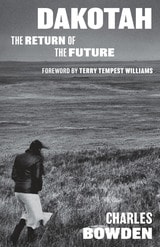
Dakotah
The Return of the FutureBy Charles Bowden; foreword by Terry Tempest Williams
University of Texas Press, 2019
“[Dakotah] is about hope, disappointment, impermanence and erasure. . . . This is a meditation Bowden fans will not want to miss.”—Arizona Daily Star
“Bowden’s prose—bleak, fierce, surreal like a swirling sandstorm, like an endlessly ramifying arroyo—provided for me, in its rejection of facile theses and clear-cut answers, an honest mapping of our contemporary predicament.”—Leath Tonino, Lit Hub
The fourth installment in Charles Bowden's acclaimed “Unnatural History of America,” Dakotah uses America’s Great Plains as a lens—sometimes sullied, sometimes shattered, but always sharp—for observing pivotal moments in the lives of anguished figures, including himself.
In scenes that are by turns wrenching and poetic, Bowden describes the Sioux’s forced migrations and rebellions alongside his own ancestors’ migrations from Europe to Midwestern acres beset by unforgiving winters. He meditates on the life of his resourceful mother and his philosophical father, who rambled between farm communities and city life. Interspersed with these images are clear-eyed, textbook-defying anecdotes about Lewis and Clark, Daniel Boone, and, with equal verve, twentieth-century entertainers “Pee Wee” Russell, Peggy Lee, and other musicians. The result is a kaleidoscopic journey that penetrates the senses and redefines the notion of heartland. Dakotah is a powerful ode to loss from one of our most fiercely independent writers.
Democracy's Education
Public Work, Citizenship, and the Future of Colleges and UniversitiesHarry C. Boyte
Vanderbilt University Press, 2015
Democracy's Education grows from the American Commonwealth Partnership, a year-long project to revitalize the democratic narrative of higher education that began with an invitation to Harry Boyte from the White House to put together a coalition aimed at strengthening higher education as a public good. The project was launched at the beginning of 2012 to mark the 150th anniversary of the Morrill Act, which created land grant colleges.
Beginning with an essay by Harry C. Boyte, "Reinventing Citizenship as Public Work," which challenges educators and their partners to claim their power to shape the story of higher education and the civic careers of students, the collection brings world-famous scholars, senior government officials, and university presidents together with faculty, students, staff, community organizers, and intellectuals from across the United States and South Africa and Japan. Contributors describe many constructive responses to change already taking place in different kinds of institutions, and present cutting-edge ideas like "civic science," "civic studies," "citizen professionalism," and "citizen alumni." Authors detail practical approaches to making change, from new faculty and student roles to changes in curriculum and student life and strategies for everyday citizen empowerment. Overall, the work develops a democratic story of education urgently needed to address today's challenges, from climate change to growing inequality.
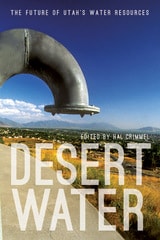
Desert Water
The Future of Utah's Water ResourcesHal Crimmel
University of Utah Press, 2014
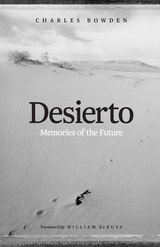
Desierto
Memories of the FutureBy Charles Bowden, foreword by William deBuys
University of Texas Press, 2018
“A dark, troubling vision of life in the desert, defined broadly; of mountain lions and drug kingpins, Mexican hopes and Indian feuds.”
—Los Angeles Times
“In these powerful epic tales of the Sonora Desert, Bowden peoples the harsh land on both sides of the US-Mexican border with saints and sinners, but his enduring hero is the desert itself.”
—Kirkus Reviews

Designing a School Library Media Center for the Future
Rolf Erikson
American Library Association, 2007
Disputed Inheritance
The Battle over Mendel and the Future of BiologyGregory Radick
University of Chicago Press, 2023
In 1900, almost no one had heard of Gregor Mendel. Ten years later, he was famous as the father of a new science of heredity—genetics. Even today, Mendelian ideas serve as a standard point of entry for learning about genes. The message students receive is plain: the twenty-first century owes an enlightened understanding of how biological inheritance really works to the persistence of an intellectual inheritance that traces back to Mendel’s garden.
Disputed Inheritance turns that message on its head. As Gregory Radick shows, Mendelian ideas became foundational not because they match reality—little in nature behaves like Mendel’s peas—but because, in England in the early years of the twentieth century, a ferocious debate ended as it did. On one side was the Cambridge biologist William Bateson, who, in Mendel’s name, wanted biology and society reorganized around the recognition that heredity is destiny. On the other side was the Oxford biologist W. F. R. Weldon, who, admiring Mendel's discoveries in a limited way, thought Bateson's "Mendelism" represented a backward step, since it pushed growing knowledge of the modifying role of environments, internal and external, to the margins. Weldon's untimely death in 1906, before he could finish a book setting out his alternative vision, is, Radick suggests, what sealed the Mendelian victory.
Bringing together extensive archival research with searching analyses of the nature of science and history, Disputed Inheritance challenges the way we think about genetics and its possibilities, past, present, and future.
Does Science Need a Global Language?
English and the Future of ResearchScott L. Montgomery
University of Chicago Press, 2013
In Does Science Need a Global Language?, Scott L. Montgomery seeks to answer this question by investigating the phenomenon of global English in science, how and why it came about, the forms in which it appears, what advantages and disadvantages it brings, and what its future might be. He also examines the consequences of a global tongue, considering especially emerging and developing nations, where research is still at a relatively early stage and English is not yet firmly established.
Throughout the book, he includes important insights from a broad range of perspectives in linguistics, history, education, geopolitics, and more. Each chapter includes striking and revealing anecdotes from the front-line experiences of today’s scientists, some of whom have struggled with the reality of global scientific English. He explores topics such as student mobility, publication trends, world Englishes, language endangerment, and second language learning, among many others. What he uncovers will challenge readers to rethink their assumptions about the direction of contemporary science, as well as its future.
Does Writing Have a Future?
Vilém Flusser
University of Minnesota Press, 2010
Confirming Flusser’s status as a theorist of new media in the same rank as Marshall McLuhan, Jean Baudrillard, Paul Virilio, and Friedrich Kittler, the balance of this book teases out the nuances of these developments. To find a common denominator among texts and practices that span millennia, Flusser looks back to the earliest forms of writing and forward to the digitization of texts now under way. For Flusser, writing—despite its limitations when compared to digital media—underpins historical consciousness, the concept of progress, and the nature of critical inquiry. While the text as a cultural form may ultimately become superfluous, he argues, the art of writing will not so much disappear but rather evolve into new kinds of thought and expression.
Doing Women's Film History
Reframing Cinemas, Past and FutureEdited by Christine Gledhill and Julia Knight
University of Illinois Press, 2015
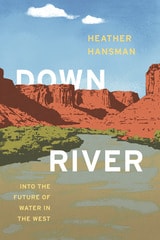
Downriver
Into the Future of Water in the WestHeather Hansman
University of Chicago Press, 2019
The Green River, the most significant tributary of the Colorado River, runs 730 miles from the glaciers of Wyoming to the desert canyons of Utah. Over its course, it meanders through ranches, cities, national parks, endangered fish habitats, and some of the most significant natural gas fields in the country, as it provides water for 33 million people. Stopped up by dams, slaked off by irrigation, and dried up by cities, the Green is crucial, overused, and at-risk, now more than ever.
Fights over the river’s water, and what’s going to happen to it in the future, are longstanding, intractable, and only getting worse as the West gets hotter and drier and more people depend on the river with each passing year. As a former raft guide and an environmental reporter, Heather Hansman knew these fights were happening, but she felt driven to see them from a different perspective—from the river itself. So she set out on a journey, in a one-person inflatable pack raft, to paddle the river from source to confluence and see what the experience might teach her. Mixing lyrical accounts of quiet paddling through breathtaking beauty with nights spent camping solo and lively discussions with farmers, city officials, and other people met along the way, Downriver is the story of that journey, a foray into the present—and future—of water in the West.
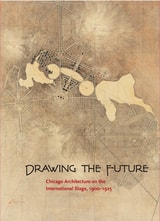
Drawing the Future
Chicago Architecture on the International Stage, 1900-1925David Van Zanten
Northwestern University Press, 2013
Drawing the Future: Chicago Architecture on the International Stage, 1900–1925 is an illustrated catalog with companion essays for an exhibition of the same name at the Mary and Leigh Block Museum of Art at Northwestern University. Drawing the Future explores the creative ferment among Chicago architects in the early twentieth century, coinciding with similar visions around the world. The essays focus on the highlights of the exhibition. David Van Zanten profiles Walter Burley Griffin and Marion Mahony Griffin, Chicago architects who created an influential, prize-winning plan for Canberra, the new capital of Australia. Ashley Dunn looks at the two exhibits at the Musée des Arts Décoratifs in Paris, one devoted to the Griffins in 1914 and the other to the French architect Tony Garnier in 1925, demonstrating the impact of World War I on city planning and architecture. Leslie Coburn examines Chicago’s Neighborhood Center Competition of 1914–15, which sought to redress gaps in Daniel Burnham’s plan of 1909. The ambition and reach of Chicago architecture in this epoch would have lasting influence on cities of the future.
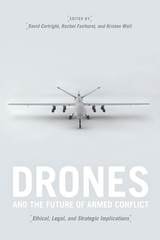
Drones and the Future of Armed Conflict
Ethical, Legal, and Strategic ImplicationsEdited by David Cortright, Rachel Fairhurst, and Kristen Wall
University of Chicago Press, 2015
Presenting a robust conversation among leading scholars in the areas of international legal standards, counterterrorism strategy, humanitarian law, and the ethics of force, Drones and the Future of Armed Conflict takes account of current American drone campaigns and the developing legal, ethical, and strategic implications of this new way of warfare. Among the contributions to this volume are a thorough examination of the American government’s legal justifications for the targeting of enemies using drones, an analysis of American drone campaigns’ notable successes and failures, and a discussion of the linked issues of human rights, freedom of information, and government accountability.
Dwelling on the Future
Architecture of the Seaside, Middle England and the MetropolisPierre d'Avoine
University College London, 2020
D’Avoine covers a wide range of examples, including proposals for luxury housing and designs for low-cost dwellings, which all address the needs and desires of their potential inhabitants. The book explores an inclusive approach to the design of settlements—and not just in cities—that recognizes difference, an approach that demands a fresh political vision to resolve humanity’s increasing inequality, for the benefit of all. Simultaneously practical and aspirational, Dwelling on The Future casts a much needed light on our thoughts and aspirations, and on our definitions of home.