Results by title
130 books match the query 'Gay men' and 3 start with d

Death Claims
A Dave Branstetter MysteryJoseph Hansen
University of Wisconsin Press, 2004
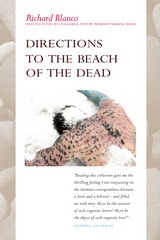
Directions to the Beach of the Dead
Richard Blanco
University of Arizona Press, 2005
The words are redolent with his Cuban heritage: Marina making mole sauce; Tía Ida bitter over the revolution, missing the sisters who fled to Miami; his father, especially, “his hair once as black as the black of his oxfords…” Yet this is a volume for all who have longed for enveloping arms and words, and for that sanctuary called home. “So much of my life spent like this-suspended, moving toward unknown places and names or returning to those I know, corresponding with the paradox of crossing, being nowhere yet here.” Blanco embraces juxtaposition. There is the Cuban Blanco, the American Richard, the engineer by day, the poet by heart, the rhythms of Spanish, the percussion of English, the first-world professional, the immigrant, the gay man, the straight world. There is the ennui behind the question: why cannot I not just live where I live? Too, there is the precious, fleeting relief when he can write "…I am, for a moment, not afraid of being no more than what I hear and see, no more than this:..." It is what we all hope for, too.

Diva
Rafael Campo
Duke University Press, 1999
At once relishing and resisting the poetic traditions of formal English verse, Diva showcases Campo moving deftly between received forms and free verse. In each poem the sound of words is transformed into the highest of arts, the act of performance into the exercise of power, and the most profound abjection into the sweet promise of divinity. Culminating with his new and daring translations of Federico García Lorca's sonetos—the great Spanish poet's most homoerotically explicit and formally accomplished poems—Campo's music instills in the reader an exalted understanding of beauty, suffering, and, ultimately, the human capacity for empathy.
From reviews of Campo's previous poetry:
“Extraordinary meditations on illness and the healing power of words.”—Lambda Literary Foundation
“Read Campo to enter the bloodstream of a man who, with a haunting clarity of vision, shares his memories, his anguish, his healing love.”—Cortney Davis, Literature and Medicine
“Riveting, provocative, and refreshing—[this volume] is a gift to the clinician who is trying to re-invoke in his or her students the humility, compassion, and deep caring that brought us all into medicine in the first place.”—Dr. Sandra L. Bertman, Annals of Internal Medicine
“[Campo] listens to the sounds the body makes, but what he hears is poetry.”—Zoë Ingalls, Chronicle of Higher Education
“Powerful and accessible.”—Jonathan Jackson, Washington Blade
“Bemused, indelible, and heartbreaking.”—Marilyn Hacker, Out
“[Campo’s] private corral of disparate words twist, torque, collide with gorgeous creative imperative.”—Nomi Eve, Independent Weekly