Results by title
52 books match the query 'Gender identity in literature' and 3 start with d

Danger Zones
Homosexuality, National Identity, and Mexican CultureClaudia Schaefer
University of Arizona Press, 1996
Homosexuality has appeared as a secondary theme in the fictional works of numerous mainstream writers in contemporary Mexico. Here, the author deals with issues of gender identity when they emerge as metaphorical red flags signaling cultural danger zones along the path to harmonious national discourse. By focusing on the representation of homosexuality in a variety of texts produced between 1964 and 1994, the book also delineates complex relationships within Mexican society.
Contents:
1. El diario de José Toledo: The Fantasies of a Middle-Class Bureaucrat
2. The Power of Subversive Imagination: Utopian Discourse in the Novels of Luis Zapata and José Rafael Calva
3. On the Cutting Edge: El jinete azul and the Aesthetics of the Abyss
4. Monobodies, Antibodies, and the Body Politic: Sara Levi Calderón’s Dos mujeres
5. Just Another Material Girl? La hermana secreta de Angélica María and the Seduction of the Popular
6. From "Infernal Realms of Delinquency" to Cozy Cabañas in Cuernavaca: José Joaquín Blanco’s Visions of Homosexuality
[more]
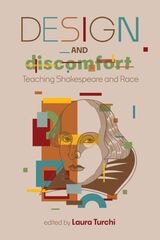
Design and Discomfort
Teaching Shakespeare and RaceEdited by Laura B. Turchi
Arizona Center for Medieval and Renaissance Studies, 2025
What does it mean to teach Shakespeare in a world reckoning with racism and injustice? Explore new and innovative strategies for transforming discomfort into dialogue.
Design and Discomfort confronts the complexities of teaching Shakespeare in today’s classrooms, where discussions of race, bias, and historical legacies can provoke discomfort—but also transformation. Edited by Laura B. Turchi, this collection brings together educators and teaching artists who share innovative strategies for rethinking Shakespeare’s role in education.
Rather than treating Shakespeare as an untouchable authority, the contributors explore how his works can be a springboard for broader conversations about identity and justice. They advocate for performance-based and student-driven approaches that help students see themselves—their communities, their families, and their lived experiences—in the complex and seemingly distant world of Shakespeare.
This open-access volume provides both conceptual essays and practical lesson designs for educators navigating the intersections of Shakespeare and race. By embracing discomfort as part of the learning process, Design and Discomfort reframes how Shakespeare should be taught in classrooms today.
[more]

Diversity and Detective Fiction
Kathleen Gregory Klein
University of Wisconsin Press, 1999
The first collection to articulate the pedagogical strategies of using detective fiction to investigate the politics of difference. The volume examines the many ways in which diversity is posited by contemporary writers exploring distinctive American subcultures. The distinguishing characteristic of the book is its mix of essays focusing on teaching cultural diversity in the classroom and illustrating diversity through fiction to the general reader.
Among the issues addressed are definitions of diversity; what constitutes ethnicity or race, especially in terms of multiple subjectivities; how race, gender, and ethnicity are culturally constructed; and what part is played by identity politics.
Among the issues addressed are definitions of diversity; what constitutes ethnicity or race, especially in terms of multiple subjectivities; how race, gender, and ethnicity are culturally constructed; and what part is played by identity politics.
[more]