Results by title
69 books match the query 'Genocide' and 3 start with d

Darfur Allegory
Rogaia Mustafa Abusharaf
University of Chicago Press, 2021
The Darfur conflict exploded in early 2003 when two rebel groups, the Sudan Liberation Movement and the Justice and Equality Movement, struck national military installations in Darfur to send a hard-hitting message of resentment over the region’s political and economic marginalization. The conflict devastated the region’s economy, shredded its fragile social fabric, and drove millions of people from their homes. Darfur Allegory is a dispatch from the humanitarian crisis that explains the historical and ethnographic background to competing narratives that have informed international responses. At the heart of the book is Sudanese anthropologist Rogaia Abusharaf’s critique of the pseudoscientific notions of race and ethnicity that posit divisions between “Arab” northerners and “African” Darfuris.
Elaborated in colonial times and enshrined in policy afterwards, such binary categories have been adopted by the media to explain the civil war in Darfur. The narratives that circulate internationally are thus highly fraught and cover over—to counterproductive effect—forms of Darfurian activism that have emerged in the conflict’s wake. Darfur Allegory marries the analytical precision of a committed anthropologist with an insider’s view of Sudanese politics at home and in the diaspora, laying bare the power of words to heal or perpetuate civil conflict.
Elaborated in colonial times and enshrined in policy afterwards, such binary categories have been adopted by the media to explain the civil war in Darfur. The narratives that circulate internationally are thus highly fraught and cover over—to counterproductive effect—forms of Darfurian activism that have emerged in the conflict’s wake. Darfur Allegory marries the analytical precision of a committed anthropologist with an insider’s view of Sudanese politics at home and in the diaspora, laying bare the power of words to heal or perpetuate civil conflict.
[more]
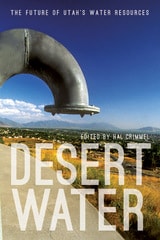
Desert Water
The Future of Utah's Water ResourcesHal Crimmel
University of Utah Press, 2014
Hal Crimmel has brought the findings of science together with the experienced voices of environmental social scientists, humanists, and activists to provide perspective on Utah water issues. The matters discussed are relevant beyond this one state, as similar conditions and concerns, especially over supply and demand in the face of demographic and climate change, exist throughout the West. Some of the essays are scientific and analytical; others literary and personal. Together they draw attention to problems that Utah residents and policy makers must address but also emphasize ways to build solutions. Desert Water will help citizens, policy makers, and anyone interested in Utah’s water supply and use—as everyone in the state should be—understand the real challengesand ethicsinvolved in managing this vital, finite resource. By awareness, these essays should create a sense of urgency for finding workable solutions.
[more]
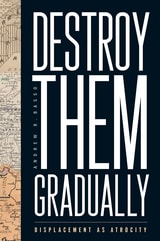
Destroy Them Gradually
Displacement as AtrocityAndrew R. Basso
Rutgers University Press, 2024
Perpetrators of mass atrocities have used displacement to transport victims to killing sites or extermination camps to transfer victims to sites of forced labor and attrition, to ethnically homogenize regions by moving victims out of their homes and lands, and to destroy populations by depriving them of vital daily needs. Displacement has been treated as a corollary practice to crimes committed, not a central aspect of their perpetration. Destroying Them Gradually examines four cases that illuminate why perpetrators have destroyed populations using displacement policies: Germany’s genocide of the Herero (1904–1908); Ottoman genocides of Christian minorities (1914–1925); expulsions of Germans from East/Central Europe (1943–1952); and climate violence (twenty-first century). Because displacement has been typically framed as a secondary aspect of mass atrocities, existing scholarship overlooks how perpetrators use it as a means of executing destruction rather than a vehicle for moving people to a specific location to commit atrocities.
[more]