Results by title
93 books match the query 'Genocide & War Crimes' and 2 start with d
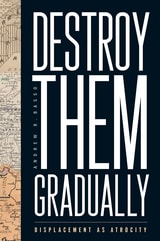
Destroy Them Gradually
Displacement as AtrocityAndrew R. Basso
Rutgers University Press, 2024
Perpetrators of mass atrocities have used displacement to transport victims to killing sites or extermination camps to transfer victims to sites of forced labor and attrition, to ethnically homogenize regions by moving victims out of their homes and lands, and to destroy populations by depriving them of vital daily needs. Displacement has been treated as a corollary practice to crimes committed, not a central aspect of their perpetration. Destroying Them Gradually examines four cases that illuminate why perpetrators have destroyed populations using displacement policies: Germany’s genocide of the Herero (1904–1908); Ottoman genocides of Christian minorities (1914–1925); expulsions of Germans from East/Central Europe (1943–1952); and climate violence (twenty-first century). Because displacement has been typically framed as a secondary aspect of mass atrocities, existing scholarship overlooks how perpetrators use it as a means of executing destruction rather than a vehicle for moving people to a specific location to commit atrocities.
[more]
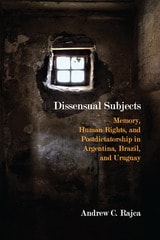
Dissensual Subjects
Memory, Human Rights, and Postdictatorship in Argentina, Brazil, and UruguayAndrew C. Rajca
Northwestern University Press, 2018
In Dissensual Subjects, Andrew C. Rajca combines cultural studies and critical theory to explore how the aftereffects of dictatorship have been used to formulate dominant notions of human rights in the present. In so doing, he critiques the exclusionary nature of these processes and highlights who and what count (and do not count) as subjects of human rights as a result.
Through an engaging exploration of the concept of “never again” (nunca más/nunca mais) and close analysis of photography exhibits, audiovisual installations, and other art forms in spaces of cultural memory, the book explores how aesthetic interventions can suggest alternative ways of framing human rights subjectivity beyond the rhetoric of liberal humanitarianism. The book visits sites of memory, two of which functioned as detention and torture centers during dictatorships, to highlight the tensions between the testimonial tenor of permanent exhibits and the aesthetic interventions of temporary installations there. Rajca thus introduces perspectives that both undo common understandings of authoritarian violence and its effects as well as reconfigure who or what are made visible as subjects of memory and human rights in postdictatorship countries.
Dissensual Subjects offers much to those concerned with numerous interlocking fields: memory, human rights, political subjectivity, aesthetics, cultural studies, visual culture, Southern Cone studies, postdictatorship studies, and sites of memory.
[more]