Results by title
383 books match the query 'Globalization' and 8 start with d
Debating the End of History
The Marketplace, Utopia, and the Fragmentation of Intellectual LifeDavid W. Noble
University of Minnesota Press, 2012
Why do modern people assume that there will be perpetual economic growth? Because, David W. Noble tells us in this provocative study of cultural criticism, such a utopian conviction is the necessary foundation for bourgeois culture. One can imagine the existence of modern middle classes only as long as the capitalist marketplace is expanding. For Noble, the related—and relevant—question is, how can the middle classes believe that a finite earth is an environment in which infinite growth is possible? The answer, which Noble so painstakingly charts, is nothing less than a genealogy of the uses and abuses of knowledge that lie at the heart of so many of our political problems today.
As far back as Plato and as recently as Alan Greenspan, Noble finds proponents of the idea of a world of independent, rational individuals living in timeless simplicity, escaping from an old world of interdependence and generations. Such notions, although in sync with Newtonian science, have come up against the subsequent conclusions of geology, biology, and the physics of Einstein. In a survey of the responses to this quandary of historians, economists, literary critics, and ecologists, Noble reveals how this confrontation, and its implications for a single global marketplace, has forced certain academic disciplines into unnatural—and untenable—positions.
David Noble’s work exposes the cost—not academic at all—of the segregation of the physical sciences from the humanities and social sciences, even as it demonstrates the required movement of the humanities toward the ecological vision of a single, interconnected world.
Decolonizing Afghanistan
Countering Imperial Knowledge and PowerWazhmah Osman and Robert D. Crews, editors
Duke University Press, 2025
Contributors. Matthieu Aikins, Dawood Azami, Purnima Bose, Paula Chakravartty, Robert D. Crews, Marya Hannun, Ali Karimi, Nivi Manchanda, Sabauon Nasseri, Tausif Noor, Wazhmah Osman, Hosai Qasmi, Zohra Saed, Gazelle Samizay, Morwari Zafar, Helena Zeweri
Decolonizing Mormonism
Approaching a Postcolonial ZionEdited by Gina Colvin and Joanna Brooks
University of Utah Press, 2018
As a social institution, Mormonism is shaped around cultural notions, systems, and ideas that have currency in the United States but make less sense beyond the land of its genesis. Even as an avowedly international religion some 183 years out from its inception, it makes few allowances for diverse international contexts, with Salt Lake City prescribing programs, policies, curricula, leadership, and edicts for the church’s international regions. While Mormonism’s greatest strength is its organizational coherence, there is also a cost paid for those at the church’s peripheries.
Decolonizing Mormonism brings together the work of 15 scholars from around the globe who critically reflect on global Mormon experiences and American-Mormon cultural imperialism. Indigenous, minority, and Global South Mormons ask in unison: what is the relationship between Mormonism and imperialism and where must the Mormon movement go in order to achieve its long-cherished dream of equality for all in Zion? Their stories are both heartbreaking and heartening and provide a rich resource for thinking about the future of Mormon missiology and the possibilities inherent in the work of Mormon contextual theology.
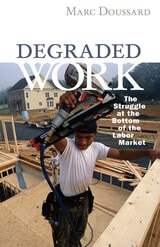
Degraded Work
The Struggle at the Bottom of the Labor MarketMarc Doussard
University of Minnesota Press, 2013
Critics on the left and the right typically agree that globalization, the loss of manufacturing jobs, and the expansion of the service sector have led to income inequality and rising numbers of low-paying jobs with poor working conditions.
In Degraded Work, Marc Doussard demonstrates that this decline in wages and working conditions is anything but the unavoidable result of competitive economic forces. Rather, he makes the case that service sector and other local-serving employers have boosted profit with innovative practices to exploit workers, demeaning their jobs in new ways—denying safety equipment, fining workers for taking scheduled breaks, requiring unpaid overtime—that go far beyond wage cuts. Doussard asserts that the degradation of service work is a choice rather than an inevitability, and he outlines concrete steps that can be taken to help establish a fairer postindustrial labor market.
Drawing on fieldwork in Chicago, Degraded Work examines changes in two industries in which inferior job quality is assumed to be intrinsic: residential construction and food retail. In both cases, Doussard shows how employers degraded working conditions as part of a successful and intricate strategy to increase profits. Arguing that a growing service sector does not have to mean growing inequality, Doussard proposes creative policy and organizing opportunities that workers and advocates can use to improve job quality despite the overwhelming barriers to national political action.
Diasporas in the New Media Age
Identity, Politics, and CommunityAndoni Alonso
University of Nevada Press, 2010
The explosion of digital information and communication technologies has influenced almost every aspect of contemporary life. Diasporas in the New Media Age is the first book-length examination of the social use of these technologies by emigrants and diasporas around the world. The eighteen original essays in the book explore the personal, familial, and social impact of modern communication technology on populations of European, Asian, African, Caribbean, Middle Eastern, and Latin American emigrants. It also looks at the role and transformation of such concepts as identity, nation, culture, and community in the era of information technology and economic globalization. The contributors, who represent a number of disciplines and national origins, also take a range of approaches—empirical, theoretical, and rhetorical—and combine case studies with thoughtful analysis. Diasporas in the New Media Age is both a discussion of the use of communication technologies by various emigrant groups and an engaging account of the immigrant experience in the contemporary world. It offers important insights into the ways that dispersed populations are using digital media to maintain ties with their families and homeland, and to create new communities that preserve their culture and reinforce their sense of identity. In addition, the book is a significant contribution to our understanding of the impact of technology on society in general.
Dislocalism
The Crisis of Globalization and the Remobilizing of AmericanismSarika Chandra
The Ohio State University Press, 2011
Notwithstanding its now extensive, trans-disciplinary bibliography, the full reality of globalization remains less well understood than commonly thought. As an objective, secular phenomenon, globalization has continued to be obscured by ideological and rhetorical strategies that travel under the same name but posit it as simply the abstract-universal other of the local. Dislocalism: The Crisis of Globalization and the Remobilizing of Americanism makes such strategies and the global/local binary they reinforce into objects of critical analysis.
Dream Trippers
Global Daoism and the Predicament of Modern SpiritualityDavid A. Palmer and Elijah Siegler
University of Chicago Press, 2017
Dream Trippers draws on more than a decade of ethnographic work with Daoist monks and Western seekers to trace the spread of Westernized Daoism in contemporary China. David A. Palmer and Elijah Siegler take us into the daily life of the monastic community atop the mountain of Huashan and explore its relationship to the socialist state. They follow the international circuit of Daoist "energy tourism," which connects a number of sites throughout China, and examine the controversies around Western scholars who become practitioners and promoters of Daoism. Throughout are lively portrayals of encounters among the book’s various characters—Chinese hermits and monks, Western seekers, and scholar-practitioners—as they interact with each other in obtuse, often humorous, and yet sometimes enlightening and transformative ways. Dream Trippers untangles the anxieties, confusions, and ambiguities that arise as Chinese and American practitioners balance cosmological attunement and radical spiritual individualism in their search for authenticity in a globalized world.
Dwelling in American
Dissent, Empire, and GlobalizationJohn Muthyala
Dartmouth College Press, 2012