Results by title
230 books match the query 'Government relations' and 7 start with d
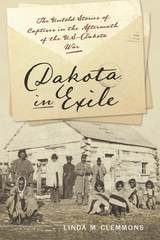
Dakota in Exile
The Untold Stories of Captives in the Aftermath of the U.S.-Dakota WarLinda M. Clemmons
University of Iowa Press, 2019
Historian Linda Clemmons examines the surviving letters from Robert and Sarah; other Dakota language sources; and letters from missionaries, newspaper accounts, and federal documents. She blends both the personal and the historical to complicate our understanding of the development of the Midwest, while also serving as a testament to the resilience of the Dakota and other indigenous peoples who have lived in this region from time immemorial.
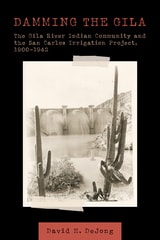
Damming the Gila
The Gila River Indian Community and the San Carlos Irrigation Project, 1900–1942David H. DeJong
University of Arizona Press, 2024
This volume continues to chronicle the history of water rights and activities on the Gila River Indian Reservation. Centered on the San Carlos Irrigation Project and Coolidge Dam, it details the history and development of the project, including the Gila Decree and the Winters Doctrine. Embedded in the narrative is the underlying tension between tribal growers on the Gila River Indian Reservation and upstream users. Told in seven chapters, the story underscores the idea that the Gila River Indian Community believed the San Carlos Irrigation Project was first and foremost for their benefit and how the project and the Gila Decree fell short of restoring their water and agricultural economy.
Damming the Gila is the third in a trio of important documentary works, beginning with DeJong’s Stealing the Gila and followed by Diverting the Gila. It continues the story of the Gila River Indian Community’s fight to regain access to their water.
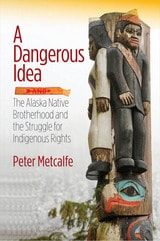
Dangerous Idea
The Alaska Native Brotherhood and the Struggle for Indigenous RightsPeter Metcalfe
University of Alaska Press, 2014
A Dangerous Idea tells an overlooked but powerful story of Alaska Natives fighting for their rights under American law and details one of the rare successes for Native Americans in their nearly two-hundred-year effort to define and protect their rights.
Dawnland Encounters
Indians and Europeans in Northern New EnglandEdited by Colin G. Calloway
University Press of New England, 1991
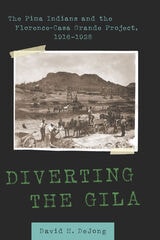
Diverting the Gila
The Pima Indians and the Florence-Casa Grande Project, 1916–1928David H. DeJong
University of Arizona Press, 2021
Diverting the Gila explores the complex web of tension, distrust, and political maneuvering to divide and divert the scarce waters of the Gila River. Residents of Florence, Casa Grande, and the Pima Reservation fought for vital access to water rights. Into this political foray stepped Arizona’s freshman congressman Carl Hayden, who not only united the farming communities but also used Pima water deprivation to the advantage of Florence-Casa Grande and Upper Gila Valley growers. The result was the federal Florence-Casa Grande Project that, as legislated, was intended to benefit Pima growers on the Gila River Indian Reservation first and foremost. As was often the case in the West, well-heeled, nontribal political interests manipulated the laws at the expense of the Indigenous community.
Diverting the Gila is the sequel to David H. DeJong’s 2009 Stealing the Gila, and it continues to tell the story of the forerunner to the San Carlos Irrigation Project and the Gila River Indian Community’s struggle to regain access to their water.
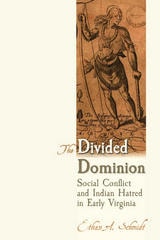
Divided Dominion
Social Conflict and Indian Hatred in Early VirginiaEthan A. Schmidt
University Press of Colorado, 2014
Myriad internal and external factors drove Virginians to interpret their disputes with one another increasingly along class lines. The decades-long tripartite struggle among elite whites, non-elite whites, and Native Americans resulted in the development of mutually beneficial economic and political relationships between elites and Native Americans. When these relationships culminated in the granting of rights—equal to those of non-elite white colonists—to Native Americans, the elites crossed a line and non-elite anger boiled over. A call for the annihilation of all Indians in Virginia united different non-elite white factions and molded them in widespread social rebellion.
The Divided Dominion places Indian policy at the heart of Bacon's Rebellion, revealing the complex mix of social, cultural, and racial forces that collided in Virginia in 1676. This new analysis will interest students and scholars of colonial and Native American history.
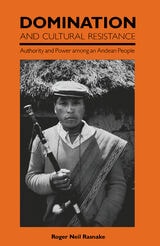
Domination and Cultural Resistance
Authority and Power Among an Andean PeopleRoger Neil Rasnake
Duke University Press, 1988