Results by title
218 books match the query 'Handbooks, manuals, etc' and 7 start with d

Describing Electronic, Digital, and Other Media Using AACR2 and RDA
Fay Angela Austin
American Library Association, 2010
Developing Library Leaders
American Library Association, 2010
Developing and Maintaining Practical Archives
Gregory S. Hunter
American Library Association, 2003
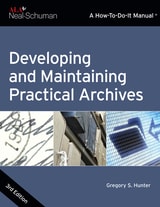
Developing and Maintaining Practical Archives
A How-To-Do-It ManualGregory S. Hunter
American Library Association, 2020
- a history of archives, including the roles of historical societies and local history collections in libraries;
- new sections on community archives, diversity, and inclusion;
- conducting a survey and starting an archival program;
- selection, appraisal, acquisition, accessioning, and deaccessioning;
- important points of copyright, privacy, and ethics;
- arrangement of archival collections, with a discussion of new theories;
- description, including DACS, EAD, and tools such as ArchivesSpace;
- access, reference, and outreach, with a look at how recent innovations in finding aids can help researchers;
- preservation, including guidance on how to handle rare books, maps, architectural records, and artifacts;
- digital records, addressing new and popular methods of storage and preservation of email, social media, image files, webpages, Word documents, spreadsheets, databases, and media files;
- disaster planning, security, and theft prevention;
- metrics, assessment, establishing employee procedures and policies, working with interns and volunteers, and other managerial duties;
- public relations and marketing, from social media and the Web to advocacy; and
- professional guidelines and codes, such as the newly developed SAA Statement of Core Values of Archivists.
Developmental Editing, Second Edition
A Handbook for Freelancers, Authors, and PublishersScott Norton
University of Chicago Press, 2023
Developmental editing—transforming a manuscript into a book that edifies, inspires, and sells—is a special skill, and Scott Norton is one of the best at it. With more than three decades of experience in the field, Norton offers his expert advice on how to approach the task of diagnosing and fixing structural problems with book manuscripts in consultation with authors and publishers. He illustrates these principles through a series of detailed case studies featuring before-and-after tables of contents, samples of edited text, and other materials to make an otherwise invisible process tangible.
This revised edition for the first time includes exercises that allow readers to edit sample materials and compare their work with that of an experienced professional as well as a new chapter on the unique challenges of editing fiction. In addition, it features expanded coverage of freelance business arrangements, self-published authors, e-books, content marketing, and more.
Whether you are an aspiring or experienced developmental editor or an author who works alongside one, you will benefit from Norton’s accessible, collaborative, and realistic approach and guidance. This handbook offers the concrete and essential tools it takes to help books to find their voice and their audience.
Developmental Editing
A Handbook for Freelancers, Authors, and PublishersScott Norton
University of Chicago Press, 2009
Editing is a tricky business. It requires analytical flair and creative panache, the patience of a saint and the vision of a writer. Transforming a manuscript into a book that edifies, inspires, and sells? That’s the job of the developmental editor, whose desk is the first stop for many manuscripts on the road to bookdom—a route ably mapped out in the pages of Developmental Editing.
Author Scott Norton has worked with a diverse range of authors, editors, and publishers, and his handbook provides an approach to developmental editing that is logical, collaborative, humorous, and realistic. He starts with the core tasks of shaping the proposal, finding the hook, and building the narrative or argument, and then turns to the hard work of executing the plan and establishing a style.
Developmental Editing includes detailed case studies featuring a variety of nonfiction books—election-year polemic, popular science, memoir, travel guide—and authors ranging from first-timer to veteran, journalist to scholar. Handy sidebars offer advice on how to become a developmental editor, create effective illustration programs, and adapt sophisticated fiction techniques (such as point of view, suspense, plotting, character, and setting) to nonfiction writing.
Norton’s book also provides freelance copyeditors with a way to earn higher fees while introducing more creativity into their work lives. It gives acquisitions, marketing, and production staff a vocabulary for diagnosing a manuscript’s flaws and techniques for transforming it into a bestseller. And perhaps most importantly, Developmental Editing equips authors with the concrete tools they need to reach their audiences.
Digital Paper
A Manual for Research and Writing with Library and Internet MaterialsAndrew Abbott
University of Chicago Press, 2014
Abbott tells what every senior researcher knows: that research is not a mechanical, linear process, but a thoughtful and adventurous journey through a nonlinear world. He breaks library research down into seven basic and simultaneous tasks: design, search, scanning/browsing, reading, analyzing, filing, and writing. He moves the reader through the phases of research, from confusion to organization, from vague idea to polished result. He teaches how to evaluate data and prior research; how to follow a trail to elusive treasures; how to organize a project; when to start over; when to ask for help. He shows how an understanding of scholarly values, a commitment to hard work, and the flexibility to change direction combine to enable the researcher to turn a daunting mass of found material into an effective paper or thesis.
More than a mere how-to manual, Abbott’s guidebook helps teach good habits for acquiring knowledge, the foundation of knowledge worth knowing. Those looking for ten easy steps to a perfect paper may want to look elsewhere. But serious scholars, who want their work to stand the test of time, will appreciate Abbott’s unique, forthright approach and relish every page of Digital Paper.