Results by title
124 books match the query 'Health and hygiene' and 9 start with d

Dads, Kids, and Fitness
A Father's Guide to Family HealthMarsiglio, William
Rutgers University Press, 2016
Now more than ever, American dads act as hands-on caregivers who are devoted to keeping themselves and their families healthy. Yet, men are also disproportionately likely to neglect their own health care, diets, and exercise routines—bad habits that they risk passing on to their children.
In Dads, Kids, and Fitness, William Marsiglio challenges dads to become more health-conscious in how they live and raise their children. His conclusions are drawn not only from his revealing interviews with a diverse sample of dads and pediatric healthcare professionals, but also from his own unique personal experiences—as a teenage father who, thirty-one years later, became a later-life dad to a second son. Marsiglio’s research highlights the value of treating dads as central players in what he calls the social health matrix, which can serve both healthy children and those with special needs. He also outlines how schools, healthcare facilities, religious groups, and other organizations can help dads make a positive imprint on their families’ health, fitness, and well-being.
Anchored in compelling life stories of joy, tragedy, and resilience, Dads, Kids, and Fitness extends and deepens public conversation about health at a pivotal historical moment. Its progressive message breathes new life into discussions about fathering, manhood, and health.
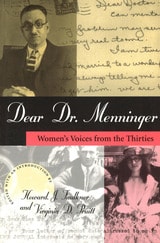
Dear Dr. Menninger
Women's Voices from the ThirtiesHoward J. Faulkner and Virginia D. Pruitt, eds.
University of Missouri Press, 1997
In 1930 Dr. Karl A. Menninger, one of America's most distinguished psychiatrists, was asked by the editor of Ladies' Home Journal to write a monthly column that would address mental health issues and answer questions from readers. The result was the widely popular column "Mental Hygiene in the Home," which ran for eighteen months at a time when the American public was just beginning to popularize the idea of mental hygiene and psychotherapy.
Of the thousands of letters Dr. Menninger received, only a small number were printed in the Journal. However, he wrote personal responses to all of them, over two thousand of which have been preserved. For this book, Howard J. Faulkner and Virginia D. Pruitt have selected more than eighty exchanges that provide intimate glimpses into the personal lives of women from across the country.
Most notable in this fascinating collection is the precision and clarity of the women's voices, as well as Dr. Menninger's incisive, analytical, and elegantly phrased replies. The topics that were of major concern to these women included their own sexuality, cheating husbands, problem children, and interfering in-lawsþin other words, the same issues that many women still face today. Although Dr. Menninger's advice may sometimes be questionable by modern standards, these letters provide a useful look at the social assumptions of the 1930s.
Included in the book is an excellent introduction by the editors that traces America's affection for advice columns, chronicles Dr. Menninger's life and work, and provides an overview of the development of psychotherapy. Entertaining as well as informative, these letters not only offer a valuable reflection of women's issues during the Depression era but also invite comparison and contrast with contemporary problems, attitudes, and values.
Developments in the Economics of Aging
Edited by David A. Wise
University of Chicago Press, 2009
The number of Americans eligible to receive Social Security benefits will increase from forty-five million to nearly eighty million in the next twenty years. Retirement systems must therefore adapt to meet the demands of the largest aging population in our nation’s history. In Developments in the Economics of Aging, David A. Wise and a distinguished group of analysts examine the economic issues that will confront policy makers as they seek to design policies to protect the economic and physical health of these older Americans.
The volume looks at such topics as factors influencing work and retirement decisions at older ages, changes in life satisfaction associated with retirement, and the shift in responsibility for managing retirement assets from professional money managers of traditional pension plans to individual account holders of 401(k)s. Developments in the Economics of Aging also addresses the complicated relationship between health and economic status, including why health behaviors vary across populations and how socioeconomic measures correlate with health outcomes.

Diabetes among the Pima
Stories of SurvivalCarolyn Smith-Morris
University of Arizona Press, 2006
Click here for a Facilitator’s Guide to Diabetes among the Pima
Diet, Health, and Status among the Pasion Maya
A Reappraisal of the CollapseLori E. Wright
Vanderbilt University Press, 2006
This volume also provides an independent assessment of the results of other Petexbatun region subprojects and a comparative evaluation of recent studies by other projects of Late and Terminal Classic culture change. For bioarchaeologists, this work sets a new standard in breadth and depth of osteological study. For Pre-Columbian scholars in general, it provides new insights into the environmental and biological issues involved in the debate on the end of the Classic period of Maya civilization.
VIMA Series #2

Discoveries in the Economics of Aging
Edited by David A. Wise
University of Chicago Press, 2014
The latest volume in the NBER’s Economics of Aging series, Discoveries in the Economics of Aging assembles incisive analyses of the most recent research in this expanding field of study. A substantive focus of the volume is the well-documented relationship between health and financial well-being, especially as people age. The contributors explore this issue from a variety of perspectives within the context of the changing demographic landscape. The first part of the volume explores recent trends in health measurement, including the use of alternative measurement indices. Later contributions explore, among other topics, alternate determinants of health, including retirement, marital status, and cohabitation with family, and the potential for innovations, interventions, and public policy to improve health and financial well-being.
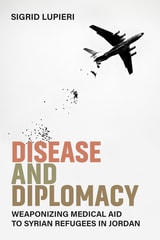
Disease and Diplomacy
Weaponizing Medical Aid to Syrian Refugees in JordanSigrid Lupieri
University of Michigan Press, 2026
When millions of Syrians fled civil war after 2011, international donors and humanitarian organizations mobilized to provide assistance to neighboring countries. Focusing on Jordan—one of the world’s largest refugee hosting states—Disease and Diplomacy investigates how medical aid to refugees operates as an instrument of diplomacy and control within the global refugee system. It argues that health, far from being an apolitical humanitarian good, is a bargaining tool that states commodify to extract resources and concessions.
Drawing on years of field research, interviews, and policy analysis, the book shows how the Jordanian government, international donors, and humanitarian agencies turned healthcare for refugees into a tool for negotiating power, resources, and responsibility. In these cases, refugees, caught within these negotiations, often found their access to care determined not by medical need, but by political calculation. Developing the concept of the weaponization of medical aid, the book extends theories of migration diplomacy and refugee rentierism to show how global power dynamics shape who receives healthcare. The analysis identifies a self-reinforcing “crisis loop” that privileges short-term, highly visible responses while neglecting chronic and long-term needs. Disease and Diplomacy advances an interdisciplinary framework for understanding how humanitarian practices reinforce global inequalities and argues for more equitable approaches to refugee health and responsibility-sharing in the international system.
Do You Really Need Surgery?
A Sensible Guide to Hysterectomy and Other Procedures for WomenMichele C. Moore, M.D., FAAFP and Caroline M. de Costa
Rutgers University Press, 2004
At last, here is a user-friendly guide to gynecologic surgery. The authors' guiding principle is that each woman for whom any kind of surgery is recommended should be well informed about the indications, the risks, and the expected results.
Using anecdotes drawn from a combined fifty years of experience, doctors Moore and de Costa provide clear and accurate information about women's anatomy, physiology, common gynecological ailments, diagnosis, alternative treatments, and, finally, full details about surgery itself. Among the surgeries discussed are removal of the uterus (hysterectomy), removal of the ovaries (oophorectomy), and removal of fibroids. The various ways of performing these procedures are examined, including minimally invasive surgery done through the laparoscope.
The authors also help the patient through the post-operative phase, revealing what to expect, how to make the recovery easier, and how to take care of yourself after the surgery. The result is a book that empowers women as they weigh their options with regard to gynecologic surgery.
Dying Inside
The HIV/AIDS Ward at Limestone PrisonBenjamin Fleury-Steiner
University of Michigan Press, 2008
"The HIV+ men incarcerated in Limestone Prison's Dorm 16 were put there to be forgotten. Not only do Benjamin Fleury-Steiner and Carla Crowder bring these men to life, Fleury-Steiner and Crowder also insist on placing these men in the middle of critical conversations about health policy, mass incarceration, and race. Dense with firsthand accounts, Dying Inside is a nimble, far-ranging and unblinking look at the cruelty inherent in our current penal policies."
---Lisa Kung, Director, Southern Center for Human Rights
"The looming prison health crisis, documented here at its extreme, is a shocking stain on American values and a clear opportunity to rethink our carceral approach to security."
---Jonathan Simon, University of California, Berkeley
"Dying Inside is a riveting account of a health crisis in a hidden prison facility."
---Michael Musheno, San Francisco State University, and coauthor of Deployed
"This fresh and original study should prick all of our consciences about the horrific consequences of the massive carceral state the United States has built over the last three decades."
---Marie Gottschalk, University of Pennsylvania, and author of The Prison and the Gallows
"An important, bold, and humanitarian book."
---Alison Liebling, University of Cambridge
"Fleury-Steiner makes a compelling case that inmate health care in America's prisons and jails has reached the point of catastrophe."
---Sharon Dolovich, University of California, Los Angeles
"Fleury-Steiner's persuasive argument not only exposes the sins of commission and omission on prison cellblocks, but also does an excellent job of showing how these problems are the natural result of our nation's shortsighted and punitive criminal justice policy."
---Allen Hornblum, Temple University, and author of Sentenced to Science
Dying Inside brings the reader face-to-face with the nightmarish conditions inside Limestone Prison's Dorm 16---the segregated HIV ward. Here, patients chained to beds share their space with insects and vermin in the filthy, drafty rooms, and contagious diseases spread like wildfire through a population with untreated---or poorly managed at best---HIV.
While Dorm 16 is a particularly horrific human rights tragedy, it is also a symptom of a disease afflicting the entire U.S. prison system. In recent decades, prison populations have exploded as Americans made mass incarceration the solution to crime, drugs, and other social problems even as privatization of prison services, especially health care, resulted in an overcrowded, underfunded system in which the most marginalized members of our society slowly wither from what the author calls "lethal abandonment."
This eye-opening account of one prison's failed health-care standards is a wake-up call, asking us to examine how we treat our forgotten citizens and compelling us to rethink the American prison system in this increasingly punitive age.