Results by title
2646 books match the query 'History & Criticism' and 101 start with d
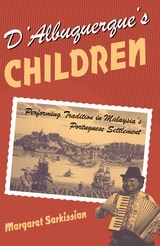
D'Albuquerque's Children
Performing Tradition in Malaysia's Portuguese SettlementMargaret Sarkissian
University of Chicago Press, 2000
Using historical and ethnographic data, Margaret Sarkissian reveals that this music and dance draws on an eclectic array of influences that span the Portuguese diaspora (one song conjures up images of Lucille Ball impersonating Carmen Miranda on "I Love Lucy"). Ironically, she shows, what began as a literate tradition in the 1950s has now become an oral one so deeply rooted in Settlement life that the younger generation, like the tourists, now see it as an unbroken heritage stretching back almost 500 years. A fascinating case of "orientalism in reverse," D'Albuquerque's Children illuminates the creative ways in which one community has adapted to life in a postcolonial world.
D-Passage
The Digital WayTrinh T. Minh-ha
Duke University Press, 2013
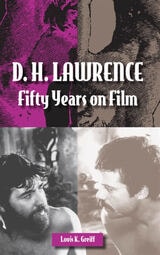
D. H. Lawrence
Fifty Years on FilmLouis K. Greiff
Southern Illinois University Press, 2001
Between 1949 and 1999, the life and works of D. H. Lawrence inspired ten feature films: nine based on works of fiction and one based on biography. In D. H. Lawrence: Fifty Years on Film, Louis K. Greiff examines these films as adaptations, as cultural or historical documents, and as independent works of art.
Significantly, the films were not spread evenly throughout the decades but appeared in three clusters. The first group, or the “black and white,” appeared between 1949 and 1960. With the exception of Marc Allegret’s L’Amant de Lady Chatterley (1955), all celebrate the British common man as a midcentury hero and promote an unmistakable yet never strident postwar ethos that is Marxist in spirit.
The second cluster occurred during the late 1960s and early 1970s. These films show Lawrence’s values as similar to the cultural values of the time—nonconformity, neobohemianism, sexual rebellion, war protest, and the celebration of youth. In his discussion of the third group Greiff explains why, in an un-Lawrentian decade like the 1980s, there was a revival of Lawrence’s works on film.
Greiff also deals with the contributions made by directors Ken Russell and Christopher Miles, both of whom directed Lawrence films of the latter two clusters. He shows how Russell and, to a lesser extent, Miles were responsible for bringing mass audiences in touch with the works of Lawrence.
Greiff’s final and most important goal is to interpret and evaluate the Lawrence films. He looks first at the film as a visual representation of its text, then as an original act of creation and object of art.
D.A. Pennebaker
Keith Beattie
University of Illinois Press, 2011
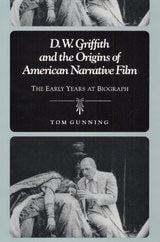
D.W. Griffith and the Origins of American Narrative Film
The Early Years at BiographTom Gunning
University of Illinois Press, 1991
In this comprehensive historical investigation, drawing on films preserved by the Library of Congress and the Museum of Modern Art, Tom Gunning reveals that the remarkable cinematic changes between 1900 and 1915 were a response to the radical reorganization within the film industry and the evolving role of film in American society. The Motion Picture Patents Company, the newly formed Film Trust, had major economic aspirations. The newly emerging industry's quest for a middle-class audience triggered Griffith's early experiments in film editing and imagery. His unique solutions permanently shaped American narrative film.
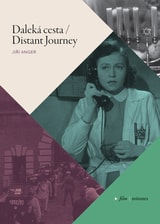
Daleká cesta / Distant Journey
By Jirí Anger
Lever Press, 2026
This volume in the film|minutes series focuses on Alfréd Radok’s Daleká cesta (Distant Journey, 1948), a pioneering Czechoslovak film admired by figures such as André Bazin and Alain Resnais. Renowned for its bold experiments in cinematic montage, the film combines fictional scenes with newsreel footage, Nazi propaganda, and images of liberated concentration camps. Produced shortly after the war, Daleká cesta remains one of the earliest and most formally daring cinematic attempts to grapple with the Holocaust. Drawing on the creators’ ideas of editing as a means of rescuing victims of atrocity—at least momentarily—from historical determinism, the book explores how a montage-like experiment in film analysis can challenge not only deterministic narratives of history, but also the conventions of established theoretical frameworks and academic writing.
Volumes in the film|minutes series cut up films into segments of exactly one minute and transform each minute into an innovative tool for thinking with the film. Each volume works rigorously with the concept of “the minute” as a non-cinematic scale/quantity, a means to zoom in on (dis)orderly fragments that do not necessarily respect the confinements of cinematic form or meaning. As a critical practice, the focus on minutes causes disruptions and displacement that create novel connections and perspectives, and uncovers hidden traces, making it possible to watch each film anew.
Dames in the Driver's Seat
Rereading Film NoirBy Jans B. Wager
University of Texas Press, 2005
With its focus on dangerous, determined femmes fatales, hardboiled detectives, and crimes that almost-but-never-quite succeed, film noir has long been popular with moviegoers and film critics alike. Film noir was a staple of classical Hollywood filmmaking during the years 1941-1958 and has enjoyed a resurgence in popularity since the 1990s. Dames in the Driver's Seat offers new views of both classical-era and contemporary noirs through the lenses of gender, class, and race. Jans Wager analyzes how changes in film noir's representation of women's and men's roles, class status, and racial identities mirror changes in a culture that is now often referred to as postmodern and postfeminist.
Following introductory chapters that establish the theoretical basis of her arguments, Wager engages in close readings of the classic noirs The Killers, Out of the Past, and Kiss Me Deadly and the contemporary noirs L. A. Confidential, Mulholland Falls, Fight Club, Twilight, Fargo, and Jackie Brown. Wager divides recent films into retro-noirs (made in the present, but set in the 1940s and 1950s) and neo-noirs (made and set in the present but referring to classic noir narratively or stylistically). Going beyond previous studies of noir, her perceptive readings of these films reveal that retro-noirs fulfill a reactionary social function, looking back nostalgically to outdated gender roles and racial relations, while neo-noirs often offer more revisionary representations of women, though not necessarily of people of color.
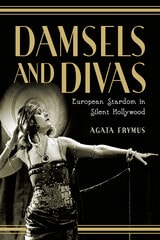
Damsels and Divas
European Stardom in Silent HollywoodAgata Frymus
Rutgers University Press, 2020
Damsels and Divas investigates the meanings of Europeanness in Hollywood during the 1920s by charting professional trajectories of three movie stars: Pola Negri, Vilma Bánky and Jetta Goudal. It combines the investigation of American fan magazines with the analysis of studio documents, and the examination of the narratives of their films, to develop a thorough understanding of the ways in which Negri, Bánky and Goudal were understood within the realm of their contemporary American culture. This discussion places their star personae in the context of whiteness, femininity and Americanization. Every age has its heroines, and they reveal a lot about prevailing attitudes towards women in their respective eras. In the United States, where the stories of rags-to-riches were especially potent, stars could offer models of successful cultural integration.
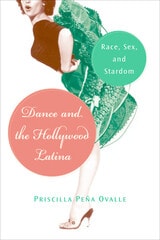
Dance and the Hollywood Latina
Race, Sex, and StardomOvalle, Priscilla P
Rutgers University Press, 2011
Introducing the concepts of "inbetween-ness" and "racial mobility" to further illuminate how racialized sexuality and the dancing female body operate in film, Priscilla Peña Ovalle focuses on the careers of Dolores Del Rio, Rita Hayworth, Carmen Miranda, Rita Moreno, and Jennifer Lopez. Dance and the Hollywood Latina helps readers better understand how the United States grapples with race, gender, and sexuality through dancing bodies on screen.
Dancing Opacity
Contemporary Dance, Transnationalism, and Queer Possibility in SenegalAmy E. Swanson
University of Michigan Press, 2025
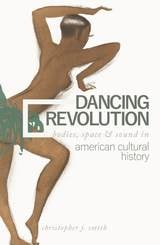
Dancing Revolution
Bodies, Space, and Sound in American Cultural HistoryChristopher J. Smith
University of Illinois Press, 2019
Dancing Revolution presents richly diverse case studies to illuminate these patterns of movement and influence in movement and sound in the history of American public life. Christopher J. Smith spans centuries, geographies, and cultural identities as he delves into a wide range of historical moments. These include the God-intoxicated public demonstrations of Shakers and Ghost Dancers in the First and Second Great Awakenings; creolized antebellum dance in cities from New Orleans to Bristol; the modernism and racial integration that imbued twentieth-century African American popular dance; the revolutionary connotations behind images of dance from Josephine Baker to the Marx Brothers; and public movement's contributions to hip hop, antihegemonic protest, and other contemporary transgressive communities’ physical expressions of dissent and solidarity.
Multidisciplinary and wide-ranging, Dancing Revolution examines how Americans turned the rhythms of history into the movement behind the movements.
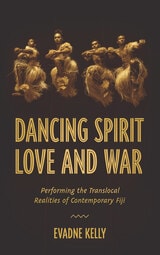
Dancing Spirit, Love, and War
Performing the Translocal Realities of Contemporary FijiEvadne Kelly
University of Wisconsin Press, 2022
Through extensive archival and ethnographic fieldwork in both Fiji and Canada, Kelly offers key insights into an underrepresented dance form, region, and culture. Her perceptive analysis of meke will be of interest in dance studies, postcolonial and Indigenous studies, anthropology and performance ethnography, and Pacific Island studies.
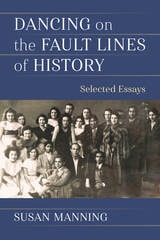
Dancing on the Fault Lines of History
Selected EssaysSusan Manning
University of Michigan Press, 2025
Like the artists at the center of her research, Manning’s writing dances on the fault lines of history. Her introduction and annotations to the essays reflect on how and why these keywords became central to her research, revealing the autobiographical resonances of her scholarship as she confronts the cultural politics of the late twentieth and early twenty-first centuries.
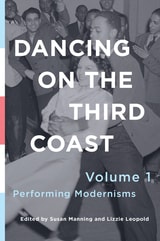
Dancing on the Third Coast, Volume 1
Performing ModernismsEdited by Susan Manning and Lizzie Leopold
University of Illinois Press, 2027
Susan Manning and Lizzie Leopold offer original essays from voices at all levels of the Chicago dance scene that explore dance in the city through the rise of the 1960s Black Arts Movement. From the beginning, dance performances questioned assumptions about gender, race, and the control of culture. Immigrant groups and Indigenous performers, among others, danced to express identity and resist injustice. The Black Arts Movement used dance to build pride and community. Throughout the period, migration and segregation shaped dance scenes while dance expanded through neighborhoods, clubs, settlement houses, and schools.
The first of two volumes, Dancing on the Third Coast: Performing Modernisms shines a light on long-overlooked Chicago artists and institutions as it repositions the city as an essential part of dance history in the United States.
Contributors: Jake Austen, Bril Barrett, David R. M. Beck, Sophie Benn, Cristin Carole, Joanna Dee Das, Amira Millicent Davis, Samuel N. Dorf, Tanya Jayani Fernando, Jessica Friedman, Megan E. Geigner, Nadine George-Graves, Auna R. Hearne, Pamela Krayenbuhl, John Neumeier, Liesl Olson, Jenna Pearse-Pollack, Jessica Erin Ray, Tyler T. Schmidt, Caroline Drane Shadle, Nina S. Spiegel, Lauren Warnecke, Carolyn Watts, Dorene Wiese, Queen Meccasia Zabriskie
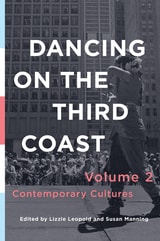
Dancing on the Third Coast, Volume 2
Contemporary CulturesEdited by Lizzie Leopold and Susan Manning
University of Illinois Press, 2027
Contributors write from their own experiences of Chicago dance. Informed by their perspectives as performers and dancemakers, critics and dramaturges, educators and ethnographers, their essays invite readers to join the ongoing work of telling the myriad stories of Chicago dance.
Contributors: Frances R. Aparicio, Maggie Bridger, Ellen Chenoweth, Sydney Erlikh, Joanna Furnans, Wills Glasspiegel, Irvin Manuel Gonzalez, Daniel “BRAVEMONK” Haywood, J’Sun Howard, Wenke (Coco) Huang, Maggie Kast, Michael J. Kramer, Mario LaMothe, Michael Landez, Lizzie Leopold, Kelsa “K-Soul” Rieger-Haywood, Rebecca Rossen, Micah Salkind, Roell Schmidt, Elizabeth Schwall, Nora Sharp, Shayna M. Silverstein, Lauren Warnecke, Zachary Whittenburg, Tara Aisha Willis

Dangerous Dames
Women and Representation in Film Noir and the Weimar Street FilmJans B. Wager
Ohio University Press, 1999
Both film noir and the Weimar street film hold a continuing fascination for film spectators and film theorists alike. The female characters, especially the alluring femmes fatales, remain a focus for critical and popular attention. In the tradition of such attention, Dangerous Dames focuses on the femme fatale and her antithesis, the femme attrapée.
Unlike most theorists, Jans Wager examines these archetypes from the perspective of the female spectator and rejects the persistence of vision that allows a reading of these female characters only as representations of unstable postwar masculinity. Professor Wager suggests that the woman in the audience has always seen and understood these characters as representations of a complex aspect of her existence.
Dangerous Dames looks at the Weimar street films The Street, Variety, Asphalt, and M and the film noir movies The Maltese Falcon, Gun Crazy, and The Big Heat. This book opens the doors to spectators and theorists alike, suggesting cinematic pleasures outside the bounds of accepted readings and beyond the narrow categorization of film noir and the Weimar street film as masculine forms.

Danish Directors
Dialogues on a Contemporary National CinemaEdited by Mette Hjort and Ib Bondebjerg
Intellect Books, 1995
Each interview is preceded by a photograph of the director, biographical information, and a filmography. Frame enlargements are used throughout to help clarify particular points of discussion and the book as a whole is contextualised by an informative general introduction. A valuable addition to the growing library of books on Scandinavian film, national cinema and minority cinema.
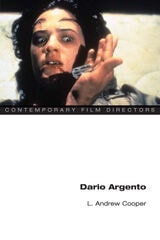
Dario Argento
L. Andrew Cooper
University of Illinois Press, 2012
Commanding a cult following among horror fans, Italian film director Dario Argento is best known for his work in two closely related genres, the crime thriller and supernatural horror, as well as his influence on modern horror and slasher movies. In his four decades of filmmaking, Argento has displayed a commitment to innovation, from his directorial debut with 1970's suspense thriller The Bird with the Crystal Plumage to 2009's Giallo. His films, like the lurid yellow-covered murder-mystery novels they are inspired by, follow the suspense tradition of hard-boiled American detective fiction while incorporating baroque scenes of violence and excess.
While considerations of Argento's films often describe them as irrational nightmares, L. Andrew Cooper uses controversies and theories about the films' reflections on sadism, gender, sexuality, psychoanalysis, aestheticism, and genre to declare the anti-rational logic of Argento's oeuvre. Approaching the films as rhetorical statements made through extremes of sound and vision, Cooper places Argento in a tradition of aestheticized horror that includes De Sade, De Quincey, Poe, and Hitchcock. Analyzing individual images and sequences as well as larger narrative structures, he reveals how the director's stylistic excesses, often condemned for glorifying misogyny and other forms of violence, offer productive resistance to the cinema's visual, narrative, and political norms.
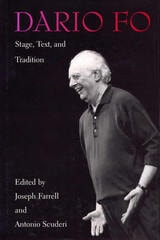
Dario Fo
Stage, Text, and TraditionEdited by Joseph Farrell and Antonio Scuderi
Southern Illinois University Press, 2000
Joseph Farrell and Antonio Scuderi present an international collection of essays reevaluating the multifaceted performance art of Nobel laureate Dario Fo.
The contributors, all of whom either have previously published on Fo or have worked with him, are the major Dario Fo scholars of three continents. Going beyond the Marxist criticism of the 1970s and 1980s, the editors and contributors try to establish an appropriate language in which to debate Fo’s theater. They seek to identify the core of Fo’s work, the material that will be of lasting value. This involves locating Fo in history, examining the nature of his development through successive phases, incorporating his politics into a wider framework of radical dissent, and setting his theatrical achievements in a context and a tradition.
The essays cover every aspect of Dario Fo: as actor, playwright, performer, and songwriter. They also provide the historical background of Fo’s theater, as well as an in-depth analyses of specific works and the contribution of Franca Rame.
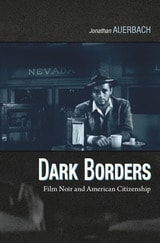
Dark Borders
Film Noir and American CitizenshipJonathan Auerbach
Duke University Press, 2011
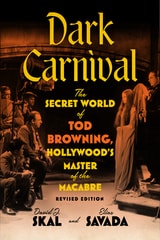
Dark Carnival
The Secret World of Tod Browning, Hollywood’s Master of the MacabreDavid J. Skal
University of Minnesota Press, 2025
The definitive biography of Hollywood horror legend Tod Browning—now revised and expanded with new material
One of the most original and unsettling filmmakers of all time, Tod Browning (1880–1962) began his career buried alive in a carnival sideshow and saw his Hollywood reputation crash with the box office disaster–turned–cult classic Freaks. Penetrating the secret world of “the Edgar Allan Poe of the cinema,” Dark Carnival excavates the story of this complicated, fiercely private man. In this newly revised and expanded edition of their biography first published in 1995, David J. Skal and Elias Savada researched Browning’s recently unearthed scrapbooks and photography archives to add further nuance and depth to their previous portrait of this enigmatic artist.
Skal and Savada chronicle Browning’s turn-of-the-century flight from an eccentric Louisville family into the realm of carnivals and vaudeville, his disastrous first marriage, his rapid climb to riches in the burgeoning silent film industry, and the alcoholism that would plague him throughout his life. They offer a close look at Browning’s legendary collaborations with Lon Chaney and Bela Lugosi as well as the studio politics that brought his remarkable run to an inglorious conclusion. With a revised prologue, epilogue, filmography, and new text and illustrations throughout, Dark Carnival is an unparalleled account of a singular filmmaker and an illuminating depiction of the evolution of horror and the early film industry.
Dark Deleuze
Andrew Culp
University of Minnesota Press, 2016
French philosopher Gilles Deleuze is known as a thinker of creation, joyous affirmation, and rhizomatic assemblages. In this short book, Andrew Culp polemically argues that this once-radical canon of joy has lost its resistance to the present. Concepts created to defeat capitalism have been recycled into business mantras that joyously affirm “Power is vertical; potential is horizontal!”
Culp recovers the Deleuze’s forgotten negativity. He unsettles the prevailing interpretation through an underground network of references to conspiracy, cruelty, the terror of the outside, and the shame of being human. Ultimately, he rekindles opposition to what is intolerable about this world.
Forerunners is a thought-in-process series of breakthrough digital works. Written between fresh ideas and finished books, Forerunners draws on scholarly work initiated in notable blogs, social media, conference plenaries, journal articles, and the synergy of academic exchange. This is gray literature publishing: where intense thinking, change, and speculation take place in scholarship.
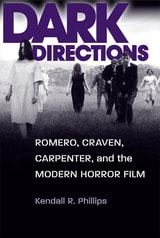
Dark Directions
Romero, Craven, Carpenter, and the Modern Horror FilmKendall R. Phillips
Southern Illinois University Press, 2012
A Nightmare on Elm Street. Halloween. Night of the Living Dead. These films have been indelibly stamped on moviegoers’ psyches and are now considered seminal works of horror. Guiding readers along the twisted paths between audience, auteur, and cultural history, author Kendall R. Phillips reveals the macabre visions of these films’ directors in Dark Directions: Romero, Craven, Carpenter, and the Modern Horror Film.
Phillips begins by analyzing the works of George Romero, focusing on how the body is used cinematically to reflect the duality between society and chaos, concluding that the unconstrained bodies of the Living Dead films act as a critical intervention into social norms. Phillips then explores the shadowy worlds of director Wes Craven. In his study of the films The Serpent and the Rainbow, Deadly Friend, Swamp Thing, Red Eye, and Shocker, Phillips reveals Craven’s vision of technology as inherently dangerous in its ability to cross the gossamer thresholds of the gothic. Finally, the volume traverses the desolate frontiers of iconic director John Carpenter. Through an exploration of such works as Halloween, The Fog, and In the Mouth of Madness, Phillips delves into the director’s representations of boundaries—and the haunting consequences for those who cross them.
The first volume ever to address these three artists together, Dark Directions is a spine-tingling and thought-provoking study of the horror genre. In analyzing the individual works of Romero, Craven, and Carpenter, Phillips illuminates some of the darkest minds in horror cinema.
Dark Film, Blood Money
The Economic Unconscious of American Neo-Noir CinemaVernon Shetley
Intellect Books, 2027
Neo-noir films exert their fascination not only through their suspense, shadowy atmosphere, and moral ambiguity, but also through their registration of the experience of American life in the long twilight of the American Dream. With a sharp curatorial eye and an elegant critical voice, Vernon Shetley interprets landmark works from the noir revival of the early 1970s to the present, showing how neo-noir reflects the darkening national mood as postwar prosperity gave way to economic stagnation and inequality, social alienation, and a deepening sense of crisis.
Through close readings of key films and overviews of neo-noir’s treatment of the genre’s defining themes and archetypes—desire and betrayal, corruption and alienation, the private detective and the femme fatale—Shetley delineates neo-noir’s exploration of anxieties about work, money, trust, and exchange. From Chinatown to Mulholland Drive, from Night Moves to Nightmare Alley, neo-noir’s marginalized characters and extreme situations emerge in Shetley’s account as powerful representations of concerns central to economic and social life. Combining illuminating analysis with lucid prose, this book offers scholars and general readers alike a fresh, penetrating understanding of the dynamics of neo-noir filmmaking and its continually renewed vitality over the last five decades.
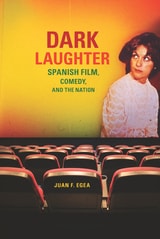
Dark Laughter
Spanish Film, Comedy, and the NationJuan F. Egea
University of Wisconsin Press, 2013
Egea begins his analysis with General Franco's dictatorship in the 1960s—a regime that opened the country to new economic forces while maintaining its repressive nature—exploring key works by Luis García Berlanga, Marco Ferreri, Fernando Fernán-Gómez, and Luis Buñuel. Dark Laughter then moves to the first films of Pedro Almodóvar in the early 1980s during the Spanish political transition to democracy before examining Alex de la Iglesia and the new dark comedies of the 1990s. Analyzing this younger generation of filmmakers, Egea traces dark comedy to Spain's displays of ultramodernity such as the Universal Exposition in Seville and the Barcelona Olympic Games.
At its core, Dark Laughter is a substantial inquiry into the epistemology of comedy, the intricacies of visual modernity, and the relationship between cinema and a wider framework of representational practices.
Dark Matter
Invisibility in Drama, Theater, and PerformanceAndrew Sofer
University of Michigan Press, 2013
Dark Mattermaps the invisible dimension of theater whose effects are felt everywhere in performance. Examining phenomena such as hallucination, offstage character, offstage action, sexuality, masking, technology, and trauma, Andrew Sofer engagingly illuminates the invisible in different periods of postclassical western theater and drama. He reveals how the invisible continually structures and focuses an audience’s theatrical experience, whether it’s black magic in Doctor Faustus, offstage sex in A Midsummer Night’s Dream, masked women in The Rover, self-consuming bodies in Suddenly Last Summer, or surveillance technology in The Archbishop’s Ceiling. Each discussion pinpoints new and striking facets of drama and performance that escape sight. Taken together, Sofer’s lively case studies illuminate how dark matter is woven into the very fabric of theatrical representation. Written in an accessible style and grounded in theater studies but interdisciplinary by design, Dark Matter will appeal to theater and performance scholars, literary critics, students, and theater practitioners, particularly playwrights and directors.
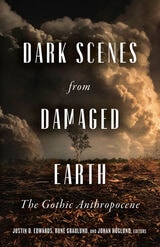
Dark Scenes from Damaged Earth
The Gothic AnthropoceneJustin D. Edwards
University of Minnesota Press, 2022
An urgent volume of essays engages the Gothic to advance important perspectives on our geological era
What can the Gothic teach us about our current geological era? More than just spooky, moonlit castles and morbid graveyards, the Gothic represents a vibrant, emergent perspective on the Anthropocene. In this volume, more than a dozen scholars move beyond longstanding perspectives on the Anthropocene—such as science fiction and apocalyptic narratives—to show that the Gothic offers a unique (and dark) interpretation of events like climate change, diminished ecosystems, and mass extinction.
Embracing pop cultural phenomena like True Detective, Jaws, and Twin Peaks, as well as topics from the New Weird and prehistoric shark fiction to ruin porn and the “monstroscene,” Dark Scenes from Damaged Earth demonstrates the continuing vitality of the Gothic while opening important new paths of inquiry. These essays map a genealogy of the Gothic while providing fresh perspectives on the ongoing climate chaos, the North/South divide, issues of racialization, dark ecology, questions surrounding environmental justice, and much more.
Contributors: Fred Botting, Kingston U; Timothy Clark, U of Durham; Rebecca Duncan, Linnaeus U; Michael Fuchs, U of Oldenburg, Germany; Esthie Hugo, U of Warwick; Dawn Keetley, Lehigh U; Laura R. Kremmel, South Dakota School of Mines and Technology; Timothy Morton, Rice U; Barry Murnane, U of Oxford; Jennifer Schell, U of Alaska Fairbanks; Lisa M. Vetere, Monmouth U; Sara Wasson, Lancaster U; Jeffrey Andrew Weinstock, Central Michigan U.
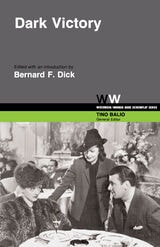
Dark Victory
Edited, with an introduction by Bernard F. Dick; Tino T. Balio, Series Editor
University of Wisconsin Press, 1981
Dark Victory, released in 1939, was a daring movie for its time. it depicted its heroine, Bette Davis, dying of a brain tumor. The film blended romance and realism so successfully that it is still a model for movies about death and dying today.
Bette Davis drew upon every mood she had ever expressed—insouciance, impatience, anger, passion, acquiescence. She worked hard at the role, reveling in a story that, according to her account, she had actively campaigned for. She also benefited greatly by the professional talents of director Edmund Goulding and screenwriter Casey Robinson and a supporting cast that included Humphrey Bogart.
Darkening Mirrors
Imperial Representation in Depression-Era African American PerformanceStephanie Leigh Batiste
Duke University Press, 2012
Darkly Perfect World
Colonial Adventure, Postmodernism, and American NoirStanley Orr
The Ohio State University Press, 2010
Dashiell Hammett and the Movies
Mooney, William H
Rutgers University Press, 2014
David Lynch
Justus Nieland
University of Illinois Press, 2012
David Lynch Swerves
Uncertainty from Lost Highway to Inland EmpireBy Martha Nochimson
University of Texas Press, 2013
Beginning with Lost Highway, director David Lynch “swerved” in a new direction, one in which very disorienting images of the physical world take center stage in his films. Seeking to understand this unusual emphasis in his work, noted Lynch scholar Martha Nochimson engaged Lynch in a long conversation of unprecedented openness, during which he shared his vision of the physical world as an uncertain place that masks important universal realities. He described how he derives this vision from the Holy Vedas of the Hindu religion, as well as from his layman’s fascination with modern physics.
With this deep insight, Nochimson forges a startlingly original template for analyzing Lynch’s later films—the seemingly unlikely combination of the spiritual landscape envisioned in the Holy Vedas and the material landscape evoked by quantum mechanics and relativity. In David Lynch Swerves, Nochimson navigates the complexities of Lost Highway, The Straight Story, Mulholland Drive, and Inland Empire with uncanny skill, shedding light on the beauty of their organic compositions; their thematic critiques of the immense dangers of modern materialism; and their hopeful conceptions of human potential. She concludes with excerpts from the wide-ranging interview in which Lynch discussed his vision with her, as well as an interview with Columbia University physicist David Albert, who was one of Nochimson’s principal tutors in the discipline of quantum physics.
Death 24x a Second
Stillness and the Moving ImageLaura Mulvey
Reaktion Books, 2006
According to Mulvey, new media technologies give viewers the ability to control both image and story, so that movies meant to be seen collectively and followed in a linear fashion may be manipulated to contain unexpected and even unintended pleasures. The individual frame, the projected film’s best-kept secret, can now be revealed by anyone who hits pause. Easy access to repetition, slow motion, and the freeze-frame, Mulvey argues, may shift the spectator’s pleasure to a fetishistic rather than a voyeuristic investment in film.
By exploring how technology can give new life to old cinema, Death 24x a Second offers an original reevaluation of film’s history and its historical usefulness.
Death by Drama and Other Medieval Urban Legends
Jody Enders
University of Chicago Press, 2002
Was a convicted criminal executed on stage during a beheading scene? Was an unfortunate actor driven insane while playing a madman? Did a theatrical enactment of a crucifixion result in a real one? Did an androgynous young man seduce a priest when portraying a female saint? Enders answers these and other questions while presenting a treasure trove of tales that have long seemed true but are actually medieval urban legends. On topics ranging through politics, religion, marriage, class, and law, these tales, Enders argues, do the cultural work of all urban legends: they disclose the hopes, fears, and anxieties of their tellers. Each one represents a medieval meditation created or dramatized by the theater with its power to blur the line between fiction and reality, engaging anyone who watches, performs, or is represented by it. Each one also raises pressing questions about the medieval and modern world on the eve of the Reformation, when Europe had never engaged more anxiously and fervently in the great debate about what was real, what was pretend, and what was pretense.
Written with elegance and flair, and meticulously researched, Death by Drama and Other Medieval Urban Legends will interest scholars of medieval and Renaissance literature, history, theater, performance studies, and anyone curious about urban legends.

Deconstructive Variations
Music and Reason in Western SocietyRose Rosengard Subotnik
University of Minnesota Press, 1995
Deconstructive Variations was first published in 1995. Minnesota Archive Editions uses digital technology to make long-unavailable books once again accessible, and are published unaltered from the original University of Minnesota Press editions.
Unique in its focus and its interdisciplinary reach, Rose Rosengard Subotnik's work is among the most original and challenging being done in American musicology. Her concerns are both formal and sociological, firmly linking music to social and cultural context and breaking down the barriers between music and life.
Deconstructive Variations is a sequel to Subotnik's previous collection, Developing Variations. It expands and continues her achievement-the promotion of humanistic criticism as a significant activity in music scholarship and the portrayal of Western art music in relation to the social structures and cultural values of the society that created it.
Bringing to her subject a vast range of philosophical, artistic, and historical knowledge, Subotnik applies the insights of Kant, Adorno, Bakhtin, and Derrida to major works of Mozart and Chopin. Each of these essays functions as an argument between two views: for and against the ideal of structural listening; Enlightenment and Romantic readings of The Magic Flute; high-modernist and postmodernist readings of Chopin's A-Major Prelude; and conceptions of reason put forward by Allan Bloom and Spike Lee.
Rose Rosengard Subotnik is professor emerita in the department of music at Brown University, and is the author of Developing Variations: Style and Ideology in Western Music (Minnesota, 1991).
Deep Mediations
Thinking Space in Cinema and Digital CulturesKaren Redrobe
University of Minnesota Press, 2021
The preoccupation with “depth” and its relevance to cinema and media studies
For decades the concept of depth has been central to critical thinking in numerous humanities-based disciplines, legitimizing certain modes of inquiry over others. Deep Mediations examines why and how this is, as scholars today navigate the legacy of depth models of thought and vision, particularly in light of the “surface turn” and as these models impinge on the realms of cinema and media studies.
The collection’s eighteen essays seek to understand the decisive but evolving fixation on depth by considering the term’s use across a range of conversations as well as its status in relation to critical methodologies and the current mediascape. Engaging contemporary debates about new computing technologies, the environment, history, identity, affect, audio/visual culture, and the limits and politics of human perception, Deep Mediations is a timely interrogation of depth’s ongoing importance within the humanities.
Contributors: Laurel Ahnert; Taylor Arnold, U of Richmond; Erika Balsom, King’s College London; Brooke Belisle, Stony Brook University; Jinhee Choi, King’s College London; Jennifer Fay, Vanderbilt U; Lisa Han, UC Santa Barbara; Jean Ma, Stanford U; Shaka McGlotten, Purchase College-SUNY; Susanna Paasonen, U of Turku, Finland; Jussi Parikka, U of Southampton; Alessandra Raengo, Georgia State U; Pooja Rangan, Amherst College; Katherine Rochester, VIA Art Fund in Boston; Karl Schoonover, University of Warwick (UK); Jordan Schonig, Michigan State U; John Paul Stadler, North Carolina State U; Nicole Starosielski, New York U; Lauren Tilton, U of Richmond.
Deep Refrains
Music, Philosophy, and the IneffableMichael Gallope
University of Chicago Press, 2017
In Deep Refrains, Michael Gallope draws together the writings of Arthur Schopenhauer, Friedrich Nietzsche, Ernst Bloch, Theodor Adorno, Vladimir Jankélévitch, Gilles Deleuze, and Félix Guattari in order to revisit the age-old question of music’s ineffability from a modern perspective. For these nineteenth- and twentieth-century European philosophers, music’s ineffability is a complex phenomenon that engenders an intellectually productive sense of perplexity. Through careful examination of their historical contexts and philosophical orientations, close attention to their use of language, and new interpretations of musical compositions that proved influential for their work, Deep Refrains forges the first panoptic view of their writings on music. Gallope concludes that music’s ineffability is neither a conservative phenomenon nor a pious call to silence. Instead, these philosophers ask us to think through the ways in which music’s stunning force might address, in an ethical fashion, intricate philosophical questions specific to the modern world.
Deep River
Music and Memory in Harlem Renaissance ThoughtPaul Allen Anderson
Duke University Press, 2001
Deep River elucidates how spirituals, African American concert music, the blues, and jazz became symbolic sites of social memory and anticipation during the Harlem Renaissance. Anderson traces the roots of this period’s debates about music to the American and European tours of the Fisk Jubilee Singers in the 1870s and to W. E. B. Du Bois’s influential writings at the turn of the century about folk culture and its bearing on racial progress and national identity. He details how musical idioms spoke to contrasting visions of New Negro art, folk authenticity, and modernist cosmopolitanism in the works of Du Bois, Alain Locke, Zora Neale Hurston, Langston Hughes, Jean Toomer, Sterling Brown, Roland Hayes, Paul Robeson, Carl Van Vechten, and others. In addition to revisiting the place of music in the culture wars of the 1920s, Deep River provides fresh perspectives on the aesthetics of race and the politics of music in Popular Front and Swing Era music criticism, African American critical theory, and contemporary musicology.
Deep River offers a sophisticated historical account of American racial ideologies and their function in music criticism and modernist thought. It will interest general readers as well as students of African American studies, American studies, intellectual history, musicology, and literature.
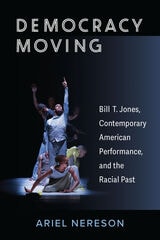
Democracy Moving
Bill T. Jones, Contemporary American Performance, and the Racial PastAriel Nereson
University of Michigan Press, 2022
The project addresses how different communities choose to commemorate historical figures, events, and places through art—whether performance, oratory, song, statuary, or portraiture—and in particular, Black US American counter-memorial practices that address histories of slavery. Advancing the theory of oscillation as Black aesthetic praxis, author Ariel Nereson celebrates Bill T. Jones as a public intellectual whose practice has contributed to the project of understanding America’s relationship to its troubled past. The book features materials from Bill T. Jones/Arnie Zane Company’s largely unexplored archive, interviews with artists, and photos that document this critical stage of Jones’s career as it explores how aesthetics, as ideas in action, can imagine more just and equitable social formations.
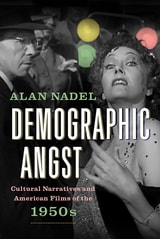
Demographic Angst
Cultural Narratives and American Films of the 1950sNadel, Alan
Rutgers University Press, 2017
Demographic Angst argues that mandated normativity—as a political agenda and a social ethic—precluded explicit expression of the anxiety produced by America’s radically reconfigured postwar population. Alan Nadel explores influential non-fiction books, magazine articles, and public documents in conjunction with films such as Singin’ in the Rain, On the Waterfront, Sunset Boulevard, and Sayonara, to examine how these films worked through fresh anxieties that emerged during the 1950s.

Demon in the Box
Jews, Arabs, Politics, and Culture in the Making of Israeli TelevisionOren, Tasha G
Rutgers University Press, 2004
What does a country's television programming say about its deep character, beliefs, dreams, and fears? In Demon in the Box, Tasha G. Oren recounts the volatile history of Israeli television and thereby reveals the history of the nation itself.
Initially rejected as a corrupting influence on "the people of the book," television became the object of fantasies and anxieties that went to the heart of Israel's most pressing concerns: Arab-Israeli relations, immigration, and the forging of a modern Israeli culture. Television broadcasting was aimed toward external relations-the flow of messages across borders, Arab-Israeli conflict, and the shaping of public opinion worldwide-as much as it was toward internal needs and interests. Through archival research and analysis of public scandals and early programs, Oren traces Israeli television's transformation from a feared agent of decadence to a powerful national communication tool, and eventually, to a vastly popular entertainment medium.
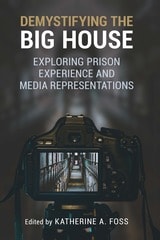
Demystifying the Big House
Exploring Prison Experience and Media RepresentationsEdited by Katherine A. Foss
Southern Illinois University Press, 2018
Scholars from cultural and critical studies, feminist studies, queer studies, African American studies, media studies, sociology, and psychology offer critical analysis of media depictions of prison, bridging the media’s portrayals of incarcerated lives with actual experiences and bringing to light forgotten voices in prison narratives.
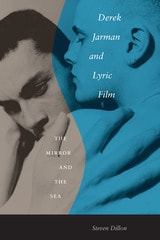
Derek Jarman and Lyric Film
The Mirror and the SeaBy Steven Dillon
University of Texas Press, 2004
Derek Jarman was the most important independent filmmaker in England during the 1980s. Using emblems and symbols in associative contexts, rather than conventional, cause-and-effect narrative, he created films noteworthy for their lyricism and poetic feeling and for their exploration of the gay experience. His style of filmmaking also links Jarman with other prominent directors of lyric film, including Pier Paolo Pasolini, Andrei Tarkovsky, Jean Cocteau, and Jean Genet.
This pathfinding book places Derek Jarman in the tradition of lyric film and offers incisive readings of all eleven of his feature-length films, from Sebastiane to Blue. Steven Dillon looks at Jarman and other directors working in a similar vein to establish how lyric films are composed through the use of visual imagery and actual poetry. He then traces Jarman's use of imagery (notably mirrors and the sea) in his films and discusses in detail the relationship between cinematic representations and sexual identity. This insightful reading of Jarman's work helps us better understand how films such as The Last of England and The Garden can be said to cohere and mean without being reduced to clear messages. Above all, Dillon's book reveals how truly beautiful and brilliant Jarman's movies are.
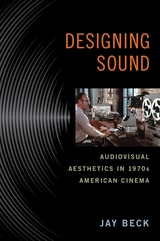
Designing Sound
Audiovisual Aesthetics in 1970s American CinemaBeck, Jay
Rutgers University Press, 2016
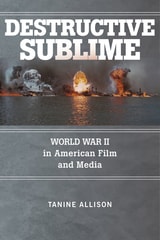
Destructive Sublime
World War II in American Film and MediaAllison, Tanine
Rutgers University Press, 2018
Destructive Sublime traces a new aesthetic history of the World War II combat genre by looking back at it through the lens of contemporary video games like Call of Duty. Allison locates some of video games’ glorification of violence, disruptive audiovisual style, and bodily sensation in even the most canonical and seemingly conservative films of the genre. In a series of case studies spanning more than seventy years—from wartime documentaries like The Battle of San Pietro to fictional reenactments like The Longest Day and Saving Private Ryan to combat video games like Medal of Honor—this book reveals how the genre’s aesthetic forms reflect (and influence) how American culture conceives of war, nation, and representation itself.
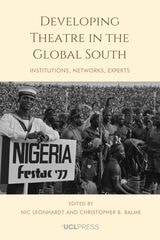
Developing Theatre in the Global South
Institutions, Networks, ExpertsEdited by Nic Leonhardt and Christopher B. Balme
University College London, 2024
This collection presents innovative institutional approaches to the theatre historiography of the Global South, proposing a fundamental reexamination of the historiography of theater in emerging countries since 1945. Covering perspectives from Africa, Asia, the Middle East, Latin America, and Eastern Europe, the chapters explore how US philanthropy, international organizations, and pan-African festivals all contributed to the globalization and institutionalization of the performing arts in the Global South.
During the Cultural Cold War, the Global North intervened in and promoted forms of cultural infrastructure that were deemed adaptable to any environment. This form of politics impacted the construction of national theaters, the introduction of new pedagogical tools, and the invention of the workshop as a format. The networks of experts responsible for this foreground seminal figures, both celebrated (Augusto Boal, Efua Sutherland) but also lesser-known (Albert Botbol, Severino Montano, Metin And), who contributed to the worldwide theatrical epistemic community of the postwar years.
Developing Theatre in the Global South investigates the institutional factors that led to the emergence of professional theatre in the postwar period throughout the decolonizing world. The book’s institutional and transnational approach enables theatre studies to overcome its commonly strong national and local focus on plays and productions and to connect it to current discourses in transnational and global history.
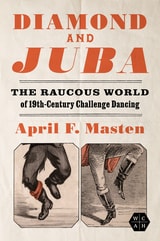
Diamond and Juba
The Raucous World of 19th-Century Challenge DancingApril F. Masten
University of Illinois Press, 2025
Diasporas of Australian Cinema
Edited by Catherine Simpson, Renata Murawska, and Anthony Lambert
Intellect Books, 2009
This volume is the first to focus exclusively on diasporic filmmaking and the rich cultural diversity within Australian cinema, and it contains previously unpublished articles by some of the foremost experts on Australian cinema in the world. Contributors to Diasporas of Australian Cinema discuss a variety of contemporary and historical filmmaking, encompassing documentaries, features and short films. A number of key feature films are discussed including Forty Thousand Horsemen, Silver City, Wog Boy, Head On, Russian Doll, Japanese Story, and Lucky Miles. Opening with a comprehensive chapter that introduces the organizing concept of this volume, diasporic hybridity, the essays go on to explore migration, Asian-Australian subjectivity, cross-cultural romance, Islamic-Australian identity and “wogsploitation” comedy. A useful reference source for scholars of film, migration, cultural, and Australian studies, Diasporas of Australian Cinema also features a comprehensive filmography listing Australian features, documentaries and shorts with significant diasporic content.
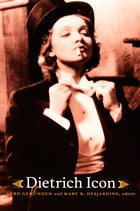
Dietrich Icon
Gerd Gemünden and Mary R. Desjardins, eds.
Duke University Press, 2007
Some of the essays in this collection revisit such familiar topics as Germany’s complex relationship with Dietrich, her ambiguous sexuality, her place in the lesbian archive, her star status, and her legendary legs, but with fresh critical perspective and an emphasis on historical background. Other essays establish new avenues for understanding Dietrich’s persona. Among these are a reading of Marlene Dietrich’s ABC—an eclectic autobiographical compendium containing Dietrich’s thoughts on such diverse subjects as “steak,” “Sternberg (Joseph von),” “Stravinsky,” and “stupidity”—and an argument that Dietrich manipulated her voice—through her accent, sexual innuendo, and singing—as much as her visual image in order to convey a cosmopolitan world-weariness. Still other essays consider the specter of aging that loomed over Dietrich’s career, as well as the many imitations of the Dietrich persona that have emerged since the star’s death in 1992.
Contributors. Nora M. Alter, Steven Bach, Elisabeth Bronfen, Erica Carter, Mary R. Desjardins, Joseph Garncarz, Gerd Gemünden, Mary Beth Haralovich, Amelie Hastie, Lutz Koepnick, Alice A. Kuzniar, Amy Lawrence, Judith Mayne, Patrice Petro, Eric Rentschler, Gaylyn Studlar, Werner Sudendorf, Mark Williams