Results by title
143 books match the query 'History of doctrines' and 4 start with d

Dangerous Speech
A Social History of Blasphemy in Colonial MexicoJavier Villa-Flores
University of Arizona Press, 2006
Why then, asks Villa-Flores, did Spaniards dare to blaspheme? Having mined the period’s moral literature—philosophical works as well as royal decrees and Inquisition treatises and trial records in Spanish, Mexican, and U.S. archives and research libraries—Villa-Flores deftly interweaves images of daily life in colonial Mexico with vivid descriptions of human interactions to illustrate the complexity of a culture profoundly influenced by the Catholic Church. In entertaining and sometimes horrifying vignettes, the reader comes face to face with individuals who used language to assert or manipulate their identities within that repressive society.
Villa-Flores offers an innovative interpretation of the social uses of blasphemous speech by focusing on specific groups—conquistadors, Spanish settlers, Spanish women, and slaves of both genders—as a lens to examine race, class, and gender relations in colonial Mexico. He finds that multiple motivations led people to resort to blasphemy through a gamut of practices ranging from catharsis and gender self-fashioning to religious rejection and active resistance.
Dangerous Speech is a valuable resource for students and scholars of colonialism, the social history of language, Mexican history, and the changing relations of gender, class, and ethnicity in colonial Latin America.
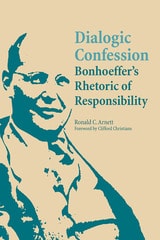
Dialogic Confession
Bonhoeffer's Rhetoric of ResponsibilityRonald C. Arnett. Foreword by Clifford Christians
Southern Illinois University Press, 2005
In this landmark volume of contemporary communication theory, Ronald C. Arnett applies the metaphor of dialogic confession—which enables historical moments to be addressed from a confessed standpoint and through a communicative lens—to the works of German theologian Dietrich Bonhoeffer, who pointed to an era of postmodern difference with his notion of "a world come of age." Arnett’s interpretations of Bonhoeffer’s life and scholarship in contention with Nazi dominance offer implications for a dialogic confession that engages the complexity of postmodern narrative contention.
Rooted in classical theory, the field of communication ethics is abstract and arguably outmoded. In Dialogic Confession: Bonhoeffer’s Rhetoric of Responsibility, Arnett locates cross-cultural and comparative anchors that not only bring legitimacy and relevance to the field but also develop a conceptual framework that will advance and inspire future scholarship.

Do Not Reisist the Spirit's Call
Michael D. Torre
Catholic University of America Press, 2013

Dynamic Repetition
History and Messianism in Modern Jewish ThoughtGilad Sharvit
Brandeis University Press, 2022
Dynamic Repetition proposes a new understanding of modern Jewish theories of messianism across the disciplines of history, theology, and philosophy. The book explores how ideals of repetition, return, and the cyclical occasioned a new messianic impulse across an important swath of late nineteenth- and early twentieth-century German Jewish thought. To grasp the complexities of Jewish messianism in modernity, the book focuses on diverse notions of “dynamic repetition” in the works of Franz Rosenzweig, Walter Benjamin, Franz Kafka, and Sigmund Freud, and their interrelations with basic trajectories of twentieth-century philosophy and critical thought.