Results by title
395 books match the query 'How' and 13 start with d
Darwinian Reductionism
Or, How to Stop Worrying and Love Molecular BiologyAlexander Rosenberg
University of Chicago Press, 2006
With clarity and wit, Darwinian Reductionism navigates this difficult and seemingly intractable dualism with convincing analysis and timely evidence. In the spirit of the few distinguished biologists who accept reductionism—E. O. Wilson, Francis Crick, Jacques Monod, James Watson, and Richard Dawkins—Rosenberg provides a philosophically sophisticated defense of reductionism and applies it to molecular developmental biology and the theory of natural selection, ultimately proving that the physicalist must also be a reductionist.
Data Grab
The New Colonialism of Big Tech and How to Fight BackUlises A. Mejias and Nick Couldry
University of Chicago Press, 2024
Large technology companies like Meta, Amazon, and Alphabet have unprecedented access to our daily lives, collecting information when we check our email, count our steps, shop online, and commute to and from work. Current events are concerning—both the changing owners (and names) of billion-dollar tech companies and regulatory concerns about artificial intelligence underscore the sweeping nature of Big Tech’s surveillance and the influence such companies hold over the people who use their apps and platforms.
As trusted tech experts Ulises A. Mejias and Nick Couldry show in this eye-opening and convincing book, this vast accumulation of data is not the accidental stockpile of a fast-growing industry. Just as nations stole territories for ill-gotten minerals and crops, wealth, and dominance, tech companies steal personal data important to our lives. It’s only within the framework of colonialism, Mejias and Couldry argue, that we can comprehend the full scope of this heist.
Like the land grabs of the past, today’s data grab converts our data into raw material for the generation of corporate profit against our own interests. Like historical colonialism, today’s tech corporations have engineered an extractive form of doing business that builds a new social and economic order, leads to job precarity, and degrades the environment. These methods deepen global inequality, consolidating corporate wealth in the Global North and engineering discriminatory algorithms. Promising convenience, connection, and scientific progress, tech companies enrich themselves by encouraging us to relinquish details about our personal interactions, our taste in movies or music, and even our health and medical records. Do we have any other choice?
Data Grab affirms that we do. To defy this new form of colonialism we will need to learn from previous forms of resistance and work together to imagine entirely new ones. Mejias and Couldry share the stories of voters, workers, activists, and marginalized communities who have successfully opposed unscrupulous tech practices. An incisive discussion of the digital media that’s transformed our world, Data Grab is a must-read for anyone concerned about privacy, self-determination, and justice in the internet age.

Democracy and Regulation
How the Public Can Govern Essential ServicesGreg Palast, Theo MacGregor, and Jerrold Oppenheim
Pluto Press, 2002
Democracy's Meanings
How the Public Understands Democracy and Why It MattersNicholas T. Davis, Keith Gåddie, and Kirby Goidel
University of Michigan Press, 2022
Democracy’s Meanings challenges conventional wisdom regarding how the public thinks about and evaluates democracy. Mining both political theory and more than 75 years of public opinion data, the book argues that Americans think about democracy in ways that go beyond voting or elected representation. Instead, citizens have rich and substantive views about the material conditions that democracy should produce, which draw from their beliefs about equality, fairness, and justice.
The authors construct a typology of views about democracy. Procedural views of democracy take a minimalistic quality. While voting and fair treatment are important to this vision of democracy, ideas about equality are mostly limited to civil liberties. In contrast, social views of democracy incorporate both civil and economic equality; according to people with these views, democracy ought to meet the basic social and material needs of citizens. Complementing these two groups are moderate and indifferent views about democracy. While moderate views sit somewhere in between procedural and social perspectives regarding the role of democracy in producing social and economic equality, indifferent views of democracy involve disaffection toward it. For a small group of apathetic citizens, democracy is an ambiguous and ill-defined concept.

Desert Landscaping
How to Start and Maintain a Healthy Landscape in the SouthwestGeorge Brookbank
University of Arizona Press, 1992
CONTENTS
Part 1 - How to Start and Maintain a Desert Landscape
1. Desert Conditions: How They Are "Different"
2. Plants Are Like People: They're Not Alike
3. Use Arid-Land Plants to Save Water
4. How to Irrigate in the Desert
5. How to Design and Install a Drip Irrigation System
6. Soils and Their Improvement I: How to Plant in the Desert
7. Soils and Their Improvement II: How to Use Fertilizers
8. What to Do When Things Go Wrong: A Troubleshooter's Guide
9. How to Avoid—and Repair—Frost Damage
10. How to Control "Weeds"
11. Palo Verde Borer Beetle: What to Do
12. How to Avoid Texas Root Rot
13. When You Move Into an Empty House
14. What to Do About Roots in Drains
15. How to Dig Up Plants and Move Them
16. How to Have Flower Bed Color All Year
17. Landscape Gardening with Containers
18. Starting Wildflowers
19. Starting a Lawn
20. Making and Keeping a Good Hedge
21. Pruning Trees and Shrubs
22. Palm Tree Care
23. Caring for Saguaros, Ocotillos, Avages, and Prickly Pears
24. Roses in the Desert: Hard Work and Some Disappointments
25. Landscaping with Citrus
26. Swimming Pools: Plants, Play, and Water-Saving
27. Landscape Maintenance While You're Away
28. Condominiums: Common Grounds, Common Problems
Part 2 - A Month-by-Month Maintenance Guide

Designing Businesses
How to develop and lead a high technology companyGeorge Young
The Institution of Engineering and Technology, 1997
Disneyland Politics
How a Medium-Size City and Corporate Giant CoexistPeter F. Burns, Matthew O. Thomas, and Max R. Bieganski
Temple University Press, 2026
Disneyland Politics is a cogent examination of this urban power struggle, which has been playing out for 70 years. The authors show how the city was initially bound to the Disneyland Imperative, which placed the theme park above everything else in the city, including other economic development projects. However, starting in the 1990s, citizens pushed back against the corporation and its supporters, wanting a more balanced public policy agenda and ultimately loosening the stranglehold Disneyland had over the city’s political order.
Recounting the history of Disney’s power in action and the tension between democratic governance and reliance on private investment, Disneyland Politics illustrates how those who pursue alternative agendas attempt to get their way, and how the fight for a more balanced public policy agenda has changed local power dynamics to be less favorable to Disneyland over time.
In the series Urban Life, Landscape, and Policy
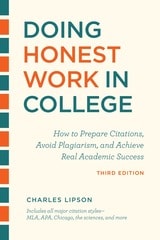
Doing Honest Work in College, Third Edition
How to Prepare Citations, Avoid Plagiarism, and Achieve Real Academic SuccessCharles Lipson
University of Chicago Press, 2018
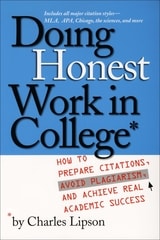
Doing Honest Work in College
How to Prepare Citations, Avoid Plagiarism, and Achieve Real Academic SuccessCharles Lipson
University of Chicago Press, 2004
In the first part of the book, Lipson outlines three core principles of academic honesty and explores how these principles inform all aspects of college work. He discusses plagiarism in detail, outlining an ingenious note-taking system and offering guidelines for quoting and paraphrasing. Careful attention is paid to online research, including the perils of "dragging and dropping" text without proper citation. These chapters include numerous tips, all highlighted for students, on how to work honestly and study effectively.
The second part of the book gives a full account of citation styles in the humanities, social sciences, and physical and biological sciences, as well as in pre-professional studies. Filled with examples, these chapters show students exactly how to cite books, journals, edited volumes, Web sites, online publications, and much more—in every citation style imaginable.
By clearly communicating the basic principles of academic honesty and exploring these principles in action, Doing Honest Work in College promotes genuine learning and academic success. This must-have reference empowers faculty and students to address questions about academic honesty before problems arise. It will be the book students turn to for advice from their first class to their final exam.
Doing Honest Work in College
How to Prepare Citations, Avoid Plagiarism, and Achieve Real Academic Success, Second EditionCharles Lipson
University of Chicago Press, 2008
For this second edition, Charles Lipson has updated hundreds of examples and included many new media sources. There is now a full chapter on how to take good notes and use them properly in papers and assignments. The extensive list of citation styles incorporates guidelines from the American Anthropological Association. The result is the definitive resource on academic integrity that students can use every day.
“Georgetown’s entering class will discover that we actually have given them what we expect will be a very useful book, Doing Honest Work in College. It will be one of the first things students see on their residence hall desks when they move in, and we hope they will realize how important the topic is.”—James J. O’Donnell, Provost, Georgetown University
“A useful book to keep on your reference shelf.”—Bonita L. Wilcox, English Leadership Quarterly
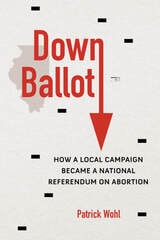
Down Ballot
How a Local Campaign Became a National Referendum on AbortionPatrick Wohl
University of Illinois Press, 2024
In 1990, a suburban Chicago race for the Republican Party nomination for state representative unexpectedly became a national proxy battle over abortion in the United States. But the hard-fought primary also illustrated the overlooked importance of down-ballot contests in America’s culture wars. Patrick Wohl offers the dramatic account of a rollercoaster campaign that, after attracting political celebrities and a media circus, came down to thirty-one votes, a coin toss to determine the winner, and a recount fight that set a precedent for how to count dimpled chads. As the story unfolds, Wohl provides a rare nuts-and-bolts look at an election for state office from its first days through the Illinois Supreme Court decision that decided the winner--and set the stage for a decisive 1992 rematch.
A compelling political page-turner, Down Ballot takes readers behind the scenes of a legendary Illinois election.

Dr. Golem
How to Think about MedicineHarry Collins and Trevor Pinch
University of Chicago Press, 2005
Dr. Golem explores some of the mysteries and complexities of medicine while untangling the inherent conundrums of scientific research and highlighting its vagaries. Driven by the question of what to do in the face of the fallibility of medicine, Dr. Golem encourages a more inquisitive attitude toward the explanations and accounts offered by medical science. In eight chapters devoted to case studies of modern medicine, Collins and Pinch consider the prevalence of tonsillectomies, the placebo effect and randomized control trials, bogus doctors, CPR, the efficacy of Vitamin C in fighting cancer, chronic fatigue syndrome, AIDS cures, and vaccination. They also examine the tension between the conflicting faces of medicine: medicine as science versus medicine as a source of succor; the interests of an individual versus the interests of a group; and the benefits in the short term versus success rates in the long term. Throughout, Collins and Pinch remind readers that medical science is an economic as well as a social consideration, encapsulated for the authors in the timeless struggle to balance the good health of the many—with vaccinations, for instance—with the good health of a few—those who have adverse reactions to the vaccine.
In an age when the deaths of research subjects, the early termination of clinical trials, and the research guidelines for stem cells are front-page news, Dr. Golem is a timely analysis of the limitations of medicine that never loses sight of its strengths.
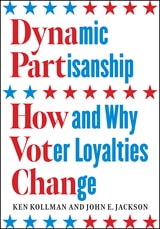
Dynamic Partisanship
How and Why Voter Loyalties ChangeKen Kollman and John E. Jackson
University of Chicago Press, 2021